
Automated lease abstraction tools for property managers
Managing commercial or residential properties involves dealing with a huge amount of lease information.
Rent amounts. Renewal dates. Escalation clauses. Security deposits. Maintenance responsibilities. Insurance requirements. Termination options. Tenant obligations.
When a property manager handles only a handful of leases, manually reviewing these documents may be manageable.
But once the portfolio grows to dozens, hundreds, or thousands of leases, manual lease abstraction becomes slow, expensive, and prone to errors.
This is where automated lease abstraction tools can help.
Modern lease abstraction software uses artificial intelligence, document processing, and increasingly generative AI to extract important information from lease documents and convert it into structured, searchable data.
Instead of spending hours reading a 50-page lease and manually entering important clauses into spreadsheets or property management systems, teams can use automated tools to complete much of the initial extraction process.
In this guide, we’ll explore some of the best automated lease abstraction tools for property managers, how these platforms work, what features to look for, and how to decide whether AI-powered lease abstraction is right for your organization.
What Is Lease Abstraction?
Lease abstraction is the process of reviewing a lease and extracting its most important information into a concise, structured summary.
The original lease might contain dozens or even hundreds of pages.
A lease abstract captures the information that property managers, asset managers, accountants, and real estate teams need to reference regularly.
Depending on the property and lease type, this may include:
- Tenant and landlord information
- Property address
- Premises details
- Lease commencement date
- Lease expiration date
- Base rent
- Rent escalation schedules
- Security deposits
- Renewal options
- Expansion options
- Termination rights
- Operating expense obligations
- Common area maintenance provisions
- Insurance requirements
- Maintenance responsibilities
- Assignment and subletting clauses
- Exclusivity provisions
- Parking rights
- Percentage rent
- Important notice dates
The abstract essentially transforms a complicated legal document into information that can be reviewed and acted upon much more quickly.
What Is Automated Lease Abstraction?
Automated lease abstraction uses software to identify and extract important information from lease documents.
Traditional abstraction is performed manually.
Someone opens the lease, reads through the document, identifies relevant clauses, and enters the information into a spreadsheet, database, or property management platform.
Automated lease abstraction changes that workflow.
A typical process looks something like this:
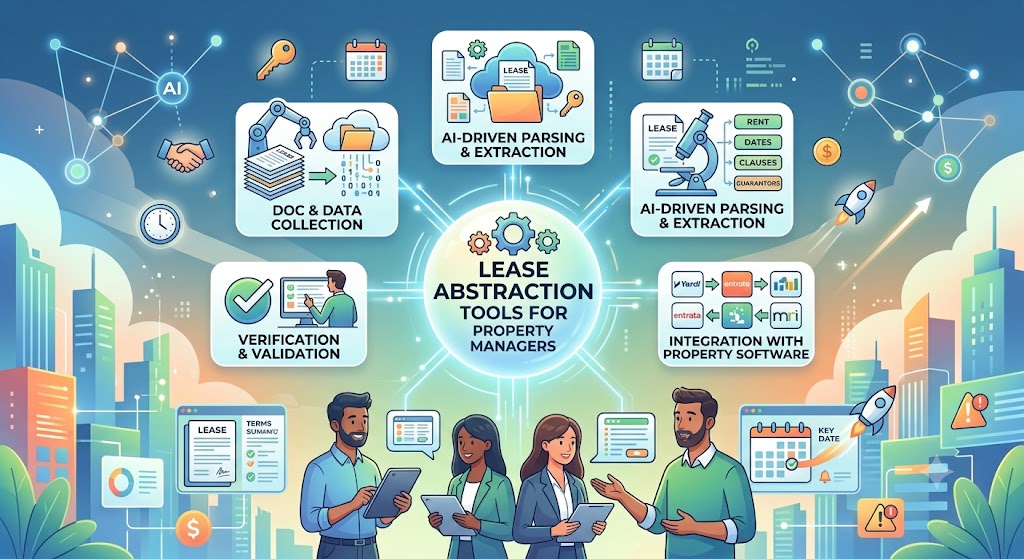
Upload lease → AI analyzes document → Key clauses and data are extracted → User reviews results → Approved information is exported or added to another system
Modern platforms may combine technologies such as:
- Optical character recognition (OCR)
- Natural language processing
- Machine learning
- Large language models
- Document classification
- Data extraction
- Workflow automation
This makes it possible to process lease documents much faster than traditional manual abstraction.
Why Property Managers Are Using AI for Lease Abstraction
Lease administration is fundamentally a data-management problem.
The problem is that much of the data property managers need is buried inside contracts.
Imagine managing 500 commercial leases.
If each lease contains 60 pages, your organization could be responsible for approximately 30,000 pages of contractual information.
Now imagine having to find every:
- Renewal option
- Rent increase
- Termination deadline
- Insurance requirement
- Maintenance responsibility
Doing this manually takes significant time.
Automated lease abstraction software can help turn those documents into structured data that teams can search, filter, analyze, and integrate into other workflows.
Benefits of Automated Lease Abstraction for Property Managers
1. Faster Lease Processing
Speed is one of the biggest advantages.
Manual lease abstraction can require substantial time, particularly when leases are lengthy or complicated.
Automated tools can perform the first stage of extraction much faster, allowing employees to concentrate on validation and exceptions rather than manually locating every piece of information.
For property managers onboarding a new portfolio, this can be especially valuable.
Instead of spending weeks or months manually entering lease information, automation can significantly accelerate the initial data-processing stage.
2. Reduced Manual Data Entry
Manual data entry isn’t just time-consuming.
It’s also repetitive.
Employees may need to copy:
- Tenant names
- Dates
- Dollar amounts
- Lease terms
- Escalation percentages
- Clause details
from documents into spreadsheets or property management systems.
Automated extraction can reduce this repetitive work.
Employees can then focus on checking the extracted information rather than entering everything from scratch.
3. More Consistent Lease Data
Different employees may interpret or summarize lease provisions differently.
One person might record a renewal clause in detail while another records only the renewal date.
Standardized abstraction templates help organizations maintain greater consistency across their portfolio.
This becomes increasingly important as the number of leases grows.
4. Easier Portfolio Search
Physical documents and PDFs aren’t ideal databases.
If management asks:
Which tenants have renewal options expiring within the next six months?
Answering that question could require substantial manual research if your lease information isn’t properly structured.
Once important lease information has been extracted into structured fields, answering portfolio-level questions becomes much easier.
5. Better Deadline Management
Commercial leases contain numerous critical dates.
Missing one can be costly.
Examples include:
- Renewal notification deadlines
- Lease expirations
- Rent escalations
- Termination windows
- Insurance deadlines
- Option exercise dates
Lease abstraction software can help organizations capture these dates and connect them to workflows, calendars, or property management systems.
6. Improved Due Diligence
Lease review becomes particularly important during real estate acquisitions.
A buyer may need to analyze hundreds of leases before completing a transaction.
Automated abstraction can help teams organize important lease information more quickly during due diligence.
Human legal and financial review is still essential, but AI can help reduce the amount of basic document-processing work required.
Best Automated Lease Abstraction Tools for Property Managers
The lease abstraction market includes specialized AI platforms as well as broader lease administration and commercial real estate software.
Here are several platforms property managers and real estate organizations may want to evaluate.
1. Prophia
Prophia focuses on AI-powered lease abstraction and commercial real estate data.
The platform is designed to transform lease documents into structured portfolio information, helping real estate teams understand important contractual details without repeatedly searching through individual documents.
Key Features
- AI-powered lease abstraction
- Document processing
- Structured lease data
- Portfolio-level information
- Search capabilities
- Commercial real estate workflows
Best For
Commercial real estate owners, operators, and property management organizations managing substantial lease portfolios.
Why Consider Prophia?
Its focus on commercial real estate makes it particularly relevant for organizations whose primary challenge is converting lease documents into usable portfolio data.
Rather than treating contracts as static PDFs, platforms like Prophia aim to make the information inside those contracts easier to access and analyze.
2. Leverton
Leverton is another technology platform associated with AI-powered document and lease data extraction.
It has been used for extracting structured information from corporate and real estate documents.
Key Capabilities
Depending on the implementation, lease abstraction platforms in this category may support:
- Automated document extraction
- Lease data structuring
- Contract analytics
- Document management
- Portfolio analysis
Best For
Larger property portfolios and organizations processing substantial volumes of real estate documents.
Why Consider It?
Platforms built specifically around document extraction can be useful when organizations have large quantities of historical leases that need to be transformed into structured information.
3. MRI Software
MRI Software provides a broad range of real estate technology solutions.
Unlike a standalone AI abstraction tool, MRI’s ecosystem covers wider areas of property management, lease administration, accounting, investment management, and real estate operations.
Key Capabilities
Depending on the selected MRI products and configuration, organizations can manage areas such as:
- Lease administration
- Property management
- Accounting
- Tenant information
- Real estate operations
- Reporting and analytics
Best For
Property management companies looking for a broader real estate management ecosystem rather than only a standalone abstraction solution.
Why Consider MRI?
For some organizations, extracting lease data is only one part of the problem.
They also need somewhere to manage that data after extraction.
A broader real estate technology platform may therefore make more sense than purchasing several disconnected tools.
4. Yardi
Yardi is one of the best-known software providers in the real estate industry.
Its ecosystem covers numerous areas of property and investment management.
Organizations already operating within Yardi’s ecosystem may want to investigate its lease-document, data-management, and related automation capabilities before introducing an entirely separate platform.
Best For
Property managers and real estate companies already using Yardi or looking for a comprehensive property management technology ecosystem.
Why Consider Yardi?
Integration matters.
Extracting lease information is useful, but the value increases when the resulting information becomes part of your existing property management workflow.
For companies already heavily invested in a particular property management platform, compatibility should be an important factor when evaluating abstraction technology.
5. Visual Lease
Visual Lease focuses on lease management and lease accounting.
It can be particularly relevant to organizations that need centralized lease information alongside accounting, reporting, and compliance workflows.
Potential Use Cases
- Centralizing lease information
- Lease portfolio management
- Lease accounting
- Reporting
- Compliance workflows
- Managing important lease dates
Best For
Organizations where lease administration and accounting requirements are closely connected.
Why Consider Visual Lease?
Not every company needs abstraction as a standalone process.
Sometimes the bigger requirement is managing the entire lease lifecycle after the information has been extracted.
Platforms with broader lease-management functionality can therefore be attractive to finance, accounting, and real estate teams.
6. Leasecake
Leasecake takes a different approach and is designed to make lease and location management easier for businesses.
It focuses heavily on important dates, lease information, and location-related workflows.
Key Capabilities
Depending on the plan and current product offering, organizations may use Leasecake to manage:
- Lease documents
- Important dates
- Location information
- Notifications
- Lease-related workflows
Best For
Smaller and mid-sized businesses that want easier lease administration without implementing a highly complex enterprise platform.
Why Consider Leasecake?
Some property and location teams don’t need an enterprise-grade contract intelligence system.
They simply need a better way to organize leases and avoid missing important events.
A simpler platform can sometimes produce better results because employees are more likely to use it consistently.
7. Docsumo
Docsumo is an intelligent document processing platform rather than a real-estate-only product.
Its technology is designed to extract information from different types of business documents.
That makes it potentially useful for organizations building custom document-processing workflows.
Key Capabilities
- AI document processing
- OCR
- Data extraction
- Document classification
- Validation workflows
- API-based integrations
Best For
Property technology companies and organizations that need customizable document extraction rather than a traditional off-the-shelf lease management platform.
Why Consider Docsumo?
A specialized lease abstraction product isn’t always the best option.
Organizations with technical resources may prefer a general intelligent document processing platform that can be integrated into their existing systems.
Automated Lease Abstraction Tools Comparison
| Tool | Primary Strength | Best For |
|---|---|---|
| Prophia | CRE-focused lease intelligence | Commercial real estate portfolios |
| Leverton | Document and lease data extraction | Large document portfolios |
| MRI Software | Broader real estate management ecosystem | Property management companies |
| Yardi | Property management ecosystem | Existing or prospective Yardi users |
| Visual Lease | Lease management and accounting | Finance and lease administration teams |
| Leasecake | Accessible lease/location management | Small and mid-sized organizations |
| Docsumo | Custom document extraction | Technical teams and PropTech companies |
The right platform depends heavily on whether you need lease abstraction only or a broader lease administration/property management solution.
How to Choose Automated Lease Abstraction Software
Don’t choose a lease abstraction platform based solely on how impressive its AI sounds.
The real question is whether it can accurately process your documents and fit into your existing workflow.
Here are the most important factors to consider.
1. Extraction Accuracy
Accuracy should be near the top of your evaluation criteria.
Ask vendors to demonstrate the platform using actual examples similar to your leases.
Ideally, test it with different documents:
- New leases
- Older leases
- Scanned documents
- Amendments
- Complex commercial leases
- Different formatting styles
A polished demonstration using perfectly formatted sample documents doesn’t necessarily tell you how the software will perform on your actual portfolio.
2. Human Review
AI-generated lease abstractions shouldn’t automatically be treated as legal truth.
Look for a workflow that allows employees to review extracted fields and compare them with the source document.
A strong system should make verification easier, not eliminate accountability.
3. Source References
One particularly useful feature is the ability to trace extracted information back to the relevant section of the lease.
For example, if the software identifies a renewal option, a reviewer should ideally be able to quickly see where that information came from.
This can make verification significantly faster.
4. Amendment Handling
Commercial leases frequently change.
A tenant may have:
- An original lease
- First amendment
- Second amendment
- Extension agreement
- Rent modification
- Expansion agreement
The abstraction system needs to account for the fact that later documents can modify earlier terms.
Ask vendors specifically how their platform handles amendments and conflicting information.
5. Custom Fields
Every organization tracks different information.
A retail property manager might care about:
- Exclusivity clauses
- Co-tenancy provisions
- Percentage rent
- Signage rights
An office portfolio may care more about:
- Parking allocations
- Expansion options
- Tenant improvement allowances
Your abstraction software should ideally support the fields your organization actually needs.
6. Integrations
Ask where the extracted data goes after abstraction.
Can the platform connect with your:
- Property management software
- Accounting system
- CRM
- Data warehouse
- Document management platform
- Business intelligence software?
If employees still have to manually copy every extracted field into another system, you’ve only automated part of the workflow.
7. Security
Leases can contain confidential business and financial information.
Before uploading documents to any AI-powered platform, understand:
- How data is stored
- How data is encrypted
- Who can access documents
- How long documents are retained
- Whether customer data is used to train AI models
- What security certifications the vendor maintains
- Whether role-based permissions are available
Security evaluation becomes even more important when managing leases on behalf of clients.
8. Pricing
Lease abstraction software can use different pricing models.
You may encounter pricing based on:
- Number of leases
- Number of pages
- Number of properties
- Number of users
- Extraction volume
- Annual subscriptions
- Enterprise contracts
Don’t compare vendors based solely on the headline subscription price.
Calculate the likely cost for your actual portfolio.
AI Lease Abstraction vs Manual Lease Abstraction
Is AI actually better than manual abstraction?
It depends on the task.
| Factor | Manual Abstraction | Automated Abstraction |
|---|---|---|
| Processing speed | Slower | Faster initial extraction |
| Scalability | Requires more human resources | Easier to scale |
| Consistency | Depends on reviewer | Can standardize extraction |
| Complex interpretation | Strong with experienced professionals | May require human review |
| Initial data entry | Manual | Largely automated |
| Quality control | Human-led | Human validation still recommended |
The strongest approach is often not AI versus humans.
It’s AI plus human review.
AI handles repetitive extraction.
Humans handle validation, ambiguity, unusual clauses, and higher-risk decisions.
How to Implement Automated Lease Abstraction
Buying software isn’t enough.
You also need a good implementation process.
Step 1: Decide What You Need to Extract
Create a standardized list of fields.
For example:
- Tenant
- Property
- Suite
- Commencement date
- Expiration date
- Base rent
- Escalations
- Renewal options
- Termination options
- Security deposit
Avoid extracting information simply because the software can.
Focus on information your team actually uses.
Step 2: Organize Your Documents
Before processing thousands of documents, determine which files represent:
- Original leases
- Amendments
- Extensions
- Side letters
- Exhibits
- Other agreements
Poor document organization can create poor abstraction results.
Step 3: Run a Pilot
Don’t immediately process your entire portfolio.
Start with perhaps 20–50 representative leases.
Include both simple and complicated documents.
Compare the software’s output against manually verified information.
Step 4: Measure Accuracy
Track errors by field.
For example:
| Field | Documents Tested | Correct | Accuracy |
|---|---|---|---|
| Commencement Date | 50 | 49 | 98% |
| Expiration Date | 50 | 50 | 100% |
| Renewal Option | 50 | 46 | 92% |
| Rent Escalation | 50 | 47 | 94% |
This gives you a much more useful evaluation than simply asking whether the software “uses AI.”
Step 5: Create a Review Process
Decide which extracted information requires human verification.
Higher-risk fields may require stricter review than basic information such as property addresses.
Step 6: Integrate the Data
Once the information is approved, determine where it should live.
The goal should be to create a reliable source of truth rather than another disconnected database.
Can ChatGPT Be Used for Lease Abstraction?
Generative AI tools have made document analysis much more accessible.
Technically, an AI system capable of processing documents can help identify, summarize, and structure information from leases.
For example, a user could ask an AI system to identify:
- Lease dates
- Renewal provisions
- Rent schedules
- Termination clauses
- Maintenance responsibilities
However, general-purpose AI and dedicated lease abstraction platforms solve somewhat different problems.
Dedicated systems may provide capabilities such as:
- Structured extraction templates
- Bulk document processing
- Audit trails
- Source references
- Review workflows
- Portfolio-level databases
- Role-based access
- Property management integrations
For occasional analysis, a general-purpose AI assistant may be useful.
For processing hundreds or thousands of leases as part of an operational workflow, a purpose-built platform will often be more appropriate.
Also remember that confidential leases shouldn’t be uploaded to AI services without first understanding the organization’s security, privacy, and data-handling policies.
What Is the Best Lease Abstraction Tool for Property Managers?
There isn’t a single best platform for every property management company.
The best choice depends on your portfolio and workflow.
If your primary requirement is commercial real estate lease intelligence and abstraction, consider a specialized solution such as Prophia.
If you need lease administration alongside broader real estate operations, platforms within ecosystems such as MRI Software or Yardi may be worth investigating.
If your organization needs lease management and accounting, Visual Lease may deserve consideration.
If you want simpler lease and location management, Leasecake may be more approachable.
And if you’re building a custom document-processing workflow, a platform such as Docsumo may offer more flexibility.
Before committing to any product, run a pilot using your own documents.
That’s far more useful than relying on a vendor demonstration.
Frequently Asked Questions About Automated Lease Abstraction
What is automated lease abstraction?
Automated lease abstraction is the use of software, AI, OCR, or natural language processing to identify and extract important information from lease documents into structured fields or summaries.
How does AI lease abstraction work?
The software processes a lease document, identifies relevant clauses and data points, and converts them into structured information. Depending on the platform, a human reviewer can then verify the extracted information before it enters the organization’s lease management system.
Is AI lease abstraction accurate?
Accuracy varies depending on the software, document quality, lease complexity, field being extracted, and other factors. Organizations should test platforms using their own documents and maintain appropriate human review for important contractual information.
Can AI read commercial leases?
Modern AI systems can analyze many types of commercial lease documents and identify common clauses, dates, monetary values, and obligations. Complicated language, amendments, poor scans, handwritten information, and unusual contractual structures can make extraction more difficult.
How much does automated lease abstraction software cost?
Pricing varies significantly between vendors. Platforms may charge based on users, leases, documents, pages, extraction volume, properties, or annual enterprise contracts. Request pricing based on your actual document volume before comparing platforms.
Can lease abstraction software handle amendments?
Some platforms can process lease amendments and connect them with original agreements, but capabilities vary. Amendment handling should be specifically tested during your software evaluation.
Does automated lease abstraction replace property managers?
No.
Lease abstraction automation is primarily designed to reduce repetitive document review and data-entry work.
Property managers still need to understand tenant relationships, building operations, contractual responsibilities, financial performance, and the practical context surrounding lease agreements.
Does AI lease abstraction replace lawyers?
No.
Extracting information from a contract isn’t the same as providing legal advice.
Important legal interpretations, disputes, unusual provisions, and high-risk decisions should be reviewed by qualified professionals.
Final Thoughts
Automated lease abstraction can solve one of the least efficient parts of property management: manually turning lengthy lease documents into usable information.
Instead of asking employees to repeatedly search through PDFs, modern tools can help extract important dates, financial terms, options, obligations, and clauses into structured data.
But AI shouldn’t be treated as a replacement for careful review.
The better model is:
AI extraction → Human verification → Structured lease database → Automated property management workflows
If you’re evaluating lease abstraction software, don’t start by asking which platform has the most impressive AI.
Start with three questions:
How accurately does it process our leases?
How quickly can our team verify the results?
How easily can the approved data flow into the systems we already use?
A platform that performs well across those three areas can turn lease abstraction from a time-consuming administrative task into a much more efficient and scalable process.
For property managers overseeing growing portfolios, that can mean fewer hours searching through documents, better visibility into lease obligations, and more time spent actually managing properties.