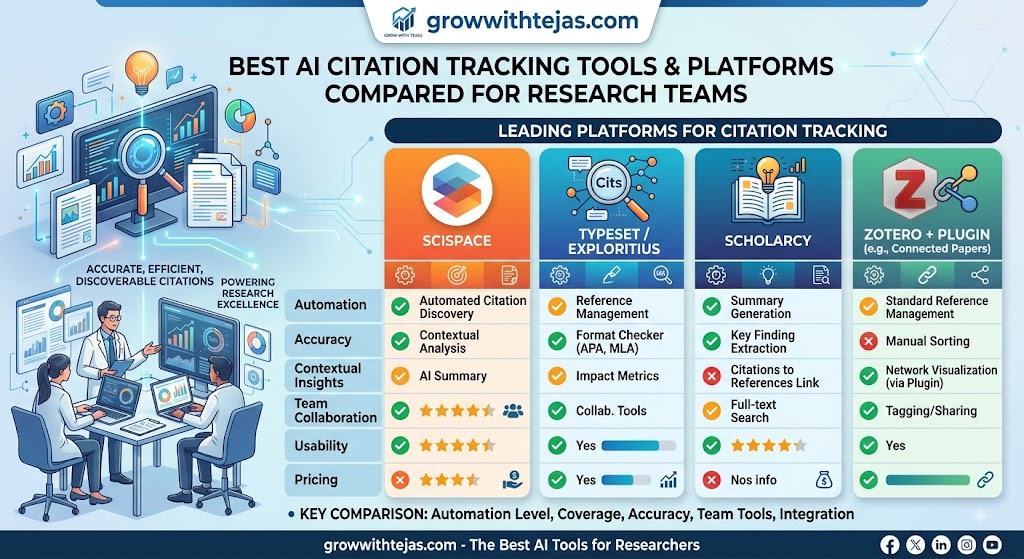
Best AI Citation Tracking Tools Platforms Compared for Research Teams
Suggested excerpt: The best AI citation tracking tools do more than count references. This guide compares eight platforms for citation context, research mapping, competitive intelligence, APIs and institutional reporting.
Quick answer: Scite is the best AI citation tracking tool for understanding whether later papers support, contrast or simply mention a study. Web of Science and Scopus are stronger for institution-wide citation analytics, while Dimensions is best for connecting publications with grants, patents, clinical trials and policy. Litmaps and ResearchRabbit are better for visual literature discovery, and The Lens is especially useful when scholarly work must be linked to patents.
Best AI Citation Tracking Tools at a Glance
| Tool | Best for | Standout capability | AI/citation approach | Pricing model |
|---|---|---|---|---|
| Scite | Evidence evaluation | Shows citation context and classifies citations as supporting, contrasting or mentioning | Contextual “Smart Citations,” search and assistant | Individual plan plus custom enterprise options |
| Web of Science | Universities and research offices | Curated citation indexes, benchmarking and institutional research intelligence | AI Research Assistant over trusted citation data | Institutional quote |
| Scopus with AI | Large multidisciplinary research teams | Natural-language discovery connected to Scopus profiles and metrics | Generative summaries grounded in Scopus metadata and abstracts | Subscription/institutional access |
| Dimensions | Corporate R&D, funders and life sciences | Links publications to grants, patents, trials, datasets and policy documents | AI summaries, semantic search and enterprise integrations | Free discovery option; paid products by quote |
| The Lens | Patent-to-paper intelligence | Connects scholarly citations with patent citations | Citation graph, analytics, APIs and bulk data | Free public tools; institutional/API plans |
| Litmaps | Visual literature monitoring | Citation maps with automatic updates for new papers | Map-based discovery and monitoring | Free tier and paid plans |
| ResearchRabbit | Exploratory research and collaboration | Adaptive recommendations, author tracking and interactive maps | AI-driven discovery over real citation networks | Free access; optional paid features may apply |
| Semantic Scholar | API-first teams and budget-conscious researchers | Free academic graph and citation/reference endpoints | AI-powered search and scholarly graph | Free; API terms and limits apply |
Pricing and features change. Confirm current terms with the vendor before purchasing.
What Is an AI Citation Tracking Tool?
An AI citation tracking tool uses machine learning, natural-language processing or graph analysis to find citations, reveal relationships between papers and help users judge research influence. Unlike a basic reference manager, it may explain how a source was cited, recommend connected research, identify emerging topics, flag risky papers or connect scholarly outputs with patents, grants and policy.
The phrase covers four overlapping product categories:
- Citation databases track who cited whom and calculate research metrics.
- Contextual citation tools analyze the sentence or passage surrounding a citation.
- Literature-mapping tools visualize connections and recommend related work.
- Research-intelligence platforms combine citations with grants, patents, clinical trials, organizations and commercial outcomes.
For a business buyer, the right category matters more than the longest feature list. A pharmaceutical evidence team, a university research office and an intellectual-property analyst do not need the same platform.
How We Compared the Tools
We evaluated each platform using criteria that matter to organizations rather than only individual students:
- Citation coverage and data quality
- Ability to interpret citation context
- Natural-language or AI-assisted discovery
- Alerts and ongoing monitoring
- Team collaboration and administration
- APIs, exports and workflow integrations
- Institutional reporting and benchmarking
- Patent, grant, clinical-trial or policy links
- Pricing transparency and procurement fit
- Evidence traceability and hallucination controls
No AI-generated summary should replace reading the source. The safest tools show the underlying paper, citation passage or structured record so a human can verify the result.
1. Scite — Best for Understanding Citation Context
Scite is the strongest choice when citation counts alone are not enough. Its Smart Citations show the passage in which a work was cited and classify the relationship as supporting, contrasting or mentioning. This helps teams distinguish popularity from evidentiary support.
Key features
- Citation statements with surrounding context
- Supporting, contrasting and mentioning classifications
- Search and AI-assisted research workflows
- Dashboards for groups of publications
- Alerts for new citations
- Browser and reference-workflow integrations
- Organization and enterprise options
Best for
Medical affairs, evidence synthesis, academic libraries, publishers, policy researchers and R&D teams that must assess how claims are treated in later literature.
Limitations
Automated labels are signals, not final scientific judgments. Coverage and available context can vary with publisher access and document type. Teams still need domain experts to review decisive evidence.
Verdict
Choose Scite when your central question is not “How many citations does this paper have?” but “What do later researchers say about it?” Scite’s official pricing page lists an individual plan and enterprise purchasing options; check the page for current rates.
2. Web of Science — Best for Institutional Research Analytics
Web of Science is a strong enterprise choice for universities, funders and research administrators that value curated citation data, established metrics and auditable institutional reporting. Its AI Research Assistant adds natural-language exploration to the Web of Science data environment.
Key features
- Curated multidisciplinary citation indexes
- Forward and backward citation searching
- Author, institution and journal analysis
- AI-assisted natural-language discovery
- Research benchmarking and portfolio intelligence
- Institutional reporting workflows
Best for
Research offices, university libraries, governments, funders and organizations that need recognized datasets for evaluation and strategy.
Limitations
Institutional access can require a larger budget and procurement process. Its curated coverage may be preferable for quality control, but buyers should test field-specific coverage before standardizing on it.
Verdict
Choose Web of Science when defensible analytics, governance and institution-wide research intelligence matter more than a lightweight visual interface.
3. Scopus with AI — Best for Multidisciplinary Discovery and Profiles
Scopus combines a large abstract-and-citation database with author profiles, affiliation data and research metrics. Scopus with AI lets users ask questions in ordinary language and produces summaries grounded in Scopus metadata, abstracts and author profiles.
Key features
- Citation overview and author-level metrics
- Source and institutional analysis
- Natural-language research questions
- AI-generated topic summaries with references
- Author and affiliation profiles
- CiteScore and other journal-level indicators
Elsevier says Scopus with AI uses vector search, keyword search or both, and draws on eligible Scopus content published from 2003 onward for its summaries. That scope is important when evaluating historical topics.
Best for
Universities, consulting teams, R&D groups and corporate libraries that want discovery, profiles and citation metrics in a single established environment.
Limitations
Access is generally subscription-based. AI summaries do not draw on every word of every full-text paper, so users must open and verify the cited sources before making scientific or commercial decisions.
Verdict
Choose Scopus with AI when broad multidisciplinary discovery and researcher or institution profiling are as important as citation tracking.
4. Dimensions — Best for Research-to-Impact Intelligence
Dimensions is more than a publication citation database. It connects research outputs with grants, patents, clinical trials, datasets and policy documents, making it particularly valuable for competitive intelligence, funding analysis and translational research.
Key features
- Linked publication, grant, patent, trial and policy data
- Citation and research-impact analytics
- AI summaries and semantic discovery
- Dashboards and organization-level analysis
- APIs and enterprise workflow options
- Research security and publisher-integrity products
Dimensions’ newer enterprise options include agent-ready access through analytics and semantic-search MCPs. The company says these products provide licensed access to more than 430 million interconnected research records, which can be useful for organizations building internal AI research workflows.
Best for
Pharmaceutical companies, corporate R&D, research funders, governments, publishers and strategy teams that need to follow the path from funding to research and real-world impact.
Limitations
The product portfolio is broad, so buyers should define their exact workflow before requesting a demonstration. Advanced analytics, integrations and specialized applications generally require a commercial agreement.
Verdict
Choose Dimensions when citations are only one part of the question and you also need grants, patents, clinical development, policy influence or enterprise AI integration.
5. The Lens — Best for Connecting Scholarly Research and Patents
The Lens combines a large scholarly citation graph with patent records. Its reversible links help users move from a paper to patents that cite the research, or from a patent portfolio back to relevant scholarly works.
Key features
- Scholarly citation graph
- Patent and scholarly record search
- Links between papers and citing patents
- Institutional analytics
- Versioned APIs and bulk-data options
- Portfolio and competitor monitoring
The Lens says its scholarly data is compiled and harmonized from sources including Crossref, PubMed, OpenAlex and others. It also offers institutional and high-volume API options for organizations that want to embed the data in internal systems.
Best for
IP teams, technology-transfer offices, competitive-intelligence analysts, publishers and innovation teams measuring how science influences inventions.
Limitations
The interface and data model can feel more analytical than consumer research apps. Users should define their identifiers, patent families and organization-resolution rules carefully before producing executive reports.
Verdict
Choose The Lens when patent citations and innovation impact are essential. It is a compelling alternative to publication-only databases.
6. Litmaps — Best for Visual Citation Monitoring
Litmaps turns seed papers into visual literature maps. Users can see connected research, share maps and receive automatic updates as relevant papers appear.
Key features
- Visual citation maps
- Seed-paper discovery
- Forward and backward exploration
- Monitoring for new related papers
- Sharing and collaboration
- Reference-manager integrations
Best for
Systematic-review teams, research groups, innovation scouts and consultants who need to keep a topic map current.
Limitations
Mapping is most useful when the starting papers and citation network are strong. Litmaps is a discovery and monitoring layer, not a substitute for a curated enterprise bibliometrics database or formal risk-of-bias assessment.
Verdict
Choose Litmaps when your main goal is to visualize a field and receive updates without repeatedly rebuilding the same searches.
7. ResearchRabbit — Best Free Option for Exploratory Mapping
ResearchRabbit helps users build collections, visualize paper and author relationships, and receive recommendations that adapt as they explore. It is approachable for researchers who want to move beyond keyword lists.
Key features
- Interactive paper and author maps
- AI-driven related-work recommendations
- Collections and collaboration
- Author and topic exploration
- Alerts and trend discovery
- Citation-network-based research signals
Best for
Research teams in the early discovery phase, graduate labs, analysts exploring unfamiliar fields and organizations testing citation mapping before buying an enterprise platform.
Limitations
It is optimized for discovery, not institution-wide evaluation or regulated evidence decisions. Coverage can differ by discipline, and recommended connections should be checked against a formal search protocol when completeness matters.
Verdict
Choose ResearchRabbit for fast, intuitive exploration. Pair it with a curated database for systematic reviews, compliance-sensitive work or formal bibliometrics.
8. Semantic Scholar — Best for Free API-Based Citation Workflows
Semantic Scholar is an AI-powered academic search engine with a scholarly graph and a REST API. Developers can retrieve papers, authors, citations, references and related metadata to create internal dashboards or enrich research products.
Key features
- AI-powered academic search
- Citation and reference graph
- Paper and author data
- Academic Graph API
- Citation export formats
- Free access subject to terms and rate limits
Best for
Startups, data teams, nonprofit researchers and developers prototyping citation-monitoring workflows without an immediate enterprise-data contract.
Limitations
Using an API is not the same as buying a supported, governed research-intelligence product. Teams must handle data quality checks, identity resolution, caching, monitoring and compliance with API terms.
Verdict
Choose Semantic Scholar when flexibility and low entry cost matter and your team can build the missing workflow, reporting and governance layers.
Scite vs Web of Science vs Scopus vs Dimensions
| Buying question | Scite | Web of Science | Scopus with AI | Dimensions |
| Best at interpreting citation context? | Yes—category leader | Limited compared with Scite | Not the main differentiator | Available in selected workflows/products |
| Strong institutional bibliometrics? | Useful, but not its primary role | Excellent | Excellent | Excellent for linked research intelligence |
| Natural-language AI discovery? | Yes | Yes | Yes | Yes, depending on product |
| Grants, patents and clinical trials linked? | Limited | Product-dependent | Limited compared with Dimensions | Core strength |
| Best for evidence checking? | Best fit | Strong discovery foundation | Strong discovery foundation | Strong cross-domain context |
| Best for university reporting? | Complementary tool | Top fit | Top fit | Strong alternative |
| Typical purchase | Individual or enterprise | Institutional contract | Subscription/institutional contract | Free entry plus commercial products |
Direct recommendation
- Pick Scite for claim verification and citation context.
- Pick Web of Science for curated institutional analytics and research evaluation.
- Pick Scopus with AI for broad discovery, profiles and established citation metrics.
- Pick Dimensions for R&D intelligence spanning grants, patents, trials and policy.
Many larger organizations will use two tools: a core citation database plus Scite or a visual discovery product. The overlap can be worthwhile when the tools answer different questions.
Best Alternatives by Use Case
| If you need… | Start with… | Consider this alternative… |
| Context behind every citation | Scite | Dimensions Citation Check for publisher self-citation risk |
| University-wide benchmarking | Web of Science | Scopus or Dimensions |
| Author and affiliation profiles | Scopus | Web of Science |
| Grant-to-patent impact analysis | Dimensions | The Lens for patent-heavy workflows |
| Visual topic monitoring | Litmaps | ResearchRabbit |
| Free citation graph/API | Semantic Scholar | The Lens public tools or OpenAlex-based development |
| Patent citations to academic research | The Lens | Dimensions |
| A low-cost discovery pilot | ResearchRabbit | Litmaps free tier or Semantic Scholar |
How to Choose an AI Citation Tracking Tool for Your Organization
1. Define the decision, not just the search
Write down what the output will change. Are you selecting drug targets, evaluating university performance, monitoring a competitor, checking evidence behind a claim or maintaining a systematic review? A clear decision prevents overbuying.
2. Test coverage with your own benchmark set
Prepare 20–50 known papers across your most important disciplines, years, languages and document types. Compare record accuracy, citation links, author disambiguation and full-text context. Vendor-wide record totals cannot predict coverage for your niche.
3. Separate discovery from formal evaluation
Recommendation engines are excellent for exploration, but research assessment requires transparent coverage rules and reproducible queries. Confirm whether your team can export searches, save versions and explain how a metric was produced.
4. Demand traceable AI outputs
Every AI summary should link to its supporting records. Ask how the platform handles retractions, corrections, contradictory findings, missing abstracts and fabricated references. A polished paragraph without inspectable evidence is a business risk.
5. Review enterprise controls
For confidential R&D or unpublished manuscripts, evaluate:
- Data retention and model-training policies
- Single sign-on and role-based access
- Audit logs and administration
- Regional hosting and data-processing terms
- API licensing and usage limits
- Export rights and vendor lock-in
- Support, onboarding and service commitments
6. Run a time-boxed proof of concept
Ask real users to complete the same tasks in each shortlisted product. Measure time to a verified answer, relevant-paper recall, false positives, citation errors and reporting effort. The cheapest subscription can be expensive if analysts must manually repair its output.
Recommended Enterprise Workflow
- Discover: Search a curated database or AI research platform using natural language and structured filters.
- Expand: Follow backward and forward citations and use a map to uncover adjacent clusters.
- Evaluate: Inspect citation context, retractions and conflicting evidence.
- Organize: Store verified references in a shared reference manager or evidence repository.
- Monitor: Create alerts for new citations, authors, competitors and topics.
- Report: Export traceable records and document the search date, query and coverage limitations.
This layered workflow is more reliable than asking a general-purpose chatbot to produce a bibliography from memory.
Are AI Citation Tracking Tools Accurate?
AI citation tools can accelerate discovery, but accuracy depends on source coverage, metadata quality, author disambiguation and how the model generates summaries. Citation counts can differ across platforms because each indexes a different set of publications and document types.
Use these safeguards:
- Open the original source before relying on a claim.
- Verify the DOI, title, authors and publication status.
- Check whether a paper has been corrected or retracted.
- Read the citation passage rather than assuming every citation is supportive.
- Use at least two databases for high-stakes or systematic searches.
- Record the database, query and search date for reproducibility.
Final Verdict
The best AI citation tracking tool depends on the job:
- Best overall for citation context: Scite
- Best for institutional research analytics: Web of Science
- Best for multidisciplinary profiles and metrics: Scopus with AI
- Best for enterprise R&D intelligence: Dimensions
- Best for patent-to-paper analysis: The Lens
- Best visual monitoring tool: Litmaps
- Best free exploratory mapper: ResearchRabbit
- Best free citation API: Semantic Scholar
For most enterprise buyers, the shortlist should begin with Scite, Web of Science, Scopus and Dimensions. Run a pilot using your own papers and decision workflows before signing a multi-year contract. Citation coverage and AI summaries are useful only when your experts can verify the underlying evidence.
Frequently Asked Questions
What is the best AI citation tracking tool?
Scite is the best option for analyzing citation context because it shows whether later papers support, contrast or mention a study. Web of Science, Scopus and Dimensions are better suited to broad institutional analytics and research intelligence.
Can AI track who cited my paper?
Yes. Citation databases and mapping tools can identify later works that cite a paper. Many also support alerts, although coverage varies by database, discipline and publisher.
Which citation tool is best for enterprise R&D?
Dimensions is a strong choice for enterprise R&D because it connects publications with grants, patents, clinical trials and policy. The Lens is a strong alternative for teams focused primarily on patent-to-paper relationships.
Is Scite better than Google Scholar?
Scite is better for reading citation context and seeing whether citations support, contrast or mention a study. Google Scholar is useful for broad discovery, but the two products serve different purposes and may report different citation counts.
Is Web of Science better than Scopus?
Neither is universally better. Web of Science is often chosen for curated citation indexes and institutional evaluation, while Scopus is valued for broad multidisciplinary discovery, author profiles and metrics. Test both with your field and benchmark papers.
What is the best free AI citation tracking tool?
ResearchRabbit is a strong free choice for visual exploration, while Semantic Scholar is better for academic search and API-based citation workflows. Free tools may not provide the governance, reporting or support required by enterprises.
Can AI citation tools detect fake references?
They can help users verify whether a record exists and may flag retractions or unusual citation behavior, but they cannot guarantee that every reference is genuine or scientifically valid. Always verify the source, DOI and publication status.
What is forward citation tracking?
Forward citation tracking finds newer works that cite a selected paper. Backward citation tracking examines the references used by that paper. Using both methods helps researchers follow how an idea developed over time.
Do citation counts differ between tools?
Yes. Each platform has different coverage, indexing rules, update schedules and document types. Compare trends within a consistent database and disclose the data source when reporting citation metrics.
Can an AI citation tracker replace a reference manager?
Usually not. Citation trackers discover, map and analyze research; reference managers store sources and format bibliographies. Many teams use both and connect them through exports or integrations.
Sources and Product Information
- Scite pricing and plans
- Web of Science AI Research Assistant
- Web of Science platform
- Scopus with AI
- Scopus metrics
- Dimensions products
- Dimensions MCPs for enterprise AI workflows
- Dimensions Citation Check
- The Lens scholarly search and analysis
- The Lens APIs
- Litmaps
- ResearchRabbit features
- Semantic Scholar Academic Graph API