
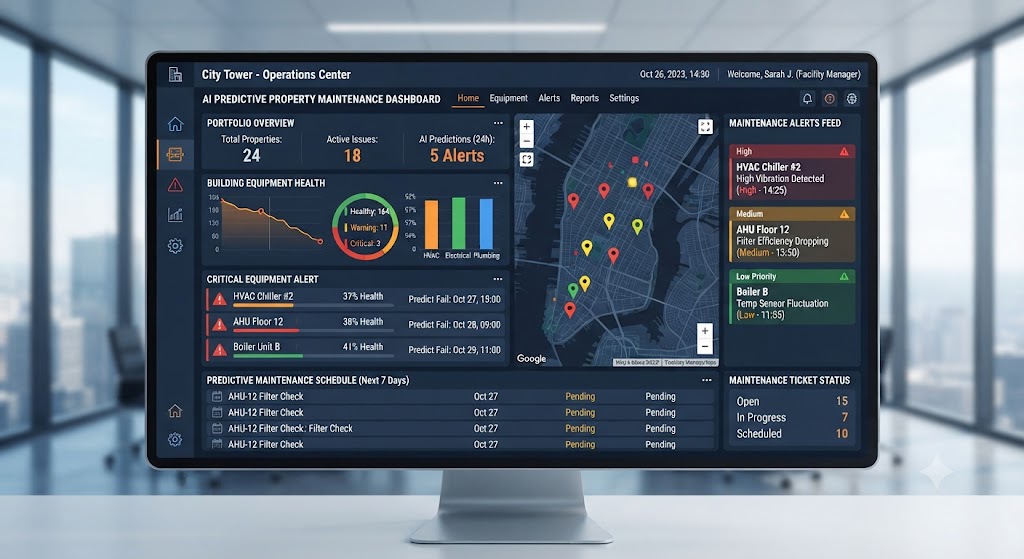
Unexpected maintenance problems can disrupt an entire property. A faulty water pump can interrupt daily routines, an air-conditioning breakdown can affect tenant comfort, and an unnoticed leak can lead to expensive repairs.
Predictive property maintenance software AI helps property owners and facility managers use equipment data to identify developing problems and plan inspections earlier. Instead of relying only on complaints or fixed service dates, teams gain additional evidence about how building systems are performing.
This guide explains how AI-powered property maintenance works, where it can help, and what to consider before adopting it.
What Is Predictive Property Maintenance Software AI?
Predictive property maintenance software AI uses artificial intelligence, equipment readings, and maintenance records to assess asset condition and identify signs of potential failure.
Depending on the system and available data, it may detect unusual operating patterns, estimate failure risk, or recommend when an inspection should take place.
For example, a pump that gradually develops abnormal vibration may need attention before it stops working. Software can flag that change so a technician can investigate.
However, an unusual reading is not a confirmed diagnosis. Predictions help teams decide where to look; qualified technicians still need to inspect equipment and determine the appropriate repair.
How Does AI Predictive Maintenance Work?
1. Collect Equipment and Maintenance Data
Relevant information may come from connected sensors, building management systems, service records, and inspection reports.
Typical inputs include:
- Equipment temperature and vibration.
- Water pressure and flow.
- Electricity consumption.
- Operating hours and start-stop cycles.
- Previous faults, repairs, and component replacements.
The required data depends on the equipment and the problem being monitored. A leak-detection system needs different inputs from a lift condition-monitoring system.
2. Establish Normal Operating Patterns
Analytics can establish how equipment behaves under different conditions. For an air-conditioning system, this may involve accounting for outdoor temperature, occupancy, and operating schedules.
Understanding these conditions helps distinguish normal changes in demand from possible faults.
3. Identify Changes and Assess Risk
The software compares new readings with expected performance. It may flag a persistent temperature rise, unusual vibration, or increasing energy consumption.
Some systems detect anomalies only. Others forecast degradation or estimate remaining useful life. Buyers should confirm which capabilities are actually included.
4. Create Alerts and Coordinate Follow-Up
An alert becomes useful when someone acts on it. A practical workflow connects the finding to an inspection, assigns responsibility, records the technician’s observations, and tracks completion.
Where integrations are available, the software can create a work order in an existing maintenance management system.
Reactive vs Preventive vs Predictive Maintenance
| Maintenance approach | What triggers action? | Example |
|---|---|---|
| Reactive maintenance | Equipment fails or a problem is reported | Repairing a pump after water supply stops |
| Preventive maintenance | A scheduled date or usage interval is reached | Servicing an AC unit at its planned interval |
| Predictive maintenance | Data indicates developing deterioration or elevated failure risk | Inspecting a motor after a sustained change in its vibration pattern |
Most properties benefit from a combination of these approaches. Predictive monitoring can supplement scheduled servicing, manufacturer requirements, and mandatory inspections.
The U.S. Department of Energy describes condition-based and predictive maintenance as ways to detect deteriorating performance and support action before equipment failure or occupant complaints. Its examples include monitoring air-filter pressure and heat-exchanger performance.
Benefits of AI Property Maintenance Software
Earlier Identification of Equipment Problems
Monitoring can help teams discover developing faults between routine inspections. Earlier investigation may create an opportunity to schedule repairs before a disruptive breakdown.
Better Maintenance Prioritization
A property manager may receive dozens of maintenance requests each week. Equipment condition, fault severity, and service criticality can help teams decide which issues deserve attention first.
A water-supply pump serving an entire building, for instance, may take priority over a nonessential asset with a similar warning.
More Informed Repair Planning
Advance warning can help teams arrange technician visits, obtain spare parts, and choose suitable service windows. Savings depend on whether alerts are accurate and lead to effective intervention.
Improved Visibility Across Multiple Properties
A shared dashboard can help managers compare asset condition and outstanding tasks across a portfolio. This is particularly useful when maintenance staff and equipment are spread across different sites.
Support for Energy Performance Investigations
Abnormal energy use can indicate a control problem, changing demand, or equipment inefficiency. Monitoring helps teams identify where further investigation is needed.
Energy savings are not automatic: they depend on the issue found, the corrective action, and how performance is measured afterward.
Practical Uses in Residential and Commercial Properties
HVAC Systems
Heating, ventilation, and air-conditioning equipment can be monitored for changes in temperature, pressure, run time, and energy use. These readings may help identify deteriorating performance.
Water Pumps and Plumbing
Flow, pressure, and vibration monitoring can support pump condition assessment. Water sensors can provide leak alerts, although detecting an existing leak is different from predicting a future one.
Lifts and Escalators
Where supported by the equipment manufacturer, operating data can help maintenance providers investigate unusual behavior. AI alerts should complement required servicing and safety inspections.
Electrical and Backup Power Equipment
Appropriate monitoring can help identify abnormal temperatures or changes in operating performance. Electrical inspections and repairs should remain the responsibility of qualified professionals.
Hotels, Offices, and Housing Societies
These properties can use maintenance dashboards to coordinate inspections and repairs around guest stays, business hours, or resident needs.
The most suitable starting point is usually a clearly defined equipment problem with measurable operational impact.
Features to Look for in Predictive Maintenance Software
Evaluate the workflow as carefully as the AI features.
- Asset register: Equipment location, model, service history, and responsible team.
- Compatible data connections: Integration with existing sensors and building systems.
- Useful alerts: Clear reasons for warnings, severity levels, and recommended next steps.
- Work-order integration: A route from an alert to an assigned inspection.
- Mobile access: Technicians can view tasks and record findings on site.
- Reporting: Visibility into faults, downtime, response times, and maintenance spending.
- Access controls: Permissions appropriate to owners, managers, technicians, and vendors.
- Data export: Access to records when changing providers or analyzing results independently.
Ask the vendor to demonstrate these features using equipment and conditions similar to your property.
Challenges and Limitations to Consider
Incomplete or Poor-Quality Data
Missing readings, inaccurate sensors, and inconsistent maintenance records can weaken results. Some assets may require additional instrumentation before useful monitoring is possible.
False Alarms and Missed Faults
AI systems can flag harmless changes or fail to identify a developing problem. Track both the usefulness of alerts and failures that occurred without warning.
Integration and Ongoing Costs
The total cost may include software, sensors, installation, connectivity, configuration, training, and ongoing technical support.
Predictions Need Human Follow-Up
A dashboard cannot fix equipment. Results depend on clear responsibilities, timely inspections, and feedback from maintenance staff.
Security and Data Management
Connected systems need appropriate access permissions, updates, and secure data handling. Collect only the information needed for the maintenance task and review how the provider stores and uses it.
How to Introduce AI Predictive Maintenance
Step 1: Define a Specific Problem
Choose a measurable objective, such as reducing unplanned pump outages or improving the detection of recurring HVAC faults.
Step 2: Review Existing Equipment and Records
Identify what data is already available, whether it is reliable, and which assets have enough operational importance to justify monitoring.
Step 3: Start With a Focused Pilot
Test the system on a limited asset group. Agree in advance on who receives alerts and how technicians will investigate them.
Step 4: Measure Results
Compare performance with a suitable baseline. Useful measures include unplanned downtime, emergency callouts, actionable alerts, repair response time, and total maintenance spending.
Account for changes in occupancy, weather, equipment usage, and asset replacements when interpreting results.
Step 5: Expand Where Value Is Demonstrated
Extend the system after the pilot shows useful alerts and a workable response process. Different equipment types may need different data and monitoring methods.
Is AI Predictive Maintenance Worth the Investment?
Its value depends on the cost of equipment failures, the quality of available data, and the team’s ability to act on alerts.
Consider the full ownership cost alongside any measured reduction in downtime, emergency repairs, and unnecessary maintenance. Avoid judging the investment only by a subscription price or a vendor’s headline savings percentage.
For smaller properties, a reliable asset register and preventive maintenance workflow may be the right first step. Properties with critical equipment, recurring failures, or large portfolios may have stronger reasons to test predictive monitoring.
Frequently Asked Questions
What is predictive property maintenance software AI?
It is software that uses AI and equipment data to identify developing faults or estimate maintenance needs. Its capabilities depend on the equipment, available data, and models used.
Does predictive maintenance always require new sensors?
No. Some buildings already have suitable instrumentation and connected systems. Other use cases require additional sensors to collect the necessary readings.
Can AI predict every equipment breakdown?
No. Sudden faults, insufficient data, and changing operating conditions can limit prediction accuracy. Regular inspections and servicing remain necessary.
Is a maintenance chatbot the same as predictive maintenance?
No. A chatbot may collect complaints or answer maintenance questions. Predictive maintenance analyzes asset condition or performance to assess developing problems.
Can the software automatically create maintenance tasks?
Some platforms can generate work orders through built-in features or integrations. Confirm whether task creation, assignment, and completion tracking are included.
Is AI property maintenance software suitable for housing societies?
It can be useful for shared equipment such as water pumps and supported lift systems. Suitability depends on equipment compatibility, budget, and the maintenance team’s response process.
Plan a More Informed Property Maintenance Workflow
Predictive property maintenance software AI can help property teams move from scattered records and unexpected faults toward better monitoring and repair planning.
Start with an important maintenance problem, verify the available data, and test whether alerts lead to useful action. A focused rollout makes it easier to assess the technology’s practical value.
Planning a property maintenance dashboard or a custom software workflow? Contact Grow With Tejas to discuss your requirements, integrations, and development scope.
Editorial source:
U.S. Department of Energy — Energy Management Information System Capabilities
https://www.energy.gov/cmei/femp/energy-management-information-system-capabilities