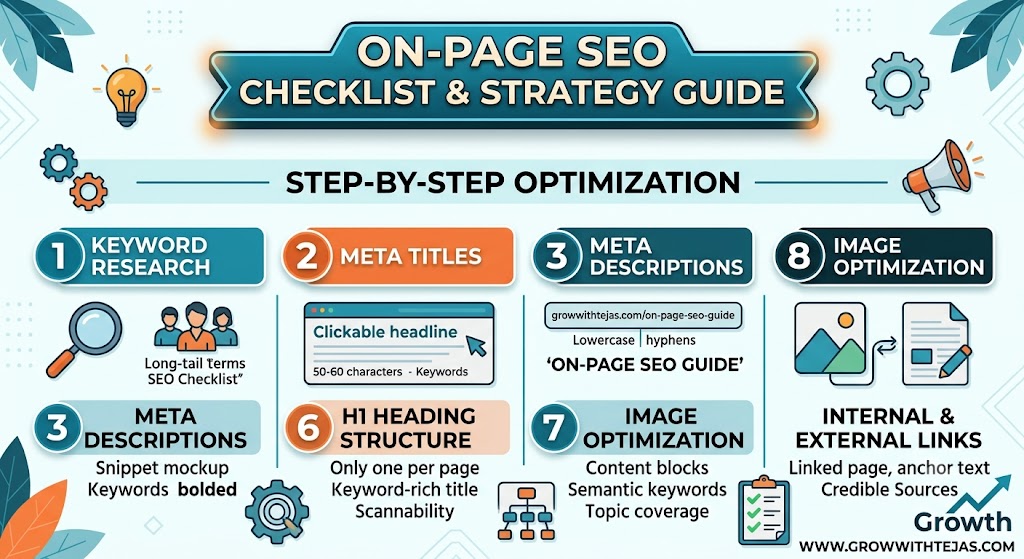
Master On-Page SEO for your website. Learn how to optimize titles, headings, URL structure, images, and content depth to rank higher on Google with practical examples from Grow With Tejas.
While Off-Page SEO focuses on building external authority through backlinks and Technical SEO ensures search engine crawlers can read your site, On-Page SEO gives you 100% control over how your content is structured and presented.
Optimizing your on-page elements tells search engines like Google exactly what your page is about and why it deserves to rank at the top of search results.
What Is On-Page SEO?
On-Page SEO refers to the practice of optimizing individual web pages to rank higher and earn more relevant traffic in search engines. This includes optimizing both the visible content (headings, copy, media) and the underlying HTML source code (title tags, meta descriptions, image alt text).
+-------------------------------------------------------------------+
|                        ON-PAGE SEO TRIFECTA                       |
+---------------------------------+---------------------------------+
|        CONTENT QUALITY          |        HTML STRUCTURE           |
|  - Search Intent Match          |  - Title Tag (H1 Alignment)     |
|  - Topic Depth & Context        |  - Meta Description             |
|  - Scannability (H2/H3s)        |  - URL Slug & Meta Tags         |
+---------------------------------+---------------------------------+
|                       USER EXPERIENCE (UX)                        |
|  - Fast Page Speed & Mobile Responsiveness                        |
|  - Clear Internal & External Links                                |
+-------------------------------------------------------------------+
1. Meta Title Tag Optimization
Your Title Tag is the single most critical on-page HTML element. It appears as the blue clickable headline in search engine results pages (SERPs).
On-Page Rules:
- Keep length between 50–60 characters (or under 600 pixels) to prevent truncation.
- Place your primary keyword near the beginning of the title.
- Include your brand name at the end separated by a pipe (
|) or hyphen (-). - Avoid keyword stuffing; make it sound natural and click-worthy.
Example:
- ❌ Poor:
On Page SEO Tips Onpage SEO Guide Learn SEO Strategy - 🟢 Optimized:
On-Page SEO Strategy Guide: 10 Easy Steps | Grow With Tejas
2. Meta Description Crafting
While meta descriptions do not directly impact Google ranking algorithms, they heavily influence your Click-Through Rate (CTR). A higher CTR signals to Google that your result is enticing to searchers.
On-Page Rules:
- Keep length between 140–160 characters.
- Include your primary keyword naturally (Google bolds matching terms in search results).
- Provide a clear value proposition and a subtle Call to Action (CTA).
Example:
- ❌ Poor:
This is our post about on page SEO. Read it to know more about how to do search engine optimization on your website. - 🟢 Optimized:
Master on-page SEO with our practical step-by-step checklist. Learn how to optimize title tags, headings, and content depth to boost Google rankings.
3. SEO-Friendly URL Structure
Clean, readable URLs help both users and search engine bots understand the context of your page immediately.
On-Page Rules:
- Keep URLs short, descriptive, and lower-case.
- Use hyphens (
-) to separate words—never underscores (_). - Include your target keyword while stripping unnecessary stop words (
and,the,for).
Example Comparison Table:
| Quality | Example URL | Why? |
| ❌ Bad | [growwithtejas.com/p=10492](https://growwithtejas.com/p=10492) | Contains no contextual keywords. |
| ⚠️ Mediocre | [growwithtejas.com/2026/05/10/a-complete-guide-to-on-page-seo-strategies](https://growwithtejas.com/2026/05/10/a-complete-guide-to-on-page-seo-strategies) | Unnecessarily long and includes date bloat. |
| 🟢 Best | [growwithtejas.com/on-page-seo-guide](https://growwithtejas.com/on-page-seo-guide) | Concise, keyword-rich, and future-proof. |
4. Heading Architecture (H1, H2, H3, H4)
Proper header tags establish a logical hierarchy for your content, making it easy for visitors to scan and for crawlers to map out the structure.
├── <h1> Main Page Title (Target Keyword)
│   ├── <h2> 1. Title & Meta Optimization
│   │   ├── <h3> Title Tag Character Limits
│   │   └── <h3> Meta Description Tips
│   ├── <h2> 2. Content Formatting & Intent
│   │   ├── <h3> Secondary & Semantic Keywords
│   │   └── <h3> Internal & External Link Placement
On-Page Rules:
- Use only one
<h1>tag per page (typically the post or product title). - Nest heading levels logically (
<h2>for main sections,<h3>for sub-sections under an<h2>). - Incorporate secondary and long-tail keywords into
<h2>and<h3>tags naturally.
5. Content Optimization & Search Intent Alignment
Search engines prioritize content that satisfies user intent—whether the user wants to learn (informational), buy (transactional), or find a specific site (navigational).
Optimization Techniques:
- First 100 Words Rule: Mention your primary keyword within the first paragraph to immediately confirm relevance to the reader.
- Semantic Context (LSI Keywords): Incorporate related search terms and topic synonyms throughout the text.
- Primary Term:
On-Page SEO - Semantic Terms:
search intent,meta tags,organic traffic,internal links,Google search console.
- Primary Term:
- Scannability: Avoid walls of text. Keep paragraphs short (2–4 sentences) and utilize bullet points, bold text, and visual tables.
6. Image Optimization & Alt Text
Unoptimized images slow down page load speed and miss out on organic traffic from image search engines.
On-Page Rules:
- Compress Files: Convert large PNGs/JPEGs into modern web formats like
.webpbefore uploading. - Descriptive File Names: Rename image files before uploading (e.g.,
on-page-seo-checklist.webpinstead ofIMG_90432.webp). - Informative Alt Text: Write alt text that describes the visual content accurately for screen readers and search engines.
Example Alt Text:
- ❌ Poor:
alt="seo"(Too vague) - ❌ Keyword Stuffed:
alt="seo on page search engine optimization checklist guide tips"(Spammy) - 🟢 Optimized:
alt="Diagram showing on-page SEO key elements including heading tags and meta titles"(Descriptive)
7. Strategic Linking Practices
Internal and external links help search engines understand relationships between pages and build context.
Internal Links (Linking within your site)
- Link to 3–5 existing articles on your site using descriptive anchor text.
- Example: “Learn how to conduct keyword research for beginners before writing your article.”
External Links (Linking to outside sites)
- Link out to high-authority, trustworthy websites (industry research, official documentation) to support data points.
- Example: “According to Google Search Central guidelines, site speed is a direct ranking factor.”
Actionable On-Page SEO Checklist
Keep this checklist handy whenever you publish a new article or update existing pages:
- [ ] Target Keyword: Selected 1 primary keyword + 3–5 supporting secondary keywords.
- [ ] URL Slug: Concise, contains primary keyword, uses hyphens.
- [ ] Meta Title: 50–60 characters, primary keyword near the start, includes brand name.
- [ ] Meta Description: 140–160 characters, includes primary keyword and a call to action.
- [ ] H1 Heading: Only one H1 tag per page, matching search intent.
- [ ] Heading Hierarchy: Structured sequentially (
H2->H3->H4) with secondary keywords included. - [ ] Keyword Placement: Primary keyword featured in the intro (first 100 words), subheadings, and conclusion.
- [ ] Image Alt Text: Descriptive alt tags on every image without spamming keywords.
- [ ] Internal Links: Added 3+ relevant links to other posts or pages on your site.
- [ ] External Links: Linked out to 1–2 reputable, high-authority sources.
- [ ] User Experience: Formatted with bullet points, short paragraphs, bold text, and clean tables for high readability.