
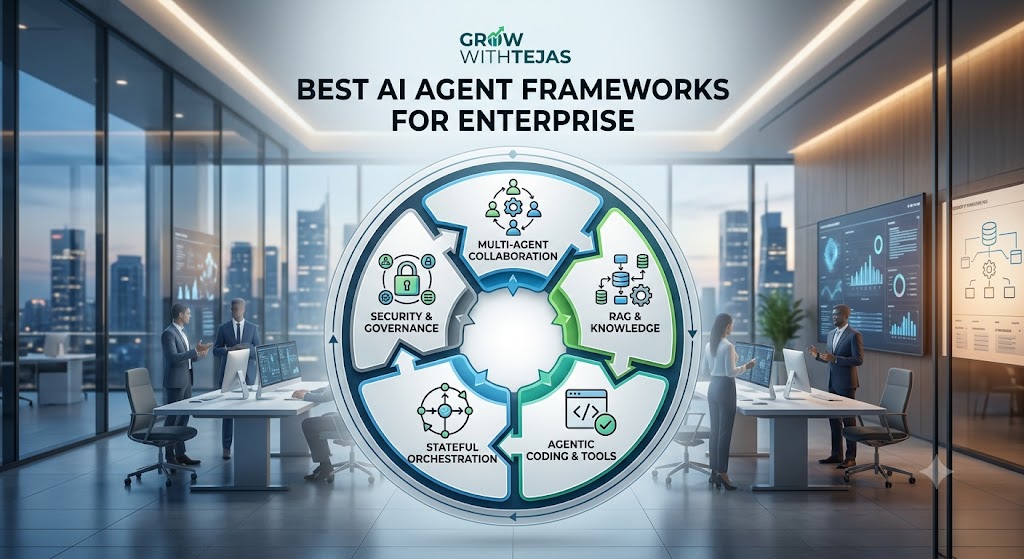
Best AI agent frameworks for enterprise
Compare the best AI agent frameworks for enterprise in 2026—including LangGraph, CrewAI, AutoGen, and Semantic Kernel. Pick the right orchestration tool.
AI is no longer just answering questions in a chat window—it is taking action. Autonomous and multi-agent AI systems are orchestrating complex business processes, executing code, managing databases, and automating customer workflows.
However, transitioning from a lightweight prototype to an enterprise-grade AI agent requires more than just calling an API. Enterprises need reliable orchestration, strict security, deterministic fallbacks, state persistence, and seamless integration with existing IT infrastructure.
If you are looking to build or scale autonomous systems across your organization, here is a detailed breakdown of the best AI agent frameworks for enterprise deployment in 2026.
What Makes an AI Framework “Enterprise-Ready”?
Before picking a framework, enterprise decision-makers must evaluate solutions against specific production requirements:
- Deterministic Orchestration: The ability to control workflow execution loops and prevent infinite loops or unwanted non-deterministic behavior.
- Security & Governance: Role-based access control (RBAC), end-to-end data encryption, SOC2/GDPR compliance, and secret management.
- Observability & Telemetry: Deep tracing, real-time logging, cost tracking, and performance monitoring.
- Multi-Agent Coordination: Structured frameworks for enabling specialized agents (e.g., Researcher, Coder, Reviewer) to collaborate reliably.
- State & Memory Management: Long-term memory persistence, context-window optimization, and clean state recovery after system failures.
What Is Artificial Intelligence? A Beginner’s Guide (2026)
Top AI Agent Frameworks Compared
Here is a quick snapshot comparing the top enterprise frameworks across key operational parameters:
| Framework | Target Use Case | Primary Strength | Governance & Observability | Execution Model |
| LangGraph (LangChain) | Stateful Multi-Agent Applications | Graph-based cyclic workflows & time-travel | Excellent (via LangSmith) | Cyclic Graphs |
| CrewAI | Role-based Multi-Agent Teams | Easy setup, role definitions & task delegation | High (Built-in tracing) | Sequential & Hierarchical |
| Microsoft AutoGen | Complex Multi-Agent Conversations | Event-driven multi-agent systems | Enterprise-grade (Azure ecosystem) | Event-Driven / Chat-Based |
| LlamaIndex (Workflows) | Knowledge-Intensive & RAG Agents | Advanced data indexing & structured extraction | High (Deep integration with vector stores) | Event-Driven Step Workflows |
| Semantic Kernel | Native Enterprise Codebases (.NET/Java) | Enterprise SDK design, strict typing & plugins | High (Native telemetry & logging) | Sequential / Orchestrated |
How to Make Money with AI: 15 Proven Ways to Earn Online in 2026
In-Depth Analysis of the Best Enterprise AI Agent Frameworks
1. LangGraph (By LangChain)
Best For: Complex, stateful, and cyclic multi-agent applications requiring fine-grained control.
LangGraph was designed specifically to overcome the limitations of linear agent chains. By modeling agent workflows as Directed Acyclic Graphs (DAGs) and stateful graphs with cycles, it allows developers to build complex loops (like human-in-the-loop review, agent reflection, and automatic error handling).
- Key Strengths:
- State Persistence: Automatically saves agent state at every step, allowing “time travel” (pausing, rewinding, or resuming agent execution).
- Human-in-the-Loop: Seamlessly pause agent execution for approval before destructive actions (like running database queries or sending emails).
- LangSmith Integration: First-party observability for monitoring latency, token spend, and trace steps.
2. CrewAI
Best For: Collaborative, role-based multi-agent workforce automation.
CrewAI models AI agents similarly to a human team structure. You assign each agent a specific Role, Goal, and Backstory, then assign them Tasks to execute individually or as a crew.
- Key Strengths:
- Role-Based Design: Extremely intuitive mental model for designing teams of agents (e.g., Market Analyst, Copywriter, QA Lead).
- Flexible Task Delegation: Agents can autonomously delegate tasks to other specialized agents based on capability.
- Production Utilities: Built-in memory systems (short-term, long-term, and entity memory) and native tool integrations.
3. Microsoft AutoGen
Best For: Event-driven, asynchronous, multi-agent systems and enterprise Microsoft ecosystems.
Backed by Microsoft, AutoGen is a robust platform for building asynchronous, event-driven multi-agent applications. It excels at scenarios where multiple agents converse, debate, and collaborate to solve multi-faceted problems.
- Key Strengths:
- Asynchronous Execution: Built from the ground up for scalable, event-driven architectures.
- Code Execution Sandboxes: Built-in secure code execution environments (Docker/Jupyter) for agentic coding and analysis tasks.
- Enterprise Integration: Deep compatibility with Azure AI, enterprise security protocols, and scalable microservice architectures.
4. LlamaIndex (Workflows)
Best For: RAG-heavy agents, structured data synthesis, and knowledge management.
While initially known for Retrieval-Augmented Generation (RAG), LlamaIndex has evolved into a powerhouse for knowledge-driven agentic workflows. Its event-driven architecture allows developers to build complex agents that ingest, synthesize, and act upon massive amounts of structured and unstructured enterprise data.
- Key Strengths:
- Unmatched Data Connectors: Connects out of the box with SQL databases, Salesforce, SharePoint, Notion, and dozens of vector storage engines.
- Event-Driven Workflows: Clean, type-safe Python decorator approach for defining complex step-based execution.
- Data-Centric Agents: Ideal for enterprise search, dynamic reporting, and complex document intelligence systems.
How to Use ChatGPT for Everyday Productivity | Grow With Tejas
5. Microsoft Semantic Kernel
Best For: Enterprise dev teams working with C#, Java, or Python in rigid production environments.
Semantic Kernel is an open-source SDK created by Microsoft that brings AI agent capabilities directly into enterprise application stacks. Unlike pure Python-centric frameworks, Semantic Kernel feels like traditional software engineering, complete with dependency injection, strict typing, and native logging.
- Key Strengths:
- Multi-Language Support: First-class C#, Python, and Java support.
- Plugin Architecture: Encapsulates existing legacy code and APIs as agent “Plugins” effortlessly.
- Enterprise Security & Reliability: Native telemetry, structured memory management, and enterprise-grade policy enforcement.
How to Choose the Right Framework for Your Enterprise
Selecting the right framework depends on your architecture goals:
- If you need precise control over complex loops and state recovery: Go with LangGraph.
- If you want to simulate multi-role teams for business processes: Choose CrewAI.
- If you are building in C#, .NET, or Microsoft Azure infrastructure: Go with Semantic Kernel or AutoGen.
- If your agent heavily relies on searching through complex enterprise data: Choose LlamaIndex.
Final Thoughts: The Future of Enterprise AI Agents
Building enterprise AI agents is no longer about prompt engineering—it’s about system architecture. Selecting a framework with strong governance, observability, and deterministic controls ensures that your AI agents scale safely from internal tools to mission-critical business automation.
25 Best AI Tools for Small Business Owners (2026 Guide)
What Is Artificial Intelligence? Artificial Intelligence (AI) is one of the most exciting technologies of the modern era. From voice Read more
How to Use ChatGPT for Everyday Productivity Artificial Intelligence (AI) is changing the way people work, study, and manage daily Read more
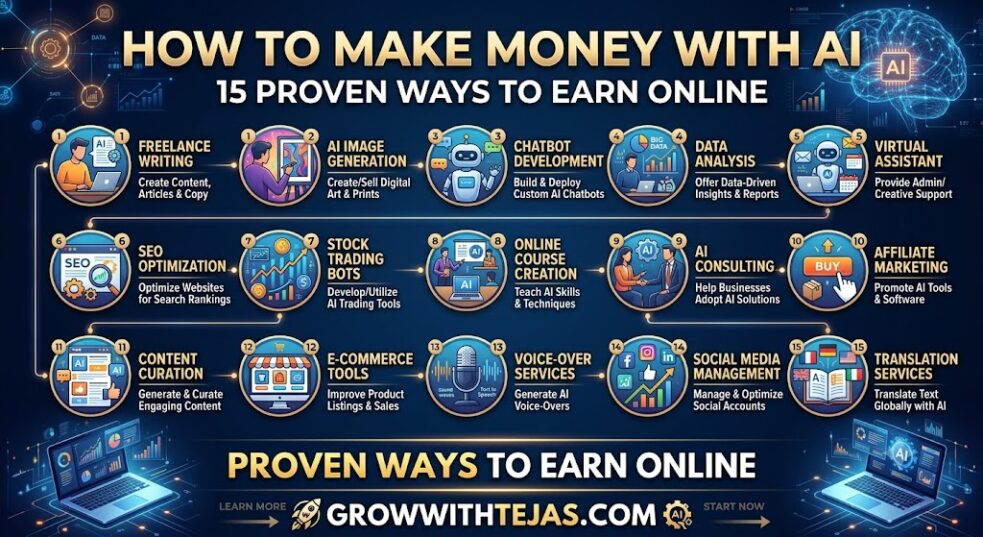
How to Make Money with AI: 15 Proven Methods (Beginner to Advanced Guide) Artificial Intelligence (AI) has transformed from a Read more
25 Best AI Tools for Small Business Owners Running a small business means wearing many hats. You have to manage Read more
What Is Artificial Intelligence? Artificial Intelligence (AI) is one of the most exciting technologies of the modern era. From voice Read more
How to Use ChatGPT for Everyday Productivity Artificial Intelligence (AI) is changing the way people work, study, and manage daily Read more
How to Make Money with AI: 15 Proven Methods (Beginner to Advanced Guide) Artificial Intelligence (AI) has transformed from a Read more
25 Best AI Tools for Small Business Owners Running a small business means wearing many hats. You have to manage Read more