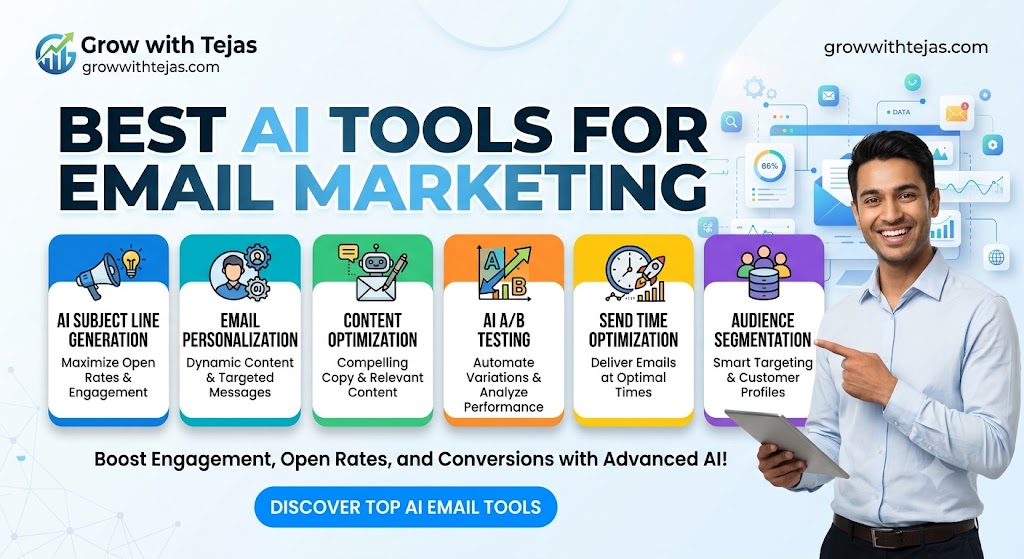
Best AI Tools for Email Marketing: Top Picks to Grow Your Business
Email marketing remains one of the most effective ways to build relationships with customers, generate leads, and increase sales. But creating emails, writing subject lines, segmenting subscribers, analyzing campaigns, and sending the right message at the right time can require a lot of work.
That’s where artificial intelligence can help.
AI-powered email marketing tools can help marketers create better content, personalize campaigns, automate repetitive tasks, and understand subscriber behavior. Whether you’re a blogger, small-business owner, digital marketer, or e-commerce brand, the right AI tools can make email marketing faster and more effective.
In this guide from GrowWithTejas, we’ll explore some of the best AI tools for email marketing, what they do, and how to choose the right one for your needs.
What Are AI Email Marketing Tools?
AI email marketing tools use artificial intelligence and machine learning to help businesses create, optimize, automate, and analyze email campaigns.
Instead of manually handling every part of a campaign, marketers can use AI for tasks such as:
- Writing email copy
- Generating subject lines
- Personalizing messages
- Segmenting subscribers
- Creating email sequences
- Predicting customer behavior
- Optimizing send times
- Running A/B tests
- Analyzing campaign performance
- Automating follow-up emails
The goal isn’t necessarily to replace marketers. AI is most useful when it reduces repetitive work and gives marketers more time to focus on strategy, creativity, offers, and customer relationships.
Best AI Tools for Email Marketing
1. HubSpot
Best for: Businesses looking for an all-in-one marketing and CRM platform
HubSpot combines email marketing, CRM, automation, analytics, and AI-powered features within one ecosystem.
Its email marketing tools can help businesses create professional campaigns while using customer data from the CRM to personalize communication.
Key features:
- AI-assisted content creation
- Email templates
- Marketing automation
- Contact segmentation
- CRM integration
- A/B testing
- Campaign analytics
- Lead management
Why choose HubSpot?
HubSpot can be particularly useful for businesses that want email marketing to work closely with their sales and customer relationship management processes.
Rather than managing contacts, marketing campaigns, and sales activity across several disconnected platforms, businesses can keep much of the customer journey in one place.
2. Mailchimp
Best for: Small businesses and beginners
Mailchimp is one of the most recognized email marketing platforms and offers AI-assisted features designed to simplify campaign creation and optimization.
Users can build campaigns, manage audiences, create automated customer journeys, and analyze email performance.
Key features:
- AI-assisted content creation
- Email templates
- Audience segmentation
- Customer journey automation
- A/B testing
- Campaign reporting
- Personalization features
- Integrations with popular business tools
Why choose Mailchimp?
Its relatively approachable interface makes Mailchimp an attractive option for people starting with email marketing.
Small businesses can begin with straightforward newsletters and gradually introduce segmentation and automation as their email strategy grows.
3. Brevo
Best for: Small businesses looking for email marketing and automation
Brevo, formerly known as Sendinblue, provides email marketing alongside automation, transactional messaging, and customer management capabilities.
Its automation tools can help businesses trigger messages according to subscriber actions and customer journeys.
Key features:
- Email campaign builder
- AI-assisted email creation
- Marketing automation
- Contact segmentation
- Transactional email
- Personalization
- Campaign analytics
Why choose Brevo?
Brevo can be a strong choice when you need more than newsletters. For example, an online business might use the platform for promotional campaigns as well as transactional customer communication.
4. ActiveCampaign
Best for: Advanced email automation
ActiveCampaign is particularly well known for marketing automation and customer journey workflows.
Businesses can create automated sequences that respond to customer behavior instead of sending identical messages to every subscriber.
Key features:
- Advanced marketing automation
- AI-assisted content capabilities
- Behavioral segmentation
- Personalized campaigns
- CRM functionality
- Automated follow-ups
- Lead nurturing
- Campaign analytics
Why choose ActiveCampaign?
The platform is worth considering when automation is central to your marketing strategy.
For example, you could create different email journeys for a new subscriber, an active customer, an abandoned-cart visitor, and a customer who hasn’t purchased recently.
5. Klaviyo
Best for: E-commerce email marketing
Klaviyo is designed heavily around customer data and e-commerce marketing.
It allows online stores to use behavioral and purchase data to create personalized email and messaging campaigns.
Key features:
- AI-assisted content creation
- Customer segmentation
- Predictive analytics capabilities
- Automated email flows
- Product recommendations
- E-commerce integrations
- Campaign analytics
- Customer profiles
Why choose Klaviyo?
For e-commerce brands, personalization often depends on understanding what customers browse, purchase, and engage with.
Klaviyo’s focus on customer and commerce data makes it particularly useful for campaigns such as:
- Welcome sequences
- Abandoned-cart emails
- Product recommendations
- Post-purchase follow-ups
- Customer win-back campaigns
6. GetResponse
Best for: Marketers wanting email marketing plus automation tools
GetResponse offers email marketing, automation, landing pages, and other marketing capabilities in one platform.
Its AI features can assist with content creation and campaign workflows.
Key features:
- AI email generation
- Email automation
- Autoresponders
- Landing pages
- Audience segmentation
- A/B testing
- Email templates
- Analytics
Why choose GetResponse?
GetResponse can be useful for businesses that want to manage several parts of a marketing funnel without relying on a separate platform for every task.
7. Jasper
Best for: Writing marketing-focused email copy
Jasper is primarily an AI content creation platform rather than a dedicated email marketing service.
Marketers can use it to brainstorm and draft:
- Promotional emails
- Newsletter content
- Subject lines
- Calls to action
- Product announcements
- Follow-up emails
- Email campaign variations
Why choose Jasper?
Jasper may be useful for marketing teams that already have an email platform but want additional AI assistance for content creation.
You can generate a first draft and then refine it according to your brand voice, audience, and campaign objectives.
8. Copy.ai
Best for: Email copy and marketing workflows
Copy.ai provides AI-powered writing and workflow capabilities that can support sales and marketing teams.
For email marketing, it can help generate different types of copy quickly.
Key features:
- Email copy generation
- Subject-line ideas
- Marketing copy
- Sales email assistance
- Content variations
- Workflow automation capabilities
Why choose Copy.ai?
It’s useful when your biggest bottleneck isn’t sending emails but producing enough campaign copy.
Instead of writing every variation from scratch, marketers can use AI to create starting points and then edit them for accuracy, personality, and brand consistency.
9. Omnisend
Best for: E-commerce marketing automation
Omnisend focuses on e-commerce marketing and provides tools for automated campaigns and customer segmentation.
Online stores can create automated workflows based on different customer actions.
Key features:
- Email automation
- Audience segmentation
- E-commerce workflows
- Campaign creation tools
- Personalization
- Reporting
- Pre-built automation workflows
Why choose Omnisend?
It’s particularly relevant for online stores looking to automate lifecycle campaigns such as welcome emails, cart recovery, post-purchase communication, and customer re-engagement.
10. ChatGPT
Best for: Brainstorming, drafting, and improving email content
ChatGPT can be used alongside an email marketing platform to accelerate content creation and campaign planning.
For example, marketers can use ChatGPT to:
- Brainstorm newsletter ideas
- Write email drafts
- Generate subject-line variations
- Rewrite emails in different tones
- Develop welcome sequences
- Create calls to action
- Summarize long content for newsletters
- Brainstorm A/B testing ideas
- Develop customer personas
- Create campaign calendars
A useful prompt might look like this:
Write a short promotional email for an online skincare store announcing a 20% weekend discount. Target existing customers, use a friendly tone, and provide five subject-line options.
The more context you provide about your audience, product, offer, and desired tone, the more useful the initial output tends to be.
AI-generated content should still be reviewed before sending, especially for factual accuracy, brand consistency, legal compliance, and potentially misleading claims.
Quick Comparison of the Best AI Email Marketing Tools
| Tool | Best For | Standout Use |
|---|---|---|
| HubSpot | Growing businesses | CRM + marketing automation |
| Mailchimp | Beginners | Easy campaign management |
| Brevo | Small businesses | Email + automation |
| ActiveCampaign | Advanced marketers | Sophisticated automation |
| Klaviyo | E-commerce | Customer-data-driven campaigns |
| GetResponse | Digital marketers | Email + funnel tools |
| Jasper | Content teams | Marketing copy generation |
| Copy.ai | Marketing & sales teams | AI copy and workflows |
| Omnisend | Online stores | E-commerce automation |
| ChatGPT | General marketers | Brainstorming and email copy |
Benefits of Using AI for Email Marketing
Save Time
Creating multiple campaigns manually can take hours. AI can generate first drafts, subject-line variations, content ideas, and campaign concepts within seconds.
Marketers can spend that saved time refining strategy rather than repeatedly starting from a blank page.
Improve Personalization
Generic mass emails aren’t always the most effective approach.
Modern marketing platforms can use customer information and behavior to help businesses create more relevant campaigns for different audience segments.
Create More Content
One campaign may require several pieces of content.
For example, a product launch could involve:
- Announcement email
- Educational email
- Customer-benefit email
- Reminder email
- Last-chance email
AI can accelerate the drafting process for the entire sequence.
Generate More Testing Ideas
AI can quickly produce multiple versions of subject lines, calls to action, headlines, and email copy.
You can then test meaningful variations rather than assuming the first version is the best.
Improve Marketing Automation
Email marketing becomes more powerful when campaigns respond to customer behavior.
Automation platforms can trigger messages when someone subscribes, browses products, abandons a cart, makes a purchase, or stops engaging.
How to Choose the Best AI Email Marketing Tool
Don’t choose a platform simply because it has the most AI features.
Start with your actual marketing requirements.
Consider these factors:
Your business type: An e-commerce store may benefit from platforms such as Klaviyo or Omnisend, while a B2B company may prefer HubSpot or ActiveCampaign.
Automation requirements: If you only send a monthly newsletter, complex automation may be unnecessary. If you run multiple customer journeys, automation capabilities become much more important.
Ease of use: A powerful platform doesn’t help much if your team finds it too difficult to operate.
Integrations: Check whether the platform works with your website, CRM, e-commerce store, analytics tools, and other software.
Subscriber volume: Email marketing pricing often changes as your contact list or sending volume grows. Consider future costs, not only the entry-level price.
Analytics: Look for reporting that helps you understand engagement, conversions, and campaign performance.
AI capabilities: Determine which AI features genuinely save you time instead of choosing a tool simply because “AI” appears on its feature list.
AI Email Marketing Best Practices
AI can accelerate email marketing, but good marketing fundamentals still matter.
1. Don’t Publish AI Copy Without Reviewing It
Always review AI-generated content for incorrect information, awkward wording, exaggerated claims, and brand consistency.
2. Give AI Detailed Instructions
Instead of asking:
Write a marketing email.
Try:
Write a 150-word welcome email for first-time subscribers to a productivity newsletter. Use a friendly and practical tone. Explain what subscribers will receive and end with a CTA encouraging them to read our latest guide.
Specific prompts generally produce more useful drafts.
3. Maintain Your Brand Voice
AI content can easily sound generic.
Provide examples of your preferred tone and edit generated content so that readers can recognize your brand’s personality.
4. Segment Your Audience
Don’t send every campaign to every subscriber.
Segmentation can help you create messages based on interests, purchasing behavior, engagement, or position in the customer journey.
5. Test Before Optimizing
AI recommendations aren’t automatically correct.
Test subject lines, offers, calls to action, email formats, and timing using real campaign data.
6. Focus on Value
More automation shouldn’t mean sending more unnecessary emails.
Every message should have a reason to exist.
Ask:
What will the subscriber gain from opening this email?
If the answer isn’t clear, improve the campaign before sending it.
Which AI Email Marketing Tool Is Best?
There isn’t one tool that’s perfect for every business.
A simple way to narrow your options is:
- Beginners: Mailchimp
- Small businesses: Brevo
- Advanced automation: ActiveCampaign
- CRM + marketing: HubSpot
- E-commerce: Klaviyo or Omnisend
- AI copywriting: Jasper or Copy.ai
- Flexible AI writing and brainstorming: ChatGPT
Before committing to a platform, compare current features, pricing, sending limits, integrations, and automation capabilities on the provider’s website.
Frequently Asked Questions
What is the best AI tool for email marketing?
The best tool depends on your requirements. HubSpot can work well for businesses wanting CRM and marketing features together, while Klaviyo and Omnisend focus strongly on e-commerce. ActiveCampaign is known for automation, while tools such as ChatGPT and Jasper can help with email content creation.
Can AI write marketing emails?
Yes. AI tools can generate email copy, subject lines, CTAs, follow-up messages, newsletters, and campaign sequences. Human review is still important before sending AI-generated marketing content.
Can AI automate email marketing?
AI can support automation, while email marketing platforms provide the workflows and triggers used to send automated campaigns. Businesses can automate welcome emails, abandoned-cart reminders, lead-nurturing campaigns, post-purchase emails, and re-engagement sequences.
Is AI email marketing good for small businesses?
It can be especially useful for small businesses because AI can reduce the time required for content creation, campaign planning, and repetitive marketing tasks.
Can I use ChatGPT for email marketing?
Yes. ChatGPT can help brainstorm campaign ideas, write email drafts, generate subject lines, create email sequences, develop CTAs, and rewrite content for different audiences. You’ll still need an email marketing platform to manage subscribers and send campaigns at scale.
Final Thoughts
AI is changing how businesses approach email marketing.
Instead of spending hours writing every email from scratch or manually managing repetitive campaign tasks, marketers can use AI to speed up content creation, improve personalization, develop campaign variations, and support automation.
But the best results come from combining AI efficiency with human strategy.
Choose a tool that fits your business model, audience, budget, and marketing goals. Then use AI to enhance your workflow rather than allowing it to replace the understanding of your customers that makes great marketing possible.
For more practical guides on AI tools, digital marketing, SEO, blogging, and online growth, keep exploring GrowWithTejas.com.