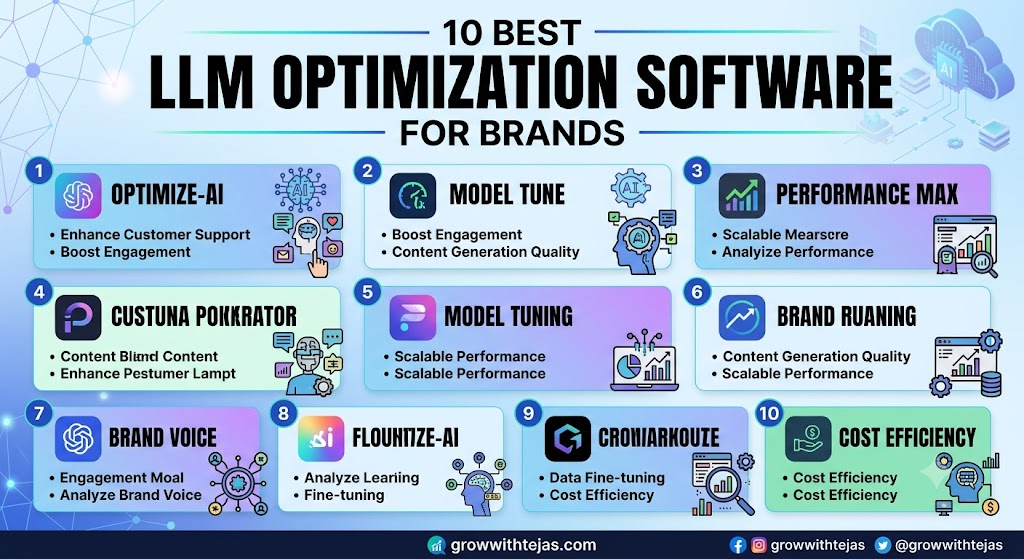
10 Best LLM Optimization Software for Brands in 2026
Customers are no longer relying exclusively on traditional search engines to discover, compare, and evaluate brands. They are asking ChatGPT, Gemini, Perplexity, Claude, Microsoft Copilot, and Google AI Mode questions such as:
- What is the best accounting software for a small business?
- Which CRM is suitable for a growing sales team?
- What are the safest skincare brands for sensitive skin?
- Which travel company offers reliable Bhutan tour packages?
- What are the best alternatives to a particular product?
The answers generated by large language models can influence awareness and purchasing decisions before a potential customer visits a brand’s website.
This change has created a new software category: LLM optimization software for brands.
These platforms help companies monitor their appearances in AI-generated answers, measure their share of voice, analyze citations, identify competitors, detect inaccurate descriptions, and find opportunities to improve AI visibility.
What Is LLM Optimization Software?
LLM optimization software is a platform that measures and helps improve how a company, product, or service appears in answers produced by large language models and AI-powered search platforms.
It is also commonly described as:
- AI visibility software
- LLM visibility software
- Generative Engine Optimization software
- GEO software
- Answer Engine Optimization software
- AEO software
- AI search monitoring software
A typical platform runs relevant questions across multiple AI engines and then analyzes whether the brand was mentioned, recommended, cited, or described accurately.
Short definition
LLM optimization software helps brands understand and improve their visibility, citations, positioning, and reputation within AI-generated answers.
It does not directly modify or control an AI model. Instead, it supplies the data and recommendations a marketing team needs to improve the signals that AI systems can discover and trust.
Why Do Brands Need LLM Optimization Software?
Traditional SEO platforms tell marketers how pages rank in conventional search results. That information remains important, but it does not provide a complete picture of AI discovery.
An AI assistant may:
- Mention a competitor without mentioning your company
- Cite an industry publication instead of your website
- Describe your product using outdated information
- Recommend your brand for one customer segment but not another
- Include your company in an answer without providing a clickable citation
- Produce different recommendations for different locations or prompts
Checking these answers manually is inefficient and difficult to reproduce. AI responses also change as models, retrieval systems, sources, and prompts change.
LLM optimization software automates this monitoring and turns variable AI responses into measurable data.
Quick Comparison of the Best LLM Optimization Software
| Software | Best suited for | Main strength |
|---|---|---|
| Profound | Enterprise brands | Comprehensive AI visibility and citation intelligence |
| Semrush AI Visibility Toolkit | SEO and marketing teams | AI visibility combined with established SEO workflows |
| Ahrefs Brand Radar | Market and competitor research | Large search-backed prompt database |
| Scrunch | Enterprises and digital experience teams | Monitoring, crawler analysis, and agent-focused delivery |
| Peec AI | Marketing teams and agencies | Accessible prompt, mention, and citation tracking |
| OtterlyAI | SMBs, agencies, and multi-brand teams | Straightforward multi-platform AI monitoring |
| Adobe Brand Visibility | Large Adobe-centered enterprises | Measurement, deployment, and analytics integration |
| Clarity ArcAI | Enterprise SEO teams | AI visibility connected to content and technical SEO |
| Brandlight | Brand and communications teams | Brand intelligence and AI perception monitoring |
| Goodie AI | Growth and content teams | AI visibility analytics with optimization workflows |
This comparison reflects each platform’s publicly stated positioning and capabilities. Features, platform coverage, and pricing can change, so brands should verify current details before purchasing.
1. Profound
Best for: Enterprise-level AI visibility intelligence
Profound is an enterprise-focused platform designed to help brands understand and improve their presence across answer engines. It monitors platforms such as ChatGPT, Gemini, Claude, Perplexity, Microsoft Copilot, Grok, DeepSeek, and Google’s AI experiences.
Its platform focuses on AI visibility, source citations, brand sentiment, competitive performance, and content opportunities.
Important features
- Brand visibility monitoring across multiple AI platforms
- Prompt-level performance analysis
- Source and citation tracking
- Competitive share-of-voice measurement
- Brand sentiment analysis
- Content optimization insights
- Reporting and enterprise integrations
Why brands may choose Profound
Profound is particularly suitable for organizations that need detailed AI visibility data across products, topics, markets, or business units. Its enterprise positioning also makes it relevant to companies that require governance, reporting, and collaboration features.
Possible limitation
Smaller businesses may find the platform more extensive than they require. Request a demonstration and evaluate the total cost before committing.
2. Semrush AI Visibility Toolkit
Best for: Teams that want AI visibility and conventional SEO in a connected ecosystem
Semrush’s AI Visibility Toolkit helps businesses benchmark AI visibility, analyze competitors, monitor prompts, examine brand sentiment, and discover opportunities for greater inclusion in AI-generated answers.
It can also identify technical issues that may prevent AI crawlers from accessing a website.
Important features
- Brand mention and visibility tracking
- Competitor research
- Prompt and topic research
- Brand perception and sentiment analysis
- Daily monitoring of selected prompts
- Technical AI-search audits
- Presentation-ready reporting
Why brands may choose Semrush
Semrush is a logical option for businesses already using its SEO, content, keyword, or competitive research tools. It allows teams to add AI visibility monitoring without introducing a completely separate SEO ecosystem.
Semrush describes the toolkit as suitable for small and medium businesses, agencies, and mid-market organizations.
Possible limitation
Teams should confirm which AI engines, locations, languages, and historical datasets are available under their selected subscription.
Explore the Semrush AI Visibility Toolkit
3. Ahrefs Brand Radar
Best for: Large-scale brand, competitor, and market research
Ahrefs Brand Radar measures how brands, products, people, and topics appear across AI search and the wider web. It combines a large database of search-backed prompts with custom prompt monitoring.
According to Ahrefs, Brand Radar covers hundreds of millions of prompts across AI Overviews, AI Mode, ChatGPT, Copilot, Gemini, Perplexity, and Grok.
Important features
- Extensive search-backed prompt database
- AI share-of-voice analysis
- Competitive benchmarking
- Custom prompt tracking
- Citation and cited-page research
- Historical visibility trends
- Web, search-demand, Reddit, and YouTube visibility data
- Research without setting up a separate project for every brand
Why brands may choose Ahrefs
Brand Radar is useful when a company wants to investigate an entire category rather than monitor only a small list of manually selected prompts. It can help teams discover which publishers, pages, content formats, and competitors dominate AI answers.
Possible limitation
Brands that primarily need prescriptive content recommendations may still require a separate optimization workflow or specialist.
4. Scrunch
Best for: Companies that want monitoring plus AI-agent website delivery
Scrunch helps companies monitor their presence, citations, positioning, and sentiment across AI platforms. It also examines how AI bots access a website and identifies problems that may prevent content from being discovered.
A distinguishing part of the platform is its Agent Experience Platform, or AXP. Scrunch says AXP can deliver a lightweight, machine-readable version of website content to AI agents while preserving the human-facing experience.
Important features
- Cross-platform AI visibility monitoring
- Prompt and topic tracking
- Citation-source analysis
- Competitor benchmarking
- Brand position and sentiment measurement
- AI crawler and bot observability
- Technical error detection
- Agent Experience Platform
- API, role-based access, and enterprise controls
Why brands may choose Scrunch
Scrunch may appeal to enterprise teams that want to move beyond reporting and examine how their website is consumed by AI agents. It is especially relevant when crawler accessibility, multi-brand support, governance, and machine-readable content delivery are priorities.
Possible limitation
The value of its more advanced capabilities will depend on the company’s technical infrastructure and implementation requirements.
5. Peec AI
Best for: Marketing teams and agencies seeking focused AI search analytics
Peec AI is designed to monitor brand mentions, citations, sentiment, and competitors across AI-generated search experiences.
Its agency offering supports multiple client brands and provides reporting that agencies can use in customer-facing workflows.
Important features
- AI visibility and mention monitoring
- Citation tracking
- Competitor comparison
- Brand sentiment analysis
- Prompt-level tracking
- Multi-brand agency workflows
- Geographic and platform-level analysis
- Client reporting
Why brands may choose Peec AI
Peec AI offers a focused approach for teams that want to begin measuring AI discovery without purchasing a broad enterprise SEO platform. Agencies may also appreciate the ability to organize and report on multiple brands.
Possible limitation
Before purchasing, check the available AI engines, prompt limits, geographic coverage, reporting options, and integration capabilities for the required plan.
6. OtterlyAI
Best for: SMBs, agencies, and teams that want straightforward tracking
OtterlyAI monitors brand mentions, website citations, competitors, and prompt performance across major AI search platforms.
Users can create a library of questions that reflect what potential customers might ask. The software runs those prompts and reports which brands and sources appear.
Important features
- Brand mention tracking
- Citation and source monitoring
- Share of AI Voice measurement
- Competitive benchmarking
- Prompt tracking
- Change alerts
- GEO audits
- Workspaces for multiple brands or clients
- Public API
- AI crawler and agent analytics
Why brands may choose OtterlyAI
OtterlyAI is a practical option for businesses that want an understandable monitoring dashboard and agency-friendly workspace management. Its prompt-based approach makes it easy to connect measurements with real customer questions.
Possible limitation
Prompt allowances, engine availability, update frequency, and country coverage can vary by plan. Compare these carefully rather than evaluating subscriptions only by their monthly price.
7. Adobe Brand Visibility
Best for: Large enterprises using Adobe’s marketing and analytics ecosystem
Adobe Brand Visibility is an enterprise generative engine optimization product that combines measurement, optimization, deployment, and business-impact analysis.
Adobe says its platform monitors visibility across multiple LLM families and can deploy agent-focused improvements at the CDN layer without changing the experience delivered to human visitors.
Important features
- Multi-platform AI visibility measurement
- Citation and competitive share-of-voice analysis
- AI optimization opportunities
- CDN-edge deployment
- Integration with Adobe Analytics
- Integration with Customer Journey Analytics
- AI bot verification through CDN logs
- Multi-language and local-market monitoring
- Enterprise collaboration features
Why brands may choose Adobe
The platform is potentially valuable for global businesses that need AI optimization to connect with existing analytics, content, and digital-experience operations.
Possible limitation
It is primarily positioned for enterprise use. Smaller companies may not require its deployment architecture or organizational integrations.
Explore Adobe Brand Visibility
8. Clarity ArcAI
Best for: Enterprise SEO teams seeking an end-to-end workflow
Clarity ArcAI by seoClarity connects AI visibility analysis with prompt research, content optimization, and technical SEO.
It is designed to help enterprises monitor their mentions and citations across AI platforms and then identify the content or technical actions needed to improve performance.
Important features
- AI search visibility tracking
- Citation and mention analysis
- Prompt and intent research
- Competitive gap identification
- Content optimization recommendations
- Technical SEO analysis
- Enterprise reporting and support
- Integration with broader SEO workflows
Why brands may choose Clarity ArcAI
Organizations already managing SEO at enterprise scale may prefer a platform that connects traditional organic search work with AI-search measurement rather than treating them as isolated activities.
Possible limitation
The platform’s enterprise orientation may be unsuitable for a business that needs only basic brand-mention monitoring.
9. Brandlight
Best for: Brand, reputation, and communications monitoring
Brandlight focuses on helping organizations understand how AI systems perceive, describe, and recommend their brands. This makes it particularly relevant to brand management, public relations, and corporate communications teams.
Features to evaluate
- Brand perception monitoring
- AI answer analysis
- Competitive share of voice
- Sentiment and positioning
- Citation-source discovery
- Reputation-risk identification
- Executive reporting
Why brands may choose Brandlight
A brand team may care about more than whether the company is mentioned. It may need to know whether an AI system describes the company accurately, associates it with the right category, or repeats an outdated claim.
Possible limitation
Confirm the platform’s current engine coverage, analytics integrations, data-export options, and optimization workflow during a product demonstration.
10. Goodie AI
Best for: Marketing teams combining analytics with optimization
Goodie AI is positioned around generative engine optimization and AI-search visibility. Its workflow is intended to help teams monitor brand performance and identify ways to increase citations and mentions.
Features to evaluate
- AI visibility monitoring
- Prompt tracking
- Competitor comparison
- Citation intelligence
- Content evaluation
- Optimization recommendations
- Team reporting
Why brands may choose Goodie AI
It may be useful for growth and content teams that want monitoring data to lead directly into content-planning and optimization activities.
Possible limitation
Brands should test the accuracy of its recommendations against their own analytics and business outcomes before scaling usage.
What Features Should LLM Optimization Software Include?
The most expensive platform is not automatically the best one. A business should select software based on its markets, customers, existing technology, and operational capacity.
1. Relevant AI-engine coverage
Verify that the software monitors the platforms your audience actually uses. These may include:
- ChatGPT
- Google AI Overviews
- Google AI Mode
- Gemini
- Perplexity
- Claude
- Microsoft Copilot
- Grok
- DeepSeek
- Meta AI
- Amazon Rufus
A longer platform list is not always better. Relevant, reliable coverage matters more than a headline number.
2. Prompt-level tracking
The software should show performance for individual questions, not only a single visibility score.
Prompt-level data reveals whether your brand appears for:
- Category searches
- “Best product” questions
- Comparison queries
- Alternative searches
- Problem-solving prompts
- Local queries
- Bottom-of-funnel recommendations
3. Mentions and citations
A mention and a citation are not the same.
A mention occurs when an AI answer names your brand. A citation occurs when it uses or links to a source associated with the answer.
Both are valuable, but they represent different opportunities. A brand may be mentioned because third-party publications discuss it, even when its own website is not cited.
4. Competitive share of voice
A useful platform should show:
- How often your brand appears
- Which competitors appear more frequently
- Which prompts competitors win
- Which sources support their visibility
- How performance changes over time
This turns AI monitoring into a competitive strategy rather than a vanity report.
5. Source intelligence
Citation analysis should reveal which websites influence AI-generated recommendations.
Common sources may include:
- Company websites
- Industry publications
- Review platforms
- News websites
- Reddit discussions
- YouTube videos
- Research reports
- Product documentation
- Comparison pages
- Government or institutional websites
This information helps marketers decide whether to update their own content, earn editorial coverage, improve documentation, or strengthen third-party validation.
6. Sentiment and answer accuracy
Being mentioned is not always positive. A model might describe a product incorrectly, associate it with an outdated price, or present a competitor as the better option.
Look for software that detects:
- Positive, neutral, or negative descriptions
- Incorrect product information
- Missing product capabilities
- Outdated claims
- Unfavourable comparisons
- Inconsistent positioning across AI platforms
7. Geographic and language support
AI answers can change by country, language, and location. A multinational or local business should verify whether the platform can reproduce the markets that matter.
8. Historical tracking
A snapshot cannot show whether optimization is working. Historical reporting should display changes in mentions, citations, share of voice, sentiment, and competitor performance.
9. Actionable recommendations
Some platforms mainly provide monitoring. Others also provide technical audits, content briefs, citation opportunities, or deployment tools.
Decide whether your team needs:
- Measurement only
- Measurement plus recommendations
- Measurement plus content production
- Measurement plus technical deployment
10. Integrations and data access
Enterprise teams may require integrations with:
- Google Analytics 4
- Adobe Analytics
- Google Search Console
- Business-intelligence tools
- Content-management systems
- Data warehouses
- Slack or Microsoft Teams
- APIs and automated reporting
How to Choose the Right Platform
Use the following process before signing a long-term agreement.
Step 1: Define the business outcome
Do not begin with “We need a GEO tool.” Begin with a measurable objective, such as:
- Increase inclusion in high-intent product comparisons
- Improve visibility for a new software category
- Correct inaccurate AI-generated product information
- Understand why competitors receive more recommendations
- Track AI visibility across multiple client accounts
- Connect AI referrals with leads and revenue
Step 2: Build a representative prompt set
Create prompts for every stage of the buying journey.
| Funnel stage | Example prompt |
|---|---|
| Awareness | How can a small business automate customer support? |
| Category discovery | What are the best AI customer-support platforms? |
| Comparison | Platform A vs Platform B: which is better? |
| Alternatives | What are the best alternatives to Platform A? |
| Validation | Is Platform A reliable for enterprise use? |
| Purchase | Which customer-support platform should a 100-person company buy? |
Include different buyer personas, problems, products, industries, and locations.
Step 3: Run the same test with shortlisted vendors
Give every vendor the same brand, competitors, markets, and sample prompts. Compare:
- Response accuracy
- Engine coverage
- Update frequency
- Citation detail
- Location support
- Historical reporting
- Recommended actions
- Export and integration options
Step 4: Evaluate workflow fit
A platform is useful only if someone can act on its findings.
Define who will be responsible for:
- Reviewing visibility changes
- Investigating negative sentiment
- Updating product information
- Creating content
- Conducting digital PR
- Fixing crawler problems
- Reporting business results
Step 5: Test business attribution
AI share of voice is an intermediate metric. Where possible, connect it with:
- AI referral sessions
- Engaged visits
- Demo requests
- Assisted conversions
- Branded search growth
- Sales-pipeline influence
- Revenue
How Can a Brand Improve Its LLM Visibility?
Software provides the measurement, but visibility improves through coordinated SEO, content, product marketing, public relations, and technical work.
Publish clear, factual content
Create pages that answer specific customer questions with concise, verifiable information.
Useful formats include:
- Product comparison pages
- Alternative pages
- Pricing explanations
- Use-case pages
- Original research
- Statistics pages
- Expert guides
- Product documentation
- Case studies
- Frequently asked questions
Strengthen entity consistency
Use consistent information about the company across the website and trusted third-party profiles.
Maintain accurate:
- Company name
- Product names
- Category descriptions
- Founder information
- Address and service locations
- Pricing statements
- Product capabilities
- Contact details
Earn credible third-party mentions
AI systems may rely on sources beyond a brand’s own website. Build genuine visibility in reputable publications, directories, analyst reports, communities, review sites, and industry resources.
Avoid manufacturing reviews, mass-producing low-quality mentions, or publishing unsupported claims. These practices can damage both trust and brand reputation.
Make important facts easy to extract
Use descriptive headings, short answer-first paragraphs, tables, bullet lists, author information, dates, citations, and structured product details.
Structured data can help machines interpret a page, but schema markup does not guarantee inclusion in an AI answer.
Keep content current
Update dates, prices, product features, statistics, screenshots, and availability information. Remove contradictions between website pages and public profiles.
Maintain strong conventional SEO
AI search and traditional SEO overlap. Crawlability, indexability, authority, original information, internal linking, and clear site architecture remain important.
Key Metrics for LLM Optimization
| Metric | What it measures |
|---|---|
| AI visibility | How frequently the brand appears across monitored answers |
| Mention rate | Percentage of tracked prompts that mention the brand |
| Citation rate | Percentage of answers that cite the brand’s domain or content |
| Share of AI Voice | Brand visibility compared with selected competitors |
| Average position | Where the brand tends to appear within generated recommendations |
| Sentiment | Whether descriptions are positive, neutral, or negative |
| Answer accuracy | Whether generated claims about the brand are correct |
| Source share | Which domains account for citations in the category |
| AI referral traffic | Visits received from AI platforms |
| AI-assisted conversions | Leads or sales influenced by AI-originated visits |
Because generative answers are variable, teams should evaluate trends across a meaningful collection of prompts and repeated measurements. A single answer is not reliable evidence of overall brand performance.
Common LLM Optimization Mistakes
Tracking only the brand name
Customers often ask unbranded questions. Track category, problem, comparison, alternative, and recommendation prompts.
Treating every AI engine as identical
Different systems may use different retrieval methods, source pools, interfaces, and citation behaviour. Measure them separately.
Chasing a visibility score without studying citations
A score shows what happened. Citation analysis can help explain why it happened.
Producing generic AI-written content at scale
Publishing large volumes of repetitive content does not create authority. Brands need original evidence, useful expertise, clear product information, and credible external validation.
Ignoring third-party sources
Your website is only one part of your AI-search presence. Reviews, news coverage, communities, videos, directories, and expert content may all influence generated answers.
Failing to connect visibility with business results
More mentions are helpful only when they improve awareness, qualified traffic, leads, customer confidence, or revenue.
Final Verdict
There is no universally best LLM optimization platform for every company.
- Profound is a strong candidate for comprehensive enterprise intelligence.
- Semrush suits teams that want AI visibility connected with established SEO workflows.
- Ahrefs Brand Radar stands out for large-scale market, prompt, and citation research.
- Scrunch is compelling for brands that need AI crawler analysis and agent-focused delivery.
- Peec AI and OtterlyAI offer approachable monitoring for marketing teams and agencies.
- Adobe Brand Visibility is designed for enterprises that want measurement, deployment, and analytics within an integrated environment.
- Clarity ArcAI connects enterprise AI-search monitoring with content and technical SEO.
Start with a pilot rather than a long contract. Track a carefully designed set of commercial prompts, compare the results with your competitors, and confirm that your team can turn the platform’s insights into content, technical improvements, credible mentions, and measurable growth.
The most valuable LLM optimization software is not the platform with the longest feature list. It is the one that consistently answers three questions:
- Where is our brand visible or absent?
- Why are AI platforms choosing particular brands and sources?
- What should our team do next?
Frequently Asked Questions
What is LLM optimization software for brands?
LLM optimization software monitors and helps improve how a brand appears in responses from platforms such as ChatGPT, Gemini, Perplexity, Claude, Copilot, and Google AI Mode. It measures mentions, citations, competitive share of voice, sentiment, and related visibility signals.
What is the difference between LLM optimization and SEO?
SEO improves visibility in conventional search results. LLM optimization focuses on inclusion, citations, and brand representation inside AI-generated answers. The disciplines overlap because AI systems frequently retrieve information from searchable web content.
Is LLM optimization the same as GEO?
LLM optimization is commonly grouped with Generative Engine Optimization, or GEO. Other related terms include Answer Engine Optimization, AI search optimization, and AI visibility optimization.
Can a brand optimize ChatGPT results?
A brand cannot directly control ChatGPT’s answers. It can improve the clarity, accuracy, authority, accessibility, and external validation of its information. Monitoring software helps identify where those improvements may be needed.
What is Share of AI Voice?
Share of AI Voice estimates how much visibility a brand receives in AI-generated answers compared with selected competitors across a defined group of prompts.
What is the difference between an AI mention and a citation?
A mention occurs when an AI answer names a brand. A citation occurs when the answer references or links to a source. A brand can be mentioned without its own website being cited.
Which LLM optimization tool is best for small businesses?
Small businesses should look for affordable prompt tracking, competitor comparison, citation monitoring, clear reporting, and easy setup. OtterlyAI, Peec AI, and Semrush may be appropriate candidates, depending on current pricing and required coverage.
Which LLM optimization platform is best for enterprises?
Profound, Scrunch, Adobe Brand Visibility, and Clarity ArcAI are positioned toward enterprise requirements. The best choice depends on governance, integrations, geographic coverage, security, deployment, and reporting needs.
How often should AI visibility be measured?
Active brands can monitor priority prompts daily or weekly and review broader strategic trends monthly. The correct frequency depends on the number of prompts, market volatility, and available resources.
Does schema markup guarantee an AI citation?
No. Structured data can improve machine understanding, but it cannot guarantee that a page or brand will be cited by an AI platform.
Can LLM optimization software measure sales?
Some platforms can connect with analytics systems and report AI referral traffic or related conversions. However, complete revenue attribution may require additional web analytics, CRM, and customer-journey data.
How long does LLM optimization take?
Monitoring can produce an initial benchmark quickly. Improving visibility may take weeks or months because results depend on content discovery, search visibility, third-party authority, model updates, and the competitiveness of the category.
Is traditional SEO still necessary?
Yes. Technical accessibility, indexability, authoritative content, internal linking, and conventional search visibility remain important foundations for AI discovery.
Conclusion
AI assistants are becoming influential brand-discovery and product-research channels. Companies now need to know not only where their websites rank, but also whether AI platforms understand, mention, cite, and recommend their brands.
LLM optimization software gives marketing teams that visibility. It converts thousands of changing AI responses into competitive intelligence and practical priorities.
Begin with the questions your customers actually ask. Measure your baseline across the relevant AI platforms, investigate the sources shaping those answers, and improve the quality and credibility of the information available about your brand.
Brands that start measuring AI visibility now will be better prepared as conversational discovery becomes a larger part of the customer journey.