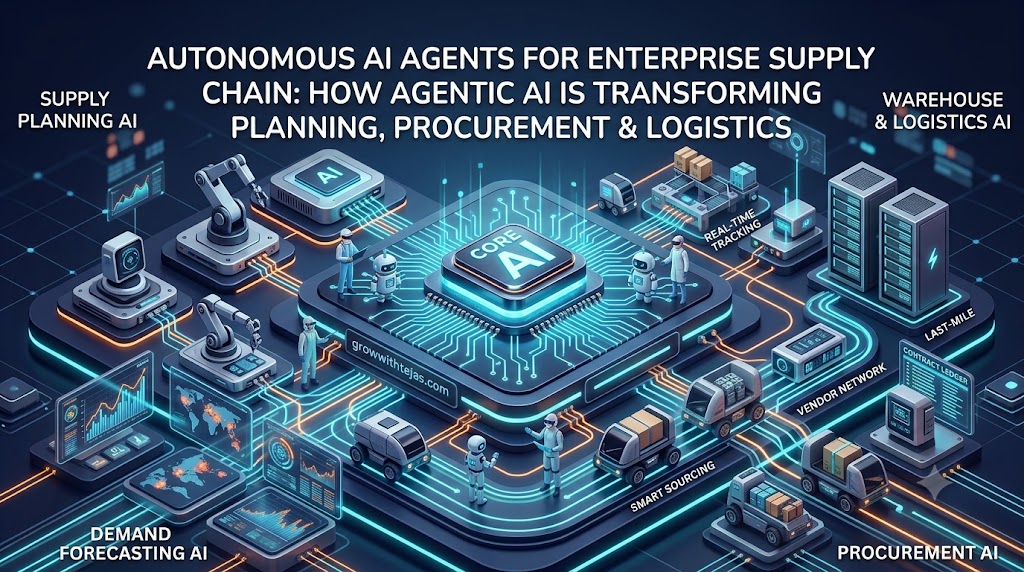
Autonomous AI Agents for Enterprise Supply Chain: How Agentic AI Is Transforming Planning, Procurement & Logistics
Enterprise supply chains have spent decades becoming more digital.
ERP platforms digitized transactions. Supply chain management software improved planning. IoT sensors increased visibility. Machine learning improved forecasting. Generative AI made it easier for employees to analyze information and interact with enterprise data.
But most of these technologies still share one limitation:
A human has to decide what happens next.
Autonomous AI agents are beginning to change that model.
Instead of simply identifying that a shipment will arrive late, an AI agent can potentially determine which customer orders are affected, evaluate alternative suppliers or transportation routes, calculate the financial impact, recommend corrective actions and—within predefined permissions—execute parts of the response.
That makes autonomous AI agents for enterprise supply chain one of the most important emerging applications of agentic AI.
The shift is from software that tells supply chain professionals what happened to intelligent systems capable of helping them decide what should happen next—and taking approved actions.
For B2B organizations dealing with thousands of suppliers, SKUs, purchase orders, warehouses and shipments, that distinction could fundamentally change how supply chains operate.
What Are Autonomous AI Agents for Enterprise Supply Chain?
Autonomous AI agents are AI-powered software systems designed to pursue business objectives, reason across information, use enterprise tools and perform multi-step actions with varying degrees of human supervision.
In a supply chain environment, an autonomous agent could monitor information from:
- ERP systems
- warehouse management systems
- transportation management systems
- supplier portals
- procurement platforms
- demand-planning software
- manufacturing systems
- IoT devices
- inventory databases
- external risk feeds
- logistics providers
- emails and documents
The agent doesn’t necessarily stop after analyzing that information.
Depending on its permissions, it can determine the next action, invoke another application or specialized agent, update a workflow and continue monitoring the outcome.
Consider a simple example.
A traditional supply chain alert might say:
Supplier X has delayed Component A by seven days.
A generative AI assistant might explain:
The delay could affect production. Consider contacting the supplier or finding an alternative source.
An autonomous supply chain agent could instead initiate a workflow:
Detect delay → identify affected production orders → calculate available inventory → evaluate alternate suppliers → estimate expedited freight cost → simulate mitigation scenarios → recommend the best option → request approval → update relevant systems
That movement from insight to coordinated action is what makes agentic AI strategically important for enterprise supply chains.
Traditional B2B Supply Chain AI vs. Autonomous AI Agents
AI isn’t new to supply chain management.
Enterprises already use machine learning for demand forecasting, route optimization, predictive maintenance and inventory optimization.
Autonomous agents add an orchestration and execution layer.
| Capability | Traditional B2B Supply Chain AI | Autonomous AI Agents |
|---|---|---|
| Demand forecasting | Predicts future demand | Detects changes and coordinates responses |
| Inventory | Recommends stock levels | Evaluates and initiates replenishment workflows |
| Procurement | Provides analytics | Can orchestrate sourcing and supplier workflows |
| Logistics | Predicts delays | Evaluates mitigation options and executes approved actions |
| Supplier risk | Generates alerts | Investigates impact and coordinates responses |
| ERP interaction | Human-operated | Agents can interact through governed tools/APIs |
| Decision-making | Primarily human | AI + human approval or bounded autonomy |
| Workflow | Mostly predefined | Dynamic multi-step planning |
| Monitoring | Dashboards and alerts | Continuous monitoring and response |
| Objective | Better decisions | Faster decisions plus controlled execution |
Traditional AI asks:
“What is likely to happen?”
Generative AI asks:
“What does this information mean?”
Agentic AI increasingly asks:
“Given the objective and constraints, what should we do next?”
That third question has enormous implications for B2B supply chain operations.
Why Enterprise Supply Chains Are Ideal for Agentic AI
Supply chains are fundamentally networks of decisions.
Every day, large enterprises make decisions involving:
- what to purchase,
- how much inventory to maintain,
- which supplier to use,
- which factory should produce an order,
- when products should ship,
- which transportation mode to select,
- how to respond to shortages,
- how to prioritize customers,
- and how to handle disruptions.
Many decisions depend on information distributed across different systems.
A procurement manager may need information from ERP, supplier management and inventory systems.
A logistics planner may need transportation data, warehouse capacity, customer priorities and weather information.
A production planner may need forecasts, inventory availability, supplier lead times and manufacturing capacity.
This fragmentation creates an opportunity for autonomous agents.
Instead of forcing employees to manually collect information from multiple applications, an agent can potentially gather the required context, reason across it and coordinate the next step.
The emerging industry direction supports this shift. SAP’s 2026 work on autonomous supply chains describes organizations moving beyond disconnected insight generation toward redesigning how enterprises sense, decide and act, with resilience increasingly tied to decision velocity.
10 High-Value Use Cases for Autonomous AI Agents in Enterprise Supply Chains
1. Autonomous Demand Planning
Demand forecasting has been one of the most established applications of AI in supply chains.
Agentic AI can add another layer.
A demand-planning agent could continuously monitor:
- historical sales,
- open orders,
- promotional activity,
- inventory,
- seasonal trends,
- regional demand,
- customer behavior,
- production constraints,
- and external market signals.
When conditions change, the agent could identify exceptions and generate scenarios rather than waiting for the next scheduled planning cycle.
For example:
Demand spike detected → inventory impact calculated → production capacity checked → material constraints identified → scenarios generated → planner receives recommended action
Current enterprise implementations are already moving in this direction. SAP’s Planning Assistant includes AI-driven agents for exception management, demand fulfillment and inventory-driver assessment, including identifying capacity problems and recommending mitigation paths for unfulfilled demand.
The objective isn’t necessarily to eliminate the demand planner.
It’s to reduce the amount of time planners spend finding problems so they can focus on resolving high-value exceptions.
2. Autonomous Inventory Optimization
Inventory creates one of supply chain management’s oldest conflicts.
Too little inventory creates stockouts and lost revenue.
Too much inventory locks up working capital and increases storage and obsolescence costs.
An inventory agent could continuously evaluate:
- SKU-level inventory,
- safety stock,
- reorder points,
- supplier lead times,
- forecast changes,
- service-level targets,
- warehouse capacity,
- and expected inbound shipments.
Instead of generating another dashboard, the agent could identify an emerging shortage and initiate the appropriate replenishment workflow.
For example:
Stockout risk → check incoming inventory → evaluate alternate warehouse → evaluate supplier lead time → calculate transfer vs. replenishment cost → recommend best action
For enterprises managing tens of thousands of SKUs, this could significantly reduce the burden of exception management.
3. AI Procurement Agents
Procurement is emerging as one of the strongest B2B applications for autonomous agents.
Procurement teams deal with highly structured workflows involving:
- requisitions,
- supplier discovery,
- RFQs,
- purchase orders,
- contracts,
- approvals,
- invoices,
- supplier performance,
- and compliance.
These workflows are particularly suitable for agentic automation because they combine repetitive processes with data-driven decisions.
A procurement agent could potentially:
- Receive a purchase requirement.
- Check existing contracts.
- Identify approved suppliers.
- Compare historical pricing.
- evaluate supplier performance.
- Prepare an RFQ.
- Analyze responses.
- Flag commercial or compliance issues.
- Recommend a supplier.
- Route the decision for approval.
Enterprise software is already heading toward this model.
SAP’s Sourcing Assistant, for example, is designed to orchestrate sourcing from supplier discovery and event creation through bid analysis and supplier negotiations.
This represents an important difference between traditional procurement automation and agentic procurement.
The objective isn’t simply:
Automate a task.
It becomes:
Coordinate an outcome.
4. Autonomous Supplier Management
Large enterprises may work with thousands of suppliers.
Monitoring each supplier manually becomes difficult.
A supplier-management agent could continuously analyze:
- delivery performance,
- quality metrics,
- pricing,
- lead-time changes,
- contract compliance,
- financial indicators,
- supplier communications,
- and risk signals.
When risk increases, the agent could investigate potential exposure.
Imagine a critical supplier experiences a production disruption.
An agentic workflow might become:
Risk detected → identify purchased components → map components to products → identify customer orders at risk → calculate current safety stock → search approved alternatives → generate mitigation plan
SAP’s Supplier Management Assistant illustrates this direction, using AI agents to unify supplier information, assess performance, generate risk-aware insights and automate parts of supplier collaboration.
This turns supplier-risk management from a periodic review process into something closer to continuous operational intelligence.
5. Autonomous Logistics Agents
Logistics involves thousands of decisions affected by rapidly changing conditions.
Potential disruptions include:
- port congestion,
- carrier delays,
- weather,
- customs issues,
- warehouse capacity,
- vehicle availability,
- driver shortages,
- inventory constraints,
- and customer delivery requirements.
Traditional transportation software can identify many of these problems.
An autonomous logistics agent can potentially coordinate the response.
For example:
Shipment delayed → determine affected orders → evaluate alternate carrier → compare cost → check inventory at alternate distribution center → estimate customer impact → recommend rerouting → execute after approval
This isn’t merely theoretical positioning. SAP’s Logistics Assistant is designed around autonomous detection, planning and execution across warehousing and transportation, including disruption mitigation, dispatch decisions, freight benchmarking and delivery-issue resolution.
For B2B companies with global distribution networks, this is one of the clearest commercial use cases for autonomous AI.
6. Manufacturing and Production Agents
Manufacturing environments create another natural use case.
Production schedules depend on:
- material availability,
- equipment capacity,
- labor,
- quality,
- maintenance,
- supplier deliveries,
- customer priorities,
- and downstream logistics.
A production agent could monitor these variables continuously.
Imagine a machine goes offline unexpectedly.
Instead of simply generating a maintenance alert, a multi-agent workflow could:
Detect machine outage → calculate production impact → identify alternative line → check workforce → verify material availability → reschedule affected jobs → estimate delivery impact → request approval
SAP’s Manufacturing Assistant is explicitly designed as a multi-agent system that can monitor disruptions and support corrective processes involving quality, scheduling, workforce, material staging and inventory.
That illustrates how agentic AI can connect planning with execution rather than leaving intelligence trapped inside dashboards.
7. Purchase Order Exception Management
Purchase-order changes are routine but potentially expensive.
Suppose a supplier changes the delivery date of a critical component.
A procurement professional may have to investigate:
- which production orders depend on it,
- available inventory,
- customer orders,
- alternative materials,
- other purchase orders,
- and potential schedule changes.
An agent can perform much of this impact analysis automatically.
Microsoft’s 2026 Procurement Agent capabilities in Dynamics 365 Supply Chain Management illustrate this approach: when suppliers propose PO changes, the system can help identify downstream effects so purchasers can distinguish low-impact changes from those requiring intervention.
This is exactly the type of narrow, high-value B2B workflow where autonomous agents can produce measurable ROI.
8. Supply Chain Disruption Management
The most valuable supply chain agent may eventually be the one businesses hope they rarely need:
the disruption agent.
Its job would be to continuously monitor the supply network for potential disruptions.
Signals might include:
- supplier failures,
- transportation interruptions,
- port closures,
- geopolitical events,
- extreme weather,
- quality failures,
- sudden demand changes,
- cyber incidents,
- or manufacturing outages.
When an event occurs, the agent doesn’t simply send an alert.
It determines exposure.
For example:
Port disruption detected
↓
Which shipments use the port?
↓
Which purchase orders are affected?
↓
Which factories need those materials?
↓
How many days of inventory remain?
↓
Which customer commitments are exposed?
↓
Can another port or transport mode be used?
↓
What will mitigation cost?
↓
Which action best balances cost and service?
That ability to connect external events to internal business consequences is where agentic AI can become much more valuable than generic AI chatbots.
9. Warehouse AI Agents
Warehouses provide another environment where digital agents can coordinate physical operations.
Warehouse agents could help manage:
- inbound receiving,
- put-away,
- picking,
- packing,
- labor allocation,
- dock scheduling,
- inventory movements,
- replenishment,
- and outbound dispatch.
Consider an unexpected surge in outbound orders.
A warehouse agent could identify the volume increase, evaluate available workers, reprioritize picking waves, coordinate inventory movements and alert transportation systems about expected changes.
As warehouse robotics becomes more capable, the longer-term opportunity becomes even more interesting.
Software agents may eventually coordinate with robotic systems, creating a bridge between agentic AI and physical AI.
10. Autonomous Supply Chain Control Towers
Supply chain control towers were originally designed to provide end-to-end visibility.
Agentic AI can potentially transform the concept.
A traditional control tower says:
“Here are your most important exceptions.”
An agentic control tower could say:
“Here are your most important exceptions, their downstream impact, the available response scenarios, the recommended option and the actions ready for approval.”
Eventually, low-risk responses could execute automatically while humans remain responsible for higher-risk decisions.
That changes the control tower from a visibility platform into a decision-and-execution layer.
Single AI Agent vs. Multi-Agent Supply Chain
Enterprise supply chains are too complicated for one agent to understand every process equally well.
This is why multi-agent architectures are important.
A company might deploy:
- Demand Planning Agent
- Inventory Agent
- Procurement Agent
- Supplier Risk Agent
- Manufacturing Agent
- Warehouse Agent
- Transportation Agent
- Customer Fulfillment Agent
Each agent specializes in its domain.
An orchestration layer coordinates them.
For example:
Scenario: Supplier Disruption
Supplier Risk Agent
Detects supplier disruption.
↓
Inventory Agent
Calculates remaining stock.
↓
Planning Agent
Determines production impact.
↓
Procurement Agent
Finds alternate suppliers.
↓
Logistics Agent
Calculates expedited transportation options.
↓
Finance/Business Rules
Evaluates financial consequences.
↓
Orchestrator
Ranks possible responses.
↓
Human
Approves high-impact decision.
↓
Agents
Execute approved actions.
This architecture is increasingly realistic as enterprise platforms adopt agent-to-agent interoperability. Microsoft and SAP, for example, announced agent-to-agent integration between Microsoft 365 Copilot and SAP Joule in 2026, allowing agentic workflows to coordinate across productivity and enterprise business environments.
Autonomous Does Not Mean Uncontrolled
The word autonomous can create the wrong impression.
Enterprises should not interpret autonomous AI as:
Give an AI model unrestricted access to the ERP and hope it makes good decisions.
Enterprise autonomy should exist within boundaries.
A better model is bounded autonomy.
An organization defines:
- what information an agent can access,
- which systems it can use,
- what actions it can perform,
- monetary limits,
- business rules,
- escalation conditions,
- and which decisions require humans.
For example:
An inventory agent might be authorized to automatically transfer stock between warehouses when:
- the transfer value is below ₹5 lakh,
- both facilities are within the same region,
- service levels improve,
- and no regulated goods are involved.
Anything outside those conditions could require planner approval.
This creates a useful combination:
AI speed + enterprise controls + human accountability
Security Risks of Autonomous Supply Chain Agents
Giving AI the ability to interact with operational systems creates significant security concerns.
A compromised chatbot is problematic.
A compromised procurement agent capable of creating purchase orders is much more serious.
Enterprises therefore need to secure the agent itself, its tools and every downstream system.
1. Excessive Agent Permissions
An agent should never receive unrestricted ERP access simply because it needs to perform one workflow.
Use least-privilege access.
2. Prompt Injection
Supply chain agents may process emails, documents, supplier messages and external information.
Malicious instructions embedded in those sources could attempt to manipulate agent behavior.
External content should therefore be treated as untrusted input.
3. Credential Exposure
Agents need authentication to enterprise systems.
Use secure token mechanisms and credential management rather than embedding passwords or long-lived API keys inside prompts.
4. Unauthorized Transactions
Financially significant actions should require explicit authorization.
Examples include:
- issuing large purchase orders,
- changing supplier bank information,
- cancelling contracts,
- accepting major price increases,
- or committing to expensive freight.
5. Agent-to-Agent Security
Multi-agent architectures create another attack surface.
Organizations need controls around which agents can communicate and which actions one agent can request from another.
6. Auditability
Every consequential agent action should be traceable.
Businesses need to know:
Who initiated the workflow?
Which agent made the decision?
What information did it use?
Which tool did it invoke?
What action occurred?
Was human approval required?
This is why agent governance platforms are becoming important. IBM, for example, introduced an Agentic Control Plane in 2026 focused on visibility, governance and centralized control of enterprise agents.
Enterprise Architecture for Autonomous Supply Chain Agents
A production architecture could look like this:
Layer 1: Enterprise Data
ERP + SCM + WMS + TMS + procurement + CRM + IoT + external data
↓
Layer 2: Integration
APIs + event streams + enterprise integration + agent tools
↓
Layer 3: AI Models
Enterprise LLMs + specialized models + forecasting models
↓
Layer 4: Specialized Agents
Planning + procurement + inventory + logistics + manufacturing agents
↓
Layer 5: Agent Orchestration
Coordinates workflows between agents and business systems
↓
Layer 6: Governance
Identity + permissions + policy + human approvals + guardrails
↓
Layer 7: Observability
Agent traces + logs + costs + performance + audit trails
↓
Layer 8: Enterprise Applications
ERP + procurement + SCM + warehouse + transportation + supplier systems
The architecture matters because an autonomous supply chain isn’t created simply by adding an LLM to an ERP.
The real challenge is connecting intelligence to enterprise processes without sacrificing governance or reliability.
A recent IBM Consulting supply-chain implementation illustrates this complexity: its automotive operations agent combines enterprise identity, isolated sessions, MCP-based tools, knowledge retrieval, guardrails and end-to-end observability rather than treating the LLM as a standalone application.
How Autonomous AI Agents Integrate With ERP Systems
ERP integration is one of the most commercially important parts of agentic supply chain deployment.
An agent needs governed ways to:
Read
- purchase orders,
- inventory,
- production orders,
- sales orders,
- supplier information,
- invoices.
Analyze
- shortages,
- delays,
- exceptions,
- dependencies,
- costs.
Write
- update approved fields,
- initiate workflows,
- create draft transactions,
- submit recommendations,
- trigger approved processes.
The safest architecture generally avoids giving the language model unrestricted database access.
Instead:
Agent → governed tool/API → authorization layer → ERP
The authorization layer verifies what the agent is permitted to do.
This distinction is critical for enterprise deployments.
Human-in-the-Loop vs. Fully Autonomous Supply Chain
Not every process should have the same level of autonomy.
A useful framework is:
Level 1 — AI Insights
AI analyzes information.
Human makes the decision.
Level 2 — AI Recommendations
AI recommends an action.
Human approves and executes.
Level 3 — Agent-Assisted Execution
AI recommends and prepares the action.
Human approves.
Agent executes.
Level 4 — Bounded Autonomy
Agent automatically executes low-risk actions within defined rules.
Humans handle exceptions.
Level 5 — Highly Autonomous Operations
Multiple agents continuously coordinate operational decisions with humans primarily governing objectives, policies and major exceptions.
Most enterprises shouldn’t begin at Level 5.
The practical path is usually:
Insight → recommendation → supervised execution → bounded autonomy
SAP’s 2026 autonomous-supply-chain research makes a similar point: the path forward is a progression rather than wholesale replacement.
How Much Do Autonomous Supply Chain Agents Cost?
There is no universal cost because enterprise implementations vary dramatically.
Companies should consider several cost categories.
| Cost Category | Examples |
|---|---|
| AI inference | LLM/API usage |
| Agent platform | Orchestration and runtime |
| Cloud infrastructure | Compute, storage and networking |
| Data infrastructure | Warehouses, lakes and vector databases |
| Integration | ERP, SCM, WMS and TMS APIs |
| Security | IAM, secrets and policy enforcement |
| Observability | Agent tracing and monitoring |
| Implementation | Development and consulting |
| Maintenance | Testing, evaluation and updates |
Businesses should avoid evaluating the technology purely on cost per AI token.
A more useful enterprise metric is:
Cost Per Successfully Resolved Supply Chain Exception
Imagine a company currently spends:
- 90 minutes identifying a disruption,
- another hour determining impact,
- 45 minutes comparing options,
- and additional time coordinating stakeholders.
If an agent reduces that workflow to several minutes of automated analysis followed by human approval, the business case extends well beyond the cost of model inference.
ROI of Autonomous AI Agents in Supply Chain
Enterprises should measure agentic AI against operational outcomes.
Potential KPIs include:
Planning
- Forecast accuracy
- Planning cycle time
- Exception-resolution time
Inventory
- Inventory turns
- Stockout rate
- Safety-stock levels
- Working capital
Procurement
- Purchase-order processing time
- Sourcing cycle time
- Supplier response time
- Cost savings
Logistics
- On-time delivery
- Freight cost
- Expedite cost
- Route efficiency
Manufacturing
- Schedule adherence
- Downtime
- Capacity utilization
- Production throughput
Agent Performance
Enterprises also need AI-specific metrics:
- successful task completion rate,
- agent error rate,
- human escalation rate,
- cost per completed workflow,
- unauthorized-action attempts,
- average agent response time,
- and percentage of actions requiring human intervention.
The ultimate KPI isn’t:
“How many AI agents have we deployed?”
It is:
“What measurable operational improvement are those agents creating?”
How to Implement Autonomous AI Agents in an Enterprise Supply Chain
A practical implementation strategy should start small.
Step 1: Select a High-Value Workflow
Don’t begin by trying to automate the entire supply chain.
Choose one expensive, repetitive problem.
Examples:
- PO exception management,
- inventory shortages,
- supplier-risk investigation,
- freight disruption,
- demand-planning exceptions.
Step 2: Map Required Data
Identify every data source the agent needs.
Step 3: Define Agent Permissions
Specify exactly what the agent can read and modify.
Step 4: Create Tools
Expose enterprise functions through secure APIs or agent tools.
Step 5: Start Read-Only
Allow the agent to analyze and recommend before granting transaction permissions.
Step 6: Add Human Approval
Introduce supervised execution.
Step 7: Measure Accuracy and ROI
Compare performance against the existing process.
Step 8: Introduce Bounded Autonomy
Automate low-risk decisions with clear thresholds.
Step 9: Add Specialized Agents
Expand into adjacent workflows.
Step 10: Build an Agent Control Layer
Centralize governance, monitoring, permissions and observability as the number of agents increases.
Build vs. Buy: Should Enterprises Develop Their Own Supply Chain Agents?
This is becoming an important B2B technology decision.
Buy Enterprise Agent Capabilities When:
- your workflows are relatively standard,
- ERP integration already exists,
- implementation speed matters,
- you want vendor-supported governance,
- and customization requirements are moderate.
Build Custom Agents When:
- your supply chain processes are highly differentiated,
- proprietary data creates competitive advantage,
- workflows cross multiple vendor ecosystems,
- you require specialized models,
- or agent behavior itself is strategically important.
Use a Hybrid Strategy When:
You want standard agents for common workflows while developing proprietary agents for high-value processes.
For many large enterprises, hybrid is likely to be the practical model.
The enterprise may use packaged procurement and planning agents while building proprietary agents for industry-specific processes.
Autonomous Supply Chain Agents vs. RPA
Businesses shouldn’t confuse agentic AI with robotic process automation.
RPA typically follows predefined instructions.
For example:
If invoice arrives → extract field → enter value → submit form.
An AI agent works more dynamically.
It can evaluate context, choose between tools and determine the next step based on its objective.
| RPA | Autonomous AI Agent |
|---|---|
| Rule-based | Goal-oriented |
| Fixed workflow | Dynamic workflow |
| Structured inputs preferred | Can handle structured + unstructured data |
| Executes predefined steps | Can select actions |
| Limited reasoning | AI reasoning |
| Breaks when workflows change | Can potentially adapt within constraints |
| Best for repetitive processes | Best for variable decision workflows |
The technologies aren’t necessarily competitors.
Agents can potentially invoke traditional automation systems as tools.
What Enterprises Should Look for in an AI Agent Platform
Before selecting technology for autonomous supply chain workflows, B2B buyers should evaluate:
Enterprise Integration
Can it securely connect to existing ERP, SCM, WMS, TMS and procurement systems?
Model Flexibility
Can different AI models be used for different tasks?
Agent Orchestration
Can multiple agents coordinate?
Identity Management
Does every agent have a defined identity?
Permission Controls
Can access be restricted at the tool and action level?
Human Approval
Can high-risk workflows require authorization?
Observability
Can administrators inspect agent actions and failures?
Audit Logs
Are actions recorded for compliance?
Data Privacy
How is enterprise information stored and processed?
Cost Controls
Can organizations track inference and workflow costs?
Scalability
Can the platform move from ten agents to thousands?
These requirements are why enterprise agent adoption is becoming a broader B2B infrastructure market rather than simply another generative AI feature.
The Autonomous Supply Chain of the Future
The future supply chain may operate very differently from today’s dashboard-driven model.
Imagine a global manufacturer where:
Demand agents continuously monitor demand.
Inventory agents rebalance stock.
Procurement agents manage routine sourcing.
Supplier agents monitor risk.
Production agents coordinate manufacturing.
Warehouse agents optimize fulfillment.
Logistics agents dynamically respond to transportation disruptions.
Customer agents monitor delivery commitments.
An orchestration layer coordinates these systems against enterprise objectives.
Human supply chain professionals don’t disappear.
Their work moves upward.
Instead of manually investigating thousands of routine exceptions, humans increasingly focus on:
- strategy,
- policy,
- supplier relationships,
- high-risk decisions,
- complex trade-offs,
- governance,
- and exceptions AI cannot confidently resolve.
The supply chain organization therefore moves from human-operated software toward human-governed autonomous systems.
B2B AI vs. Agentic Supply Chain: Why This Market Matters
Generic enterprise AI solves horizontal problems such as writing, summarization and knowledge search.
Supply chain agents address operational problems tied directly to money.
A purchasing decision affects cost.
An inventory decision affects working capital.
A logistics decision affects freight expenditure.
A production decision affects capacity.
A disruption decision affects revenue.
That makes autonomous supply chain agents particularly attractive from a B2B technology perspective.
The commercial ecosystem includes:
- enterprise AI platforms,
- cloud infrastructure,
- ERP software,
- supply chain management platforms,
- procurement software,
- logistics platforms,
- data platforms,
- cybersecurity,
- API management,
- agent observability,
- consulting,
- systems integration,
- and AI infrastructure.
This is one reason autonomous AI agents for enterprise supply chain represents a more commercially focused niche than generic topics such as “What is artificial intelligence?”
The reader isn’t necessarily looking for an AI definition.
They may be trying to answer:
Can this technology solve an expensive operational problem inside my company?
That is much closer to B2B buying intent.
Frequently Asked Questions
What are autonomous AI agents for enterprise supply chain?
Autonomous supply chain agents are AI-powered systems capable of monitoring supply chain information, reasoning about operational problems, using enterprise tools and executing approved workflows with varying levels of human supervision.
How are AI agents used in supply chain management?
Common applications include demand planning, inventory optimization, procurement, supplier-risk monitoring, manufacturing, warehouse management, logistics and disruption response.
Can AI agents connect to SAP or ERP systems?
Yes, provided appropriate integrations are available. Enterprise implementations should connect agents through governed APIs and tools with identity, permissions and audit controls rather than giving models unrestricted system access.
Can autonomous AI agents create purchase orders?
Technically, an appropriately integrated agent could initiate or create transactions. Enterprises should define authorization thresholds and require human approval for financially significant actions.
What is the difference between generative AI and autonomous AI agents?
Generative AI primarily generates content or answers. Autonomous agents use AI models to pursue objectives, select tools and perform multi-step workflows.
What is the difference between AI agents and RPA?
RPA generally executes predefined workflows. AI agents can reason about context and dynamically select actions within defined constraints.
Are autonomous AI agents safe for enterprise supply chains?
They can be deployed with appropriate controls, but operational autonomy introduces significant risks. Enterprises need least-privilege access, secure authentication, tool restrictions, human approvals, monitoring and auditability.
Will AI agents replace supply chain planners?
The near-term enterprise model is more likely to augment planners by automating data gathering, exception analysis and routine actions. Humans remain important for strategic decisions, relationships, governance and high-impact exceptions.
What is a multi-agent supply chain system?
It is an architecture where specialized agents—such as procurement, inventory, planning and logistics agents—coordinate to complete cross-functional supply chain workflows.
What is an autonomous supply chain?
An autonomous supply chain uses connected data, AI, automation and agentic systems to continuously sense conditions, make or recommend decisions and execute approved responses with reduced manual intervention.
Final Thoughts
Enterprise supply chains have traditionally operated through a combination of software, dashboards, alerts and human decision-making.
Autonomous AI agents introduce a different operating model.
Instead of:
System detects → human investigates → human decides → human executes
the workflow increasingly becomes:
Agent detects → agent investigates → agent evaluates → human approves when necessary → agent executes → agent monitors
And for low-risk, highly governed processes:
Agent detects → agent decides within policy → agent executes → system records the action
That shift is bigger than adding another AI assistant to supply chain software.
It changes the relationship between people and enterprise applications.
The companies that gain the most value from autonomous AI agents will probably not be those that simply deploy the largest number of agents.
They will be the organizations that connect agents to high-quality enterprise data, give them carefully designed tools, establish strict permissions, measure operational outcomes and gradually increase autonomy where the business case justifies it.
The future of B2B supply chain management isn’t simply better forecasting.
It is moving toward a supply chain that can sense disruption, reason about consequences, coordinate responses and take controlled action at enterprise speed.
And autonomous AI agents may become the intelligence layer that makes that possible.