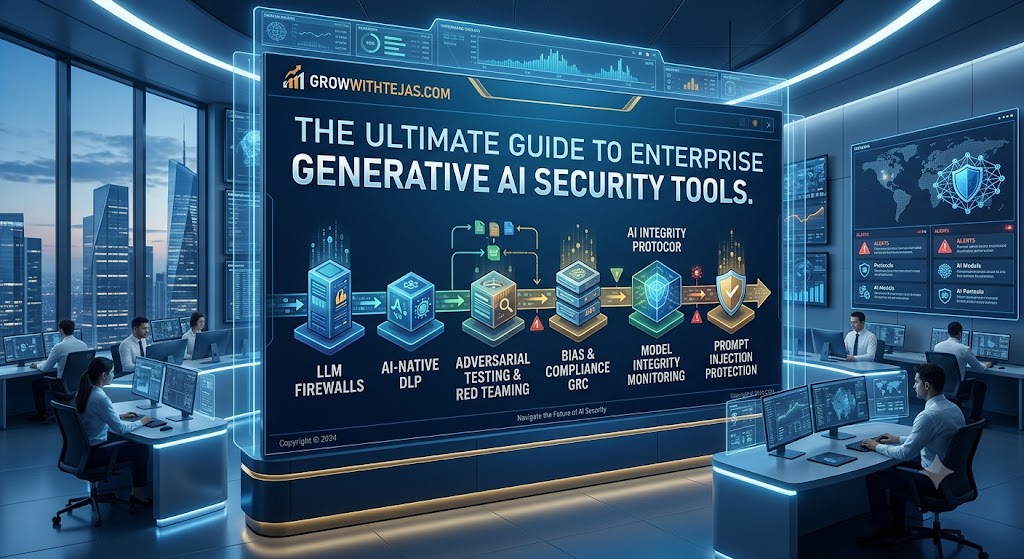
Enterprise Generative AI Security Tools: Everything You Need to Know
Generative AI has transformed how businesses work. Employees now use AI assistants for writing emails, generating code, analyzing documents, customer support, and automating workflows. However, with these benefits come significant security risks.
Organizations must protect sensitive information, prevent data leaks, ensure regulatory compliance, and monitor AI usage across their workforce. This is where enterprise generative AI security tools become essential.
In this guide, you’ll learn:
- What enterprise AI security tools are
- Why businesses need them
- Their key features
- Best AI security platforms
- Benefits
- Challenges
- Best practices for implementation
What Are Enterprise Generative AI Security Tools?
Enterprise generative AI security tools are software platforms designed to secure, monitor, govern, and control the use of generative AI applications within an organization.
These tools help companies:
- Prevent confidential data exposure
- Monitor employee AI usage
- Enforce security policies
- Detect risky prompts
- Protect intellectual property
- Meet compliance standards
- Secure AI-generated content
Rather than blocking AI completely, they enable businesses to use AI safely.
Why Enterprises Need AI Security Tools
Many employees use AI tools without IT approval, a practice often called Shadow AI.
Common risks include:
- Uploading confidential company documents
- Sharing customer information
- Exposing source code
- Violating GDPR or HIPAA
- Intellectual property leakage
- Prompt injection attacks
- AI-generated malware
- Compliance failures
Without proper monitoring, these risks can become expensive security incidents.
Key Features of Enterprise Generative AI Security Tools
1. Data Loss Prevention (DLP)
Detects and blocks sensitive information before it reaches AI systems.
Examples include:
- Credit card numbers
- Personal information
- Medical records
- Financial documents
- Trade secrets
2. Prompt Monitoring
Tracks prompts submitted by employees.
This helps identify:
- Suspicious requests
- Confidential data sharing
- Unsafe AI usage
- Policy violations
3. AI Access Control
Control who can access AI tools.
Organizations can:
- Restrict departments
- Require approval
- Block risky AI models
- Define user permissions
4. Policy Enforcement
Security teams can create rules such as:
- Never upload customer data
- Block source code sharing
- Prevent financial data exposure
- Restrict AI-generated confidential reports
5. AI Application Discovery
Many organizations don’t know how many AI applications employees use.
Security tools automatically discover:
- ChatGPT
- Gemini
- Claude
- Microsoft Copilot
- Perplexity
- DeepSeek
- Hundreds of browser-based AI tools
6. Compliance Monitoring
Ensure compliance with regulations including:
- GDPR
- HIPAA
- ISO 27001
- SOC 2
- PCI DSS
7. Threat Detection
Detect attacks such as:
- Prompt injection
- Jailbreak attempts
- Malicious prompts
- AI abuse
- Credential exposure
8. Activity Logging
Maintain detailed logs for:
- Audits
- Investigations
- Compliance reporting
- Security reviews
Best Enterprise Generative AI Security Tools
1. Microsoft Purview AI Security
Best for Microsoft 365 environments.
Features:
- AI governance
- Data loss prevention
- Compliance
- Insider risk management
- AI monitoring
2. Palo Alto Networks Prisma AI Security
Ideal for organizations already using Prisma Cloud.
Features:
- AI runtime protection
- Prompt inspection
- API security
- Model protection
- Threat detection
3. Netskope One
Excellent for secure AI access.
Capabilities include:
- AI app discovery
- Shadow AI monitoring
- DLP
- Secure web gateway
- CASB integration
4. Zscaler AI Security
Provides:
- Secure AI access
- Zero Trust architecture
- Prompt inspection
- Data protection
- Policy enforcement
5. CrowdStrike Falcon AI Security
Known for:
- Endpoint protection
- AI threat detection
- Identity security
- Incident response
- Risk analytics
6. Cisco AI Defense
Designed for enterprise AI protection.
Features include:
- AI model security
- Runtime monitoring
- Prompt validation
- Threat intelligence
- Compliance reporting
7. Symantec Data Loss Prevention
Protects organizations from:
- Data leakage
- Sensitive information exposure
- Insider threats
- AI-related data sharing
Benefits of Enterprise AI Security Platforms
Better Data Protection
Prevent accidental exposure of confidential information.
Regulatory Compliance
Meet industry regulations without slowing innovation.
Safe AI Adoption
Employees can use AI confidently within approved guidelines.
Reduced Cybersecurity Risks
Detect threats before they become incidents.
Improved Visibility
Know exactly how AI is being used across your organization.
Centralized Governance
Manage AI usage from a single dashboard.
Common Enterprise AI Security Challenges
Despite modern tools, organizations still face challenges.
Shadow AI
Employees use unauthorized AI tools.
Rapid AI Growth
New AI applications appear every week.
Compliance Complexity
Different countries require different regulations.
Third-Party Risks
External AI providers may store submitted data.
Employee Awareness
Many users don’t realize the risks of sharing sensitive information.
How to Choose the Right Enterprise AI Security Tool
Consider the following factors:
Scalability
Can it support thousands of employees?
Integration
Does it integrate with:
- Microsoft 365
- Google Workspace
- Slack
- Salesforce
- AWS
- Azure
AI Model Support
Ensure compatibility with:
- ChatGPT
- Claude
- Gemini
- Copilot
- Open-source LLMs
Compliance
Look for support for:
- GDPR
- HIPAA
- SOC 2
- ISO 27001
Reporting
Choose tools with real-time dashboards and audit reports.
Ease of Deployment
Cloud-native solutions often require less maintenance.
Best Practices for Securing Enterprise AI
Follow these recommendations:
- Develop a formal AI usage policy.
- Train employees on responsible AI use.
- Classify sensitive data before AI access.
- Enable Data Loss Prevention (DLP).
- Continuously monitor AI activity.
- Restrict access based on user roles.
- Audit AI usage regularly.
- Update security policies as AI evolves.
Future of Enterprise AI Security
The future of AI security is moving toward autonomous protection powered by AI itself.
Emerging trends include:
- AI-powered threat detection
- Automated policy enforcement
- Real-time prompt analysis
- Secure AI agents
- Zero Trust AI frameworks
- Explainable AI governance
- AI supply chain security
Organizations investing in AI governance today will be better prepared for future regulations and increasingly sophisticated cyber threats.
Final Thoughts
Generative AI is becoming a core part of modern business operations, but its adoption must be paired with strong security controls. Enterprise generative AI security tools help organizations protect sensitive data, manage compliance, detect threats, and govern AI usage without limiting innovation.
By implementing the right security platform, defining clear AI policies, and educating employees, businesses can unlock the benefits of generative AI while minimizing risk.
If your organization plans to scale AI initiatives, investing in a robust enterprise AI security solution is no longer optional—it’s a strategic necessity.
Frequently Asked Questions (FAQs)
1. What are enterprise generative AI security tools?
They are platforms that help organizations secure, monitor, and govern the use of generative AI applications while protecting sensitive data and ensuring compliance.
2. Why do businesses need AI security tools?
They reduce risks such as data leaks, prompt injection attacks, unauthorized AI usage, and regulatory violations.
3. What is Shadow AI?
Shadow AI refers to employees using AI tools without approval or oversight from the organization’s IT or security teams.
4. What features should an enterprise AI security tool include?
Key features include Data Loss Prevention (DLP), prompt monitoring, access control, policy enforcement, compliance reporting, threat detection, and activity logging.
5. Which industries benefit most from AI security tools?
Healthcare, finance, legal services, government, education, manufacturing, and technology companies all benefit from secure AI adoption.
6. Can AI security tools prevent data leaks?
Yes. Many platforms inspect prompts and responses to detect and block sensitive information before it is shared with AI models.
7. Do enterprise AI security tools support multiple AI platforms?
Most modern solutions support popular AI services such as ChatGPT, Microsoft Copilot, Gemini, Claude, and other large language models.
8. How do AI security tools help with compliance?
They enforce security policies, maintain audit logs, and help organizations meet standards like GDPR, HIPAA, SOC 2, ISO 27001, and PCI DSS.
9. What is prompt injection, and why is it dangerous?
Prompt injection is an attack where malicious instructions manipulate an AI model into revealing sensitive information or performing unintended actions.
10. How can organizations implement AI securely?
Create clear AI policies, deploy enterprise AI security tools, train employees, monitor AI usage continuously, and regularly review security controls.