Best Multi-Agent Orchestration Frameworks for Business
AI agents are moving beyond simple chatbots.
Instead of asking one AI model to handle an entire business process, companies can now create teams of specialized AI agents. One agent can research information, another can analyze it, another can interact with internal systems, and another can review the final output before an action is taken.
The difficult part isn’t necessarily building these agents.
It’s coordinating them.
That is where multi-agent orchestration frameworks come in.
For businesses exploring agentic AI, choosing the right framework can determine whether an AI workflow remains an interesting prototype or becomes a reliable system that can operate inside real business processes.
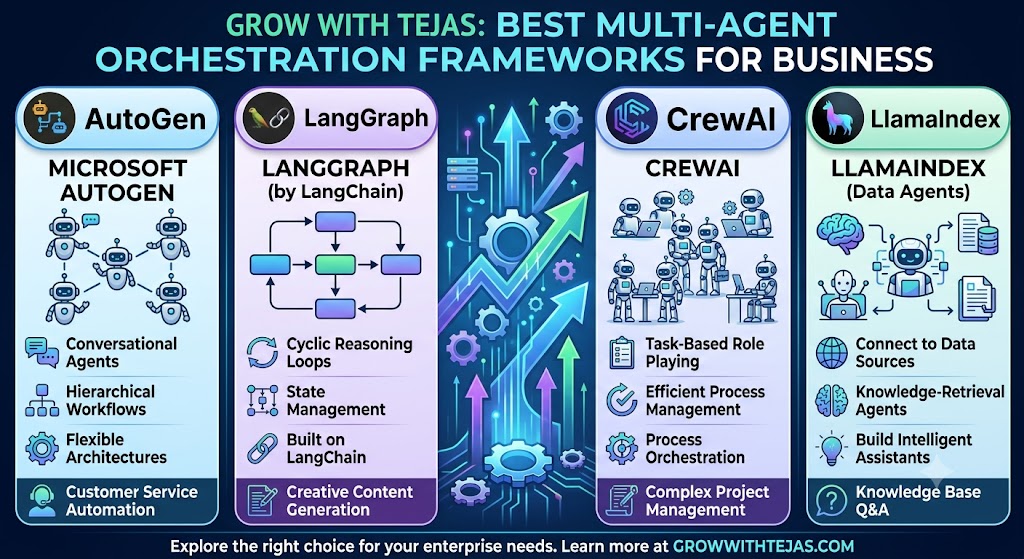
In this guide, we’ll compare the best multi-agent orchestration frameworks for business in 2026, including LangGraph, CrewAI, Microsoft Agent Framework, OpenAI Agents SDK, Google ADK, LlamaIndex Workflows, Mastra, and Agno.
We’ll also look at what multi-agent orchestration actually means, when businesses need it, and how to choose the right framework for your use case.
What Is a Multi-Agent Orchestration Framework?
A multi-agent system consists of multiple AI agents that collaborate to complete a task.
Each agent can have its own:
- instructions
- tools
- language model
- data access
- permissions
- memory or state
- business role
For example, imagine an AI-powered market research workflow.
Instead of creating one giant “market research agent,” a business could create:
Research Agent → Competitor Analysis Agent → Data Analyst Agent → Report Writer → Review Agent
Each agent specializes in one part of the process.
The orchestration framework determines how those agents communicate and how work moves between them.
It can control things such as:
- which agent runs first
- which agents run simultaneously
- what information gets passed between agents
- when an agent can use a tool
- how failures are handled
- how workflow state is stored
- when a human must approve an action
- when an agent should hand work to another agent
LangGraph, for example, represents agents as nodes within a graph and uses connections between those nodes to control workflow and state.
Think of the agents as employees and the orchestration framework as the operating system for coordinating their work.
Best Multi-Agent Orchestration Frameworks for Business: Quick Comparison
| Framework | Best For | Architecture | Business Fit | Learning Curve |
|---|---|---|---|---|
| LangGraph | Complex production workflows | Graph/state-based | Excellent | Medium–High |
| CrewAI | Role-based agent teams | Crews + flows | Excellent | Low–Medium |
| Microsoft Agent Framework | Microsoft/Azure enterprises | Agents + graph workflows | Excellent | Medium |
| OpenAI Agents SDK | OpenAI-native applications | Agents + handoffs | Excellent | Low–Medium |
| Google ADK | Google Cloud/Gemini ecosystems | Agent hierarchy + workflows | Very Good | Medium |
| LlamaIndex Workflows | Data/RAG-heavy agents | Event-driven workflows | Very Good | Medium |
| Mastra | TypeScript development teams | Agents + workflows | Very Good | Medium |
| Agno | Lightweight agent teams | Agents + teams | Good | Low–Medium |
There isn’t one universally “best” framework.
The right choice depends on how much control, infrastructure flexibility, observability, data integration, and developer abstraction your organization needs.
1. LangGraph — Best Overall for Complex Business Agent Workflows
Best for: Complex, stateful, production-grade AI workflows.
LangGraph is one of the strongest options for organizations building sophisticated agent systems where developers need precise control over execution.
Rather than allowing agents to freely communicate until they reach an answer, LangGraph allows developers to define the system as a graph.
A simplified customer-service workflow might look like:
Customer Request
↓
Classification Agent
↙ ↓ ↘
Billing Agent — Technical Agent — Account Agent
↓
Quality Check
↓
Human Approval if Required
↓
Response
Each node can represent an agent, function, tool, or business process.
This approach makes complicated workflows much easier to reason about.
Why LangGraph Is Strong for Business
Business workflows rarely involve completely unrestricted AI autonomy.
Companies normally need rules.
For example:
If a refund exceeds ₹50,000, send it for human approval.
Or:
If confidence is below 80%, escalate the case.
Or:
Run compliance and fraud checks simultaneously before processing the transaction.
Graph-based orchestration makes these conditions explicit.
LangGraph’s broader ecosystem also emphasizes capabilities important for production systems, including stateful execution, human-in-the-loop workflows, observability, evaluation, and durable execution. A 2026 LangChain comparison positions LangGraph particularly strongly for stateful multi-agent orchestration.
Advantages
- Excellent workflow control
- Strong state management
- Supports complex branching and loops
- Human-in-the-loop workflows
- Suitable for long-running agent processes
- Large LangChain ecosystem
- Model flexibility
- Strong debugging and observability options through the surrounding ecosystem
Limitations
The biggest disadvantage is complexity.
Developers need to think carefully about:
- nodes
- edges
- state
- routing
- persistence
- error handling
For a simple three-agent workflow, LangGraph can therefore feel heavier than necessary.
Best Business Use Cases
LangGraph works particularly well for:
- financial workflows
- compliance automation
- enterprise customer support
- AI research pipelines
- complex approval workflows
- supply-chain operations
- document processing
- internal AI assistants
- long-running autonomous processes
Verdict
Choose LangGraph when reliability and workflow control matter more than getting a prototype running as quickly as possible.
For sophisticated enterprise orchestration, it is one of the strongest choices available.
2. CrewAI — Best for Quickly Building Teams of AI Agents
Best for: Role-based business automation and rapid multi-agent development.
CrewAI approaches multi-agent systems differently.
Its mental model resembles a team of employees.
You define specialized agents with roles and responsibilities and then assign tasks to them.
Imagine a content marketing workflow.
You could create:
SEO Researcher
Finds keywords and competitor opportunities.
↓
Content Strategist
Creates the content outline.
↓
Writer
Produces the article.
↓
Editor
Reviews quality and accuracy.
↓
SEO Reviewer
Checks optimization.
That structure maps naturally to the way many businesses already think about teams.
CrewAI’s own getting-started material focuses on collaborative agent crews, agents, tasks and YAML-based configuration, making it relatively approachable for developers experimenting with multi-agent applications.
Crews and Flows
A useful aspect of CrewAI is the distinction between agent collaboration and workflow control.
Crews represent teams of agents collaborating on tasks.
Flows help developers structure the broader application workflow.
This combination makes CrewAI useful for business processes where some work is deterministic while other parts require agent reasoning.
Advantages
- Easy-to-understand agent architecture
- Fast development
- Good for role-based workflows
- Designed specifically around multi-agent collaboration
- Strong open-source community
- Useful enterprise tooling around the core framework
Limitations
The simplicity that makes CrewAI attractive can become a constraint for highly complicated systems.
Organizations needing extremely precise control over:
- state transitions
- branching
- long-running execution
- complicated failure recovery
may prefer a graph-oriented architecture such as LangGraph or Microsoft Agent Framework.
Best Business Use Cases
CrewAI works particularly well for:
- content production
- marketing automation
- sales research
- lead qualification
- competitive intelligence
- recruiting workflows
- report generation
- business research
- back-office automation
CrewAI has also published examples of enterprise applications spanning compliance reporting, support triage, healthcare intake, and e-commerce operations.
Verdict
CrewAI is one of the best frameworks for businesses that want to experiment with multi-agent automation quickly.
Its role-based approach makes the concept particularly easy to explain to both developers and business teams.
3. Microsoft Agent Framework — Best for Microsoft and Azure Enterprises
Best for: Enterprise organizations heavily invested in Microsoft technologies.
Microsoft’s agent ecosystem has changed significantly.
Historically, two important Microsoft projects were:
- AutoGen
- Semantic Kernel
Microsoft now describes Microsoft Agent Framework as the direct successor to both, combining AutoGen’s agent abstractions with enterprise capabilities associated with Semantic Kernel.
This distinction matters when comparing multi-agent frameworks in 2026.
Businesses researching older articles may still see AutoGen recommended heavily. For new Microsoft-centric projects, Microsoft Agent Framework deserves serious consideration.
What Makes Microsoft Agent Framework Interesting?
The framework combines agents with explicit workflows.
According to Microsoft’s documentation, workflows are intended for situations where processes have defined steps, explicit execution order, or multiple agents/functions that must coordinate.
It includes capabilities around:
- session-based state
- middleware
- telemetry
- graph workflows
- multi-agent coordination
- human-in-the-loop execution
- checkpoints
- long-running workflows
Microsoft’s documentation also covers integrations such as A2A and durable hosting options.
Advantages
- Strong Microsoft ecosystem integration
- Python and .NET orientation
- Explicit workflow orchestration
- Enterprise-focused state management
- Human-in-the-loop capabilities
- Telemetry and middleware
- Natural option for Azure-centric organizations
Limitations
The ecosystem is undergoing a transition from older Microsoft agent frameworks.
Teams with significant AutoGen or Semantic Kernel implementations need to understand migration paths rather than treating all three frameworks as interchangeable.
Microsoft provides specific migration guidance from AutoGen to Agent Framework.
Best Business Use Cases
Microsoft Agent Framework makes sense for:
- Microsoft-heavy enterprises
- Azure AI applications
- internal corporate copilots
- enterprise knowledge systems
- regulated workflows
- approval processes
- business process automation
Verdict
For organizations already standardized on Microsoft technologies, Microsoft Agent Framework is one of the most logical enterprise options.
4. OpenAI Agents SDK — Best for OpenAI-Native Agent Applications
Best for: Businesses building primarily around OpenAI models and tools.
Not every company wants a large orchestration abstraction.
Sometimes developers want a relatively small set of primitives that make it easy to build agents and hand tasks between them.
That’s where the OpenAI Agents SDK becomes attractive.
The SDK provides core concepts including:
- agents
- tools
- handoffs
- guardrails
- tracing
OpenAI introduced the SDK as a way to simplify the orchestration of multi-agent workflows, with handoffs allowing control to move between specialized agents and tracing helping developers understand what happened during execution.
Example
Imagine an AI customer-support system.
A Triage Agent receives the request.
If it identifies a billing problem:
→ Billing Agent
If it identifies a technical issue:
→ Technical Support Agent
If the customer wants to cancel:
→ Retention Agent
If the situation requires approval:
→ Human Agent
This handoff architecture can be easier to understand than implementing a large graph for relatively straightforward routing problems.
Advantages
- Relatively lightweight
- Clear multi-agent handoffs
- Built-in tracing
- Guardrail primitives
- Strong integration with OpenAI’s agent ecosystem
- Fast path from prototype to functional agent application
Limitations
Organizations should consider ecosystem dependence.
If your AI strategy requires constantly switching between many model providers, a more model-neutral orchestration layer may be preferable.
Best Business Use Cases
- customer-support agents
- internal AI assistants
- research agents
- sales assistants
- service routing
- operational copilots
- OpenAI-centric SaaS products
Verdict
Choose the OpenAI Agents SDK when your company already uses OpenAI heavily and you want straightforward agent delegation without adopting a much larger orchestration abstraction.
5. Google Agent Development Kit (ADK) — Best for Google Cloud Ecosystems
Best for: Organizations building agent systems around Google Cloud and Gemini.
Google’s Agent Development Kit provides another important option for businesses developing agentic applications.
ADK supports several orchestration concepts, including agents that can run sub-agents sequentially, in parallel, or in loops. Its ecosystem also supports Agent-to-Agent (A2A) communication for distributed multi-agent architectures.
This becomes useful when organizations move beyond one AI application and start building networks of specialized agents.
Example
Imagine an IT incident-response system.
Four agents might run simultaneously:
Log Analysis Agent
Infrastructure Agent
Past Incident Retrieval Agent
Customer Communication Agent
Their results can then be collected by a coordinator agent.
Google’s own agent tooling documentation uses parallel specialist agents for incident-response-style scenarios as an example of advanced multi-agent coordination.
Advantages
- Natural fit for Google Cloud
- Strong Gemini integration
- Sequential and parallel agent patterns
- A2A support
- Evaluation and observability ecosystem
- Useful deployment tooling
Limitations
Companies outside the Google ecosystem may find more provider-neutral frameworks easier to integrate into their existing infrastructure.
Best Business Use Cases
- Google Cloud workloads
- enterprise search
- incident response
- research systems
- data-analysis agents
- Gemini-based enterprise applications
- distributed agent systems
Verdict
Google ADK deserves serious consideration for organizations already building their AI infrastructure around Google Cloud and Gemini.
6. LlamaIndex Workflows — Best for Data-Heavy and RAG Agent Systems
Best for: AI workflows centered around enterprise documents and knowledge.
Many business agent systems ultimately revolve around data.
The agents need to:
- retrieve documents
- search databases
- extract information
- compare sources
- reason over retrieved context
- generate an answer or action
This is where LlamaIndex’s data-centric heritage becomes valuable.
Its workflow architecture is particularly relevant for applications built around retrieval-augmented generation (RAG), knowledge systems, and document-intensive pipelines.
A 2026 framework comparison from LangChain similarly characterizes LlamaIndex Workflows as particularly suited to event-driven orchestration for document-heavy and data-intensive pipelines.
Example
Consider an investment research platform.
Document Retrieval Agent
↓
Financial Data Agent
↓
Industry Research Agent
↓
Risk Analysis Agent
↓
Investment Memo Agent
The quality of that system depends heavily on getting reliable data into the agents.
That’s an area where LlamaIndex can be particularly useful.
Advantages
- Excellent for RAG
- Strong document/data ecosystem
- Event-driven workflows
- Useful for knowledge-intensive applications
- Good fit for enterprise search
Limitations
For workflows that have little to do with knowledge retrieval or documents, other orchestration frameworks may provide a more natural abstraction.
Best Business Use Cases
- enterprise knowledge assistants
- financial research
- legal document analysis
- knowledge management
- document processing
- RAG applications
- due diligence
Verdict
If your multi-agent system revolves around large amounts of proprietary knowledge, LlamaIndex should be high on your shortlist.
7. Mastra — Best for TypeScript Teams
Best for: JavaScript and TypeScript engineering teams.
A large percentage of modern SaaS applications are built with JavaScript and TypeScript.
Those teams don’t necessarily want to introduce a Python-heavy AI stack simply to implement agents.
Mastra targets this audience with a TypeScript-focused agent development framework combining concepts such as:
- agents
- workflows
- memory
- integrations
- development tooling
Recent framework comparisons increasingly position Mastra as a notable option for TypeScript teams building production agent applications.
Why This Matters for Businesses
Technology fit matters more than feature checklists.
If your engineering organization already builds with:
- TypeScript
- Node.js
- React
- Next.js
using a TypeScript-native agent framework can simplify hiring, development, deployment, and maintenance.
Advantages
- TypeScript-first
- Familiar developer experience for web teams
- Agents and workflows in the same ecosystem
- Good fit for SaaS development
Limitations
Its ecosystem is younger than some of the more established AI orchestration projects.
Organizations should evaluate maturity, integrations, deployment requirements, and observability needs against their specific production workload.
Best Business Use Cases
- SaaS AI features
- internal business applications
- TypeScript-heavy organizations
- AI workflow products
- customer-facing AI agents
Verdict
Mastra is worth evaluating when your development organization is already deeply invested in TypeScript.
8. Agno — Best for Lightweight Agent Teams
Best for: Developers wanting a relatively lightweight approach to agents and agent teams.
Not every application requires an elaborate orchestration engine.
For smaller teams, simplicity can be an advantage.
Agno provides abstractions for building agents and organizing agents into teams, making it an interesting alternative for developers who want multi-agent capabilities without immediately adopting a highly complex architecture.
Advantages
- Developer-friendly
- Suitable for agent teams
- Fast experimentation
- Useful for smaller AI applications
Limitations
Large enterprises should evaluate its surrounding ecosystem carefully against requirements such as:
- governance
- observability
- security
- durable execution
- enterprise integrations
- operational support
Best Business Use Cases
- startup AI products
- internal automation
- research agents
- lightweight agent teams
- rapid prototypes
Verdict
Agno is an interesting option when development speed and simplicity matter more than heavyweight orchestration infrastructure.
LangGraph vs CrewAI vs Microsoft Agent Framework vs OpenAI Agents SDK
For many businesses, the final decision will come down to four frameworks.
| Requirement | Best Choice |
|---|---|
| Complex stateful workflows | LangGraph |
| Fast role-based multi-agent development | CrewAI |
| Microsoft/Azure enterprise environment | Microsoft Agent Framework |
| OpenAI-native application | OpenAI Agents SDK |
| Google Cloud/Gemini environment | Google ADK |
| Document/RAG-heavy application | LlamaIndex |
| TypeScript development team | Mastra |
The most important thing is not choosing the framework with the longest feature list.
Choose the architecture that matches your workflow.
How Businesses Should Choose a Multi-Agent Framework
Before choosing a framework, ask seven questions.
1. Do You Actually Need Multiple Agents?
This is the most important question.
Multi-agent systems sound impressive, but more agents don’t automatically produce better results.
Microsoft’s own Agent Framework documentation gives developers surprisingly sensible advice: if a normal function can handle the task, use a function rather than an AI agent.
The same principle applies to multi-agent architectures.
If one agent with five tools can reliably complete the workflow, you probably don’t need five agents.
Use multiple agents when specialization provides a meaningful benefit.
2. How Predictable Is the Workflow?
Consider two processes.
Workflow A
Research → Analyze → Write → Review → Publish
The structure is predictable.
A graph or workflow-based architecture works well.
Workflow B
“Investigate why our customer churn increased.”
The system may need to dynamically decide whether to:
- query analytics
- interview CRM data
- analyze support tickets
- investigate pricing
- compare competitors
That workflow requires more autonomous reasoning.
Your orchestration architecture should reflect the difference.
3. Do You Need Human Approval?
For business automation, the answer is often yes.
Consider agents capable of:
- issuing refunds
- sending contracts
- changing customer accounts
- modifying infrastructure
- purchasing inventory
These actions should not necessarily happen autonomously.
A production-ready architecture should support:
Agent Decision
↓
Approval Required
↓
Human Review
↓
Approve / Reject
↓
Continue Workflow
Human-in-the-loop orchestration is therefore an important criterion for enterprise deployments.
4. What Happens When an Agent Fails?
This question separates prototypes from production systems.
Suppose a workflow contains eight agents.
Agent seven fails.
Does the entire workflow restart?
That could mean repeating:
- API requests
- LLM calls
- database queries
- expensive analysis
A strong production architecture should consider checkpointing and resumability.
This is one reason state management and durable workflows matter.
5. Which Models Will You Use?
Some organizations standardize on one provider.
Others use multiple models.
For example:
Research Agent → Gemini
Reasoning Agent → OpenAI
Internal Document Agent → Claude
Classification Agent → Small open-source model
If model flexibility is strategically important, evaluate how tightly your framework couples you to a particular provider.
6. How Will You Monitor the Agents?
Imagine an agent workflow makes the wrong decision.
You need to know:
- which agent made the decision
- what information it received
- which tools it called
- how long each step took
- how many tokens were consumed
- where the workflow failed
Observability isn’t optional once agents start touching business processes.
Framework selection should therefore include the debugging, tracing and evaluation ecosystem surrounding the framework—not just how quickly you can write the initial agent.
7. What Will the System Cost?
A five-agent workflow can potentially make many more model calls than a single-agent application.
Your real cost may include:
LLM usage + vector database + API calls + orchestration infrastructure + observability + storage + engineering
Agent architecture should therefore optimize for business outcomes, not maximum autonomy.
Sometimes the best optimization is simply removing an unnecessary agent.
Example: Multi-Agent Orchestration for Sales
Let’s look at a realistic business workflow.
A company wants AI to identify and qualify potential customers.
Agent 1: Lead Research Agent
Collects company information.
↓
Agent 2: Qualification Agent
Evaluates company size, industry, location, and buying signals.
↓
Agent 3: CRM Agent
Checks whether the company already exists in the CRM.
↓
Agent 4: Personalization Agent
Researches relevant pain points.
↓
Agent 5: Outreach Agent
Drafts personalized communication.
↓
Agent 6: Compliance Agent
Checks communication policies.
↓
Human Approval
↓
CRM Update / Outreach
The orchestration layer manages the entire sequence.
It can also introduce conditional routing.
For example:
Lead score > 80
→ send to sales representative.
Lead score 50–80
→ add to nurture workflow.
Lead score < 50
→ archive.
This is where multi-agent systems become much more interesting than simple chatbots.
They begin functioning as AI-powered business processes.
Where Multi-Agent Systems Can Deliver Business Value
Multi-agent orchestration can be applied across departments.
Marketing
Research Agent → SEO Agent → Writer → Editor → Distribution Agent
Sales
Prospecting Agent → Research Agent → Qualification Agent → Outreach Agent → CRM Agent
Customer Support
Triage Agent → Knowledge Agent → Specialist Agent → Resolution Agent → QA Agent
Finance
Invoice Agent → Validation Agent → Fraud Agent → Approval Agent → ERP Agent
Recruiting
Resume Agent → Candidate Research Agent → Screening Agent → Scheduling Agent
Software Development
Planning Agent → Coding Agent → Testing Agent → Security Agent → Review Agent
Business Intelligence
Data Agent → Analysis Agent → Forecasting Agent → Report Agent
This modular approach allows organizations to automate increasingly sophisticated workflows while keeping responsibilities separated.
The Biggest Mistake Businesses Make With Multi-Agent AI
The biggest mistake is assuming:
More agents = better AI.
It doesn’t.
Every additional agent creates additional:
- latency
- model calls
- failure points
- prompts
- context transfers
- monitoring requirements
- security considerations
Start with the simplest architecture capable of solving the problem.
A sensible progression is:
Step 1: Normal automation
↓
Step 2: Automation + LLM
↓
Step 3: Single AI agent + tools
↓
Step 4: Agent + deterministic workflow
↓
Step 5: Multiple specialized agents
Multi-agent architecture should be the result of a genuine coordination problem—not the starting assumption.
Best Multi-Agent Orchestration Framework by Business Type
Startup
Start with CrewAI or OpenAI Agents SDK.
Both can help teams move quickly without designing an elaborate orchestration architecture from day one.
Large Enterprise
Consider LangGraph or Microsoft Agent Framework.
Complex organizations typically require stronger workflow control, state management, observability, governance, and human approval.
Microsoft-Centric Enterprise
Choose Microsoft Agent Framework.
Its direction is specifically designed around Microsoft’s next generation of enterprise agent development.
Google Cloud Company
Consider Google ADK.
It fits naturally with Google’s growing agent and cloud ecosystem.
Knowledge-Heavy Company
Consider LlamaIndex Workflows.
It is especially compelling when your AI agents need to reason over large amounts of proprietary information.
TypeScript SaaS Company
Consider Mastra.
Keeping your AI stack within TypeScript can reduce unnecessary engineering complexity.
Highly Complex AI Automation
Choose LangGraph.
Its explicit state and graph architecture provides developers with fine-grained control over sophisticated workflows.
So, What Is the Best Multi-Agent Orchestration Framework for Business?
If I had to reduce the market to a shortlist, it would look like this:
Best overall for complex orchestration: LangGraph
Best for rapid multi-agent development: CrewAI
Best for Microsoft enterprises: Microsoft Agent Framework
Best for OpenAI-native applications: OpenAI Agents SDK
Best for Google Cloud: Google ADK
Best for data and RAG workflows: LlamaIndex
Best for TypeScript teams: Mastra
There is no framework that wins every category.
And that is actually a good thing.
Businesses shouldn’t choose agent infrastructure because one framework is currently popular on GitHub or social media.
They should choose based on the workflow they need to automate.
Final Thoughts
The next stage of business AI isn’t simply about building smarter chatbots.
It’s about connecting AI models, tools, data, APIs, business rules, humans, and specialized agents into reliable workflows.
That makes orchestration one of the most important layers of the agentic AI stack.
Frameworks such as LangGraph, CrewAI, Microsoft Agent Framework, OpenAI Agents SDK, Google ADK, LlamaIndex, and Mastra are taking different approaches to solving that problem.
But don’t begin by asking:
“Which multi-agent framework should we use?”
Begin with:
“What business process are we trying to improve?”
Map the workflow.
Identify where reasoning is required.
Identify where deterministic software is better.
Identify which tasks genuinely benefit from specialized agents.
Then choose the orchestration framework.
That approach will save your business far more time—and probably far more money—than chasing whichever agent framework happens to be trending this month.
FAQs About Multi-Agent Orchestration Frameworks
What is the best multi-agent orchestration framework?
LangGraph is one of the strongest choices for complex, stateful production workflows, while CrewAI is particularly attractive for quickly building role-based teams of agents. Microsoft Agent Framework is compelling for Microsoft enterprises, and OpenAI Agents SDK is a strong option for OpenAI-centric applications.
What is multi-agent orchestration?
Multi-agent orchestration is the process of coordinating multiple AI agents so they can collaborate on a larger task. The orchestration layer determines execution order, communication, state management, tool access, routing, approvals, and failure handling.
Is LangGraph better than CrewAI?
Neither is universally better. LangGraph provides more explicit control over complex stateful workflows, while CrewAI provides an easier role-based abstraction for creating collaborative agent teams. LangGraph generally makes more sense when orchestration complexity is high; CrewAI can be faster for straightforward business automation.
Is AutoGen still worth using?
AutoGen remains important historically and existing systems may continue to use it. However, Microsoft now describes Microsoft Agent Framework as the direct successor to AutoGen and Semantic Kernel and provides migration guidance for existing AutoGen applications.
Can multiple AI agents use different LLMs?
Yes. Depending on the framework and architecture, specialized agents can potentially use different models or model providers. This allows businesses to optimize individual tasks for cost, speed, capabilities, or infrastructure requirements.
Do businesses really need multi-agent AI?
Not always. Many business workflows can be handled more reliably with traditional software, a single LLM call, or one agent with several tools. Multi-agent systems become valuable when a task genuinely benefits from specialization, delegation, parallel execution, independent review, or complex routing.
What is the difference between an AI agent framework and an orchestration framework?
An AI agent framework provides tools for creating agents that can reason and use tools. An orchestration framework focuses on coordinating how agents, functions, tools, humans, and workflows interact. Modern platforms increasingly provide both capabilities within the same framework.
Are multi-agent systems ready for enterprise use?
They can be, but enterprise readiness depends on much more than whether agents can communicate. Businesses need reliable state management, permissions, observability, security controls, evaluations, failure recovery, human approval mechanisms, and cost monitoring before deploying agents into critical processes.