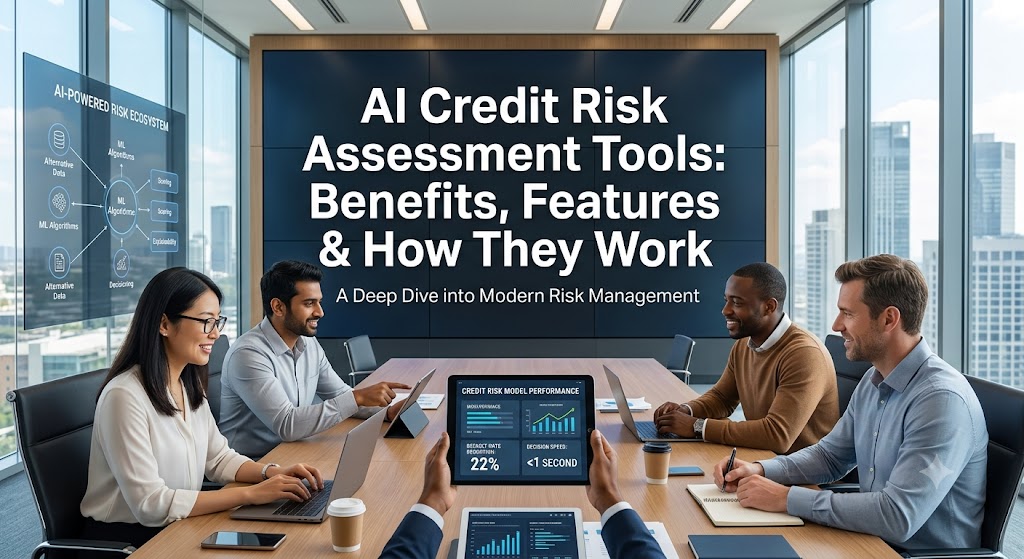
AI Credit Risk Assessment Tools: How AI Is Changing Credit Risk Decisions
Credit risk assessment has traditionally depended on financial statements, credit scores, repayment history, and manual analysis. While these methods remain important, businesses today have access to much larger volumes of financial and behavioral data than traditional credit models were designed to process.
This is where AI credit risk assessment tools are becoming increasingly useful.
By applying artificial intelligence and machine learning to credit data, these tools can help lenders and businesses identify risk patterns, evaluate borrowers more efficiently, and support faster credit decisions.
But how do AI-powered credit risk tools actually work? What benefits do they offer, and what should businesses consider before adopting one?
This guide explains the essentials.
What Are AI Credit Risk Assessment Tools?
AI credit risk assessment tools are software solutions that use artificial intelligence, machine learning, and data analytics to estimate the likelihood that a borrower will repay a loan or meet other credit obligations.
Traditional credit assessment typically evaluates factors such as credit history, income, existing debt, financial statements, collateral, and repayment behavior.
AI-based systems can analyze many of these same factors while also processing larger and more complex datasets. Depending on the use case and applicable regulations, this can include transaction patterns, cash-flow data, account activity, business performance indicators, and other relevant information.
The goal isn’t necessarily to replace conventional credit analysis. Instead, AI can help organizations process information more efficiently and give credit teams additional insights for decision-making.
How Does AI Credit Risk Assessment Work?
An AI-powered credit assessment system typically starts by collecting relevant borrower and financial data.
The system then processes that information using statistical models, machine-learning algorithms, or a combination of different analytical techniques.
A simplified process may look like this:
1. Data collection
The system gathers information relevant to the credit decision. This could include financial records, repayment history, credit bureau information, banking transactions, or business performance data.
2. Data processing
The information is cleaned, standardized, and organized so that the model can analyze it consistently.
3. Risk analysis
Machine-learning models identify patterns and relationships within the data that may be associated with repayment performance or default risk.
4. Risk scoring
The borrower may receive a risk score, probability of default estimate, risk category, or another decision-support metric.
5. Credit decision support
Credit teams can use these results alongside internal lending policies, human review, regulatory requirements, and other relevant factors.
Some systems can also continue monitoring borrower data after a loan has been approved, helping lenders identify potential changes in risk.
Why Are Businesses Using AI for Credit Risk Assessment?
Credit decisions often involve a difficult balance.
Businesses want to make decisions quickly, but they also need enough information to understand the risks involved.
Manual credit assessment can become time-consuming when analysts have to examine large amounts of financial information across many applicants.
AI can help automate parts of this process.
For example, instead of manually reviewing hundreds or thousands of transaction records, an AI system may be able to identify unusual cash-flow patterns, changes in payment behavior, or other signals that deserve closer attention.
This can allow credit professionals to spend more time investigating complex cases rather than performing repetitive data-processing tasks.
Key Benefits of AI Credit Risk Assessment Tools
1. Faster Credit Decisions
One of the biggest advantages of AI credit risk assessment is speed.
AI systems can process large amounts of information much faster than a purely manual workflow. For lenders handling high application volumes, this can shorten the time required to complete initial risk assessments.
Faster analysis can also improve the customer experience, particularly in digital lending environments where borrowers increasingly expect quick decisions.
2. Analysis of Larger Data Sets
Traditional credit models often rely on a relatively limited set of variables.
AI models can potentially evaluate a much wider range of information.
For business lending, for example, relevant information might include revenue patterns, cash-flow volatility, repayment history, account balances, debt obligations, and industry-related factors.
Analyzing multiple variables together can provide a more detailed view of a borrower’s financial position.
3. More Consistent Assessment
Human judgment is valuable in credit analysis, but manual processes can produce inconsistencies.
Different analysts may interpret the same information differently.
AI-based systems can apply the same analytical framework across applications, helping organizations create a more standardized assessment process.
Human oversight remains important, particularly when the consequences of a lending decision are significant.
4. Earlier Identification of Risk Signals
Credit risk doesn’t end when a loan is approved.
A borrower’s financial circumstances can change over time.
AI-powered monitoring systems may help identify changes in transaction activity, repayment patterns, cash flow, or other relevant indicators.
These signals can give credit teams an opportunity to investigate potential deterioration before the problem becomes more serious.
5. Improved Operational Efficiency
Credit teams frequently spend significant time collecting information, entering data, checking documents, and performing repetitive calculations.
Automation can reduce some of this administrative workload.
Instead of replacing credit professionals, well-designed AI systems can function as decision-support tools that help analysts concentrate on cases requiring deeper investigation and judgment.
AI Credit Risk Assessment vs Traditional Credit Scoring
Traditional credit scoring and AI-based credit assessment have the same broad objective: estimating creditworthiness and potential repayment risk.
The major difference lies in how the analysis is performed.
| Factor | Traditional Credit Assessment | AI Credit Risk Assessment |
|---|---|---|
| Data volume | Usually limited | Can process larger datasets |
| Analysis | Rules and statistical models | May use machine learning and advanced analytics |
| Processing speed | Can involve manual review | Greater potential for automation |
| Monitoring | Often periodic | Can support more frequent monitoring |
| Model complexity | Generally easier to interpret | Can be more complex |
| Human involvement | Usually significant | Varies depending on implementation |
AI isn’t automatically better in every situation.
A sophisticated model built on poor-quality data can still produce poor results. Likewise, a highly accurate model may create governance problems if an organization cannot adequately explain or validate how it operates.
The effectiveness of any credit risk system depends on the quality of its data, models, controls, and implementation.
Common Features of AI Credit Risk Assessment Tools
Different platforms offer different capabilities, but businesses evaluating AI credit risk assessment tools may encounter features such as:
- Automated borrower risk scoring
- Probability-of-default estimation
- Financial statement analysis
- Cash-flow and transaction analysis
- Credit application automation
- Portfolio risk monitoring
- Early-warning indicators
- Fraud and anomaly detection
- Risk dashboards and reporting
- API integrations with existing financial systems
- Model monitoring and validation capabilities
- Explainability or reason-code features
The right combination of features depends heavily on the organization’s lending model and risk-management requirements.
A small business lender, for example, may prioritize cash-flow analysis and fast application processing, while a larger financial institution may place greater emphasis on model governance, auditability, integrations, and portfolio monitoring.
What Data Can AI Credit Risk Models Analyze?
The effectiveness of an AI credit risk model depends heavily on the information available to it.
Depending on the organization, borrower type, consent framework, and regulatory environment, relevant data may include:
Credit bureau data: Existing loans, payment history, credit utilization, defaults, and other credit-related information.
Financial statements: Revenue, profit, liabilities, assets, working capital, and other indicators of financial health.
Banking and transaction data: Cash inflows and outflows, account balances, payment patterns, and liquidity trends.
Loan performance data: Historical information showing how similar borrowers performed after receiving credit.
Business information: Company age, industry, business performance, and other relevant commercial factors.
More data doesn’t automatically produce a better model.
Data quality, relevance, representativeness, privacy, and governance can be just as important as volume.
Challenges and Risks of AI-Based Credit Assessment
Despite its potential, AI introduces several challenges that businesses should understand.
Data Quality
AI models learn from data.
If historical data is inaccurate, incomplete, outdated, or unrepresentative, the resulting predictions may be unreliable.
Strong data management therefore needs to be part of any AI credit risk strategy.
Bias and Fairness
Historical lending data can contain patterns that lead to unfair outcomes if they are reproduced by automated systems.
Organizations need processes for testing models, monitoring outcomes, and identifying potential bias.
Explainability
Credit decisions can have significant financial consequences.
Businesses may need to understand why a model generated a particular result rather than relying on an unexplained score.
This makes explainable AI particularly important in credit risk management.
Regulatory Compliance
Lending and credit decisions are subject to regulations that vary by jurisdiction.
Organizations considering AI should evaluate requirements relating to areas such as consumer protection, privacy, automated decision-making, model governance, data usage, and adverse-action explanations where applicable.
Model Drift
Borrower behavior and economic conditions change.
A model that performs well today may become less reliable if the environment changes significantly.
Models therefore need ongoing monitoring, testing, validation, and recalibration where necessary.
How to Choose an AI Credit Risk Assessment Tool
Businesses shouldn’t choose a platform simply because it advertises advanced AI.
The technology needs to fit the organization’s actual credit workflow.
Before selecting a solution, consider the following questions:
Does it work with your existing data?
A powerful model is of little use if your organization cannot provide the information it requires.
Can the results be explained?
Look for systems that provide interpretable outputs, supporting factors, or reason codes rather than only producing a score.
How is model performance measured?
Understand how the vendor tests accuracy, validates models, monitors performance, and handles model drift.
Can it integrate with existing systems?
Integration with loan origination platforms, CRMs, banking systems, data providers, or internal risk infrastructure can significantly affect implementation.
How does the provider handle data security?
Credit assessment involves sensitive information, making privacy, security, access controls, and data governance critical considerations.
Does it support human review?
For many lending environments, AI works best as part of a broader decision-making framework rather than as an uncontrolled replacement for human judgment.
Can the system scale?
Consider whether the platform can support higher application volumes, new products, or additional markets as the business grows.
Can AI Replace Credit Risk Analysts?
AI is more likely to change the role of credit analysts than eliminate it entirely.
Machines are particularly effective at processing large datasets, identifying patterns, performing repetitive calculations, and generating risk indicators.
Humans remain important for tasks involving context, judgment, unusual circumstances, policy interpretation, model oversight, and complex borrower relationships.
A practical model is therefore AI-assisted credit decision-making.
The technology performs data-intensive analysis while experienced professionals review the results and make decisions within the organization’s risk framework.
The Future of AI in Credit Risk Management
AI credit risk assessment is likely to become increasingly integrated into broader lending and risk-management systems.
Future platforms may combine credit scoring, real-time financial data, portfolio monitoring, fraud detection, and early-warning systems within a single workflow.
Explainability is also likely to remain a major focus.
Organizations won’t only want models that generate accurate predictions. They will increasingly need systems that can demonstrate how those predictions were produced, how models are governed, and whether outcomes remain reliable over time.
As financial data becomes more accessible and analytical technology improves, credit assessment may shift from occasional reviews toward more continuous forms of risk monitoring.
Frequently Asked Questions About AI Credit Risk Assessment Tools
What is an AI credit risk assessment tool?
An AI credit risk assessment tool uses artificial intelligence, machine learning, or advanced analytics to analyze borrower information and estimate credit risk. It can help lenders evaluate applications, generate risk indicators, and monitor existing borrowers.
How does AI improve credit risk assessment?
AI can process larger datasets, automate repetitive analysis, identify complex patterns, and help organizations make credit assessments more efficiently. Its effectiveness depends on data quality, model design, governance, and human oversight.
Are AI credit risk assessment tools accurate?
They can achieve strong predictive performance when trained and validated using appropriate data. However, no credit risk model is perfectly accurate, and performance can change as economic conditions and borrower behavior evolve.
What are the risks of using AI for credit decisions?
Important risks include poor data quality, algorithmic bias, limited explainability, privacy concerns, regulatory compliance issues, cybersecurity risks, and model drift.
Can small businesses use AI for credit risk assessment?
Yes. AI-based credit tools aren’t limited to large banks. Fintech companies, alternative lenders, B2B businesses, and other organizations extending credit may use these technologies, depending on their needs, resources, data availability, and regulatory obligations.
Will AI replace traditional credit scoring?
Probably not completely. Traditional scoring techniques remain useful and well established. AI is more likely to complement or extend existing credit assessment methods by analyzing additional data and supporting faster, more dynamic risk analysis.
Final Thoughts
AI credit risk assessment tools are changing how businesses approach lending and credit risk management.
Their biggest advantage isn’t simply automation. It is the ability to process large amounts of financial information, identify patterns, and turn that information into insights that credit teams can use more efficiently.
However, AI should not be treated as a shortcut to better lending decisions.
Data quality, explainability, fairness, model validation, regulatory compliance, and human oversight all remain essential.
For businesses evaluating AI-powered credit assessment, the most useful question isn’t “Can AI make our credit decisions?”
It is:
“How can AI help us make better-informed, faster, and more consistent credit decisions while maintaining appropriate controls?”
That approach puts AI where it can provide the most value—as a powerful tool supporting sound credit risk management.