AI Medical Diagnostic Software Cost
AI Medical Diagnostic Software Cost: Quick Answer
The cost to develop AI medical diagnostic software typically ranges from $80,000 to $500,000+ in 2026. At an indicative exchange rate of about ₹95.7 per US dollar in August 2026, that is roughly ₹77 lakh to ₹4.79 crore+.
A narrow proof of concept may cost $25,000–$60,000, while a regulated, enterprise-grade diagnostic platform involving proprietary clinical data, hospital integrations, prospective validation and regulatory submissions can require $500,000 to several million dollars.
| Project level | Typical cost | Approximate cost in INR* | Typical timeline |
|---|---|---|---|
| Feasibility study or proof of concept | $25,000–$60,000 | ₹24–₹57 lakh | 2–4 months |
| Diagnostic AI MVP | $80,000–$150,000 | ₹77 lakh–₹1.44 crore | 4–8 months |
| Production-ready clinical platform | $200,000–$500,000 | ₹1.91–₹4.79 crore | 9–18 months |
| Regulated, multi-site enterprise product | $500,000–$2 million+ | ₹4.79–₹19.14 crore+ | 18–36+ months |
*INR figures are rounded estimates using approximately ₹95.7 per US dollar and will change with exchange rates. These ranges are planning benchmarks, not vendor quotations. Regulatory strategy, clinical evidence and intended use can move a project outside them.
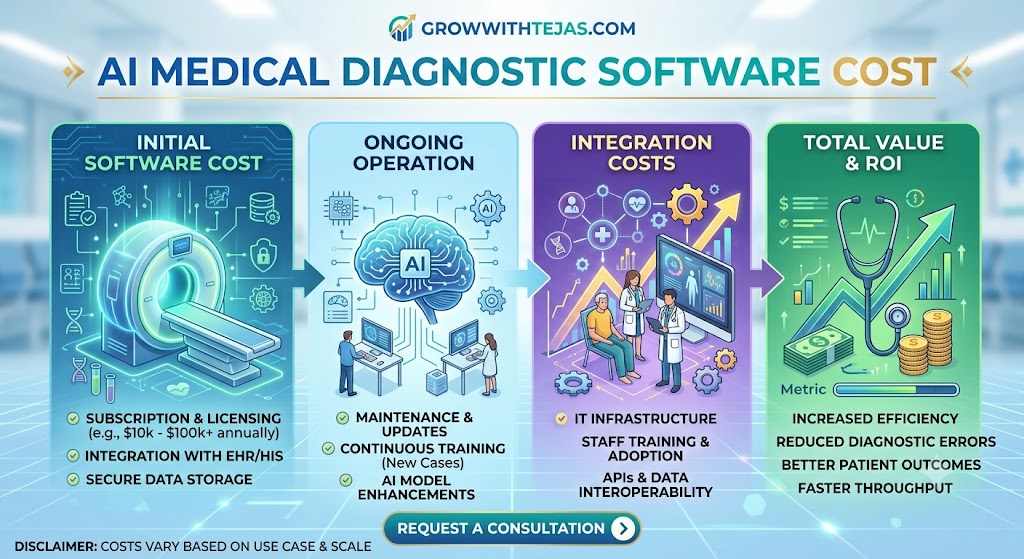
The most important budgeting lesson is simple: the AI model is only one part of the total cost. Medical data preparation, clinical validation, quality management, cybersecurity, regulatory documentation, workflow integration and post-market monitoring can cost as much as—or more than—the first model.
What Is AI Medical Diagnostic Software?
AI medical diagnostic software analyses health information to identify abnormalities, estimate disease risk, prioritise cases or support a clinician’s diagnosis. Depending on its intended use, it may process:
- X-rays, CT scans, MRI scans, ultrasound or retinal images;
- pathology slides and microscopy images;
- ECG, EEG and other physiological signals;
- laboratory results and biomarkers;
- symptoms, clinical notes and medical histories; or
- multimodal combinations of images, text, signals and structured records.
Examples include an algorithm that flags a possible lung nodule on a CT scan, a digital pathology system that highlights suspicious tissue, and a clinical decision-support tool that estimates sepsis risk.
The phrase “diagnostic software” matters. A general wellness chatbot and software intended to influence a clinical diagnosis have very different safety, evidence and regulatory requirements. In the United States, some clinical decision-support functions may fall outside the definition of a medical device, while many patient-facing or device-like functions remain under FDA oversight. Product classification should therefore be determined from the exact intended use, users, inputs, outputs and clinical claims—not from the fact that the product contains AI.
AI Diagnostic Software Cost by Product Type
1. Medical imaging AI
Estimated cost: $150,000–$700,000+
Medical imaging systems analyse radiology, ophthalmology, dermatology or ultrasound images. Costs rise because developers need large, correctly labelled datasets, imaging specialists, DICOM support, PACS/RIS integration, performance testing across scanner models and validation across patient subgroups.
A single-condition triage model using a licensed dataset may stay near the lower end. A multi-condition platform for several imaging modalities and hospital networks can exceed the upper end.
2. AI pathology software
Estimated cost: $200,000–$1 million+
Digital pathology involves extremely large whole-slide images, specialised storage and compute infrastructure, stain and scanner variability, and expert annotation by pathologists. Companion diagnostics or systems used in cancer treatment decisions may also require extensive analytical and clinical evidence.
3. Symptom checker or AI triage system
Estimated cost: $60,000–$250,000
A limited triage assistant with predetermined protocols costs less than a multilingual, generative AI platform that connects to patient records and recommends next steps. Patient-facing tools require careful escalation rules, safety testing, privacy controls and clear communication of uncertainty.
4. Predictive diagnostic analytics
Estimated cost: $100,000–$500,000+
These systems use EHR, laboratory, monitoring or claims data to predict events such as deterioration, readmission or sepsis. Data harmonisation and integration are major cost centres because hospitals often store information in different formats and use different clinical workflows.
5. Laboratory or genomic diagnostic AI
Estimated cost: $150,000–$800,000+
Costs depend on assay complexity, data volume, laboratory information system integration, reproducibility studies and whether the software forms part of an in-vitro diagnostic workflow.
6. Multimodal diagnostic platform
Estimated cost: $400,000–$2 million+
Combining images, clinical text, laboratory results and patient history can improve context, but it creates more integration, validation and explainability work. Each data source introduces another potential failure mode and another set of access and governance requirements.
Detailed Cost Breakdown
| Cost component | Typical budget range | What it covers |
| Discovery and regulatory strategy | $10,000–$40,000 | Intended use, users, risk, claims, classification and development plan |
| UX and clinical workflow design | $10,000–$40,000 | Research, prototypes, clinician interfaces and usability testing |
| Data acquisition and licensing | $10,000–$250,000+ | Dataset access, consent constraints and commercial-use rights |
| Data cleaning and annotation | $20,000–$300,000+ | De-identification, labelling, adjudication and quality control |
| AI model development | $40,000–$200,000+ | Experiments, training, evaluation and optimisation |
| Application and backend engineering | $50,000–$250,000+ | APIs, user management, dashboards, audit logs and reporting |
| EHR, PACS, LIS or device integration | $10,000–$150,000+ | HL7/FHIR, DICOM, vendor APIs and interface testing |
| Security and privacy engineering | $15,000–$80,000+ | Encryption, access control, logging, threat modelling and testing |
| Verification and validation | $30,000–$200,000+ | Software testing, model testing, usability and traceability |
| Clinical performance studies | $50,000–$1 million+ | Study design, sites, investigators, data and statistical analysis |
| Regulatory and quality documentation | $30,000–$250,000+ | QMS, risk files, technical documentation and submission support |
| Cloud and MLOps setup | $10,000–$75,000+ | Deployment, monitoring, model registry and rollback controls |
These categories overlap in practice. For example, a clinical study may generate new data that must be relabelled, analysed and incorporated into regulatory documentation.
The 10 Biggest Cost Drivers
1. Intended use and patient risk
Software that organises information for a clinician is cheaper to develop and validate than software that independently identifies a disease or directs urgent treatment. A higher-risk claim usually means stricter controls, stronger evidence and a more demanding regulatory pathway.
2. Medical data availability
Teams often underestimate the cost of obtaining representative, legally usable data. A hospital may have millions of records, but that does not mean the data are clean, consistently labelled, consented for the planned use or licensed for commercial model development.
3. Annotation by medical specialists
Radiologists, pathologists and other specialists are more expensive than general data annotators. Difficult cases may need two or three independent reviews plus an adjudication process to establish a reliable reference standard.
4. Model complexity
Fine-tuning an existing model for a narrow task may be economical. Building a novel multimodal architecture, training on high-resolution images or running real-time inference increases research, compute and validation costs.
5. Required clinical evidence
Retrospective testing on an existing dataset is not equivalent to validation in real clinical use. Multi-site, prospective or interventional studies can add hundreds of thousands of dollars and extend the timeline substantially.
6. Regulatory pathway
In the US, an AI-enabled medical device may follow a 510(k), De Novo or premarket approval pathway depending on classification and predicate availability. FDA’s published FY 2026 fees alone were $26,067 for a standard 510(k), $173,782 for De Novo and $579,272 for PMA, with reduced fees for qualified small businesses. The annual establishment registration fee was $11,423. These government fees do not include regulatory consultants, testing, clinical studies or remediation.
In the EU, medical-purpose AI can be considered high risk under the AI Act and may also be subject to MDR or IVDR requirements. Risk management, high-quality datasets, documentation, human oversight and post-market controls must be planned into the architecture.
India regulates medical devices by risk under the Medical Devices Rules, with Classes A, B, C and D. A company targeting India should obtain product-specific advice on whether its software is a medical device, its class and the applicable licensing route through CDSCO or the relevant authority.
7. Hospital and device integrations
A standalone web dashboard is relatively inexpensive. Integration with Epic, Oracle Health, PACS, laboratory systems, medical devices and identity providers is not. Interface licences, sandbox access, vendor certification and site-specific testing may all affect the final price.
8. Privacy and cybersecurity
Medical systems handle sensitive information and require encryption, least-privilege access, auditability, secure development, incident response and supplier controls. Projects may also need to address HIPAA, GDPR, India’s DPDP framework and contractual requirements imposed by hospitals.
9. Explainability and human oversight
Clinicians need to understand what the output means, its limitations and when not to rely on it. Confidence scores, visual overlays, reason codes, contraindications and escalation paths require design, testing and documentation.
10. Ongoing model monitoring
Performance can change when patient populations, workflows, scanners or data distributions change. Production budgets must cover drift detection, subgroup analysis, complaint handling, security updates, periodic review and controlled model changes.
Build, Buy or Customise?
| Approach | Initial cost | Advantages | Limitations |
| Buy a commercial product | $10,000–$250,000+ per year | Faster deployment, existing evidence and support | Recurring fees, limited control and possible workflow mismatch |
| White-label or API integration | $30,000–$150,000+ | Faster route to a branded solution | Vendor dependency and restrictions on data or claims |
| Custom AI MVP | $80,000–$150,000 | Ownership and product differentiation | Evidence and approval are usually not complete |
| Full custom regulated platform | $200,000–$2 million+ | Maximum control and strategic IP | Highest cost, time and execution risk |
Buying is often more economical when the problem is common and a validated product already fits the workflow. Custom development makes more sense when an organisation has unique data, a differentiated clinical use case, strong distribution or a valuable integration advantage.
Example Budget: AI Chest X-Ray Triage MVP
Consider a system designed to flag one suspected abnormality for radiologist review. It is not an autonomous diagnosis and initially targets one deployment environment.
| Workstream | Example budget |
| Product discovery and regulatory assessment | $15,000 |
| Data licensing, de-identification and annotation | $35,000 |
| Model development and retrospective evaluation | $45,000 |
| Web application and APIs | $35,000 |
| DICOM/PACS integration | $20,000 |
| Security, QA and documentation | $25,000 |
| Cloud and MLOps setup | $10,000 |
| Contingency | $20,000 |
| Estimated MVP total | $205,000 |
This is a budgeting illustration, not a quotation. A prospective multi-hospital study and regulatory submission could add $150,000–$750,000+, depending on study design, pathway and the amount of existing evidence.
How Much Does Maintenance Cost?
Plan to spend approximately 15%–25% of the original development cost per year on maintenance and support. A $300,000 platform may therefore require $45,000–$75,000 annually before major new features or new clinical studies.
Ongoing costs can include:
- cloud storage, GPUs and inference;
- security monitoring and penetration testing;
- data-quality and model-drift monitoring;
- help desk and clinical support;
- bug fixes and operating-system updates;
- regulatory surveillance and post-market activities;
- model revalidation after material changes; and
- new hospital interfaces and vendor fees.
Usage-based AI costs also matter. A low-volume risk calculator may have negligible inference cost, while whole-slide pathology, 3D imaging or large multimodal models can require significant compute and storage.
Development Timeline
| Phase | Typical duration |
| Feasibility and product definition | 4–8 weeks |
| Data access and preparation | 2–6+ months |
| Model and application MVP | 3–6 months |
| Verification and retrospective validation | 2–5 months |
| Clinical validation | 4–18+ months |
| Regulatory review and launch preparation | Varies by pathway and review cycle |
Some work can run in parallel, but data agreements and clinical studies frequently become the critical path. A production medical AI product commonly takes 12–24 months, and a complex multi-site programme may take longer.
How to Reduce Cost Without Compromising Safety
Start with one narrow clinical claim
Choose one user, one workflow, one patient population and one measurable output. A narrowly defined product is easier to train, validate and explain than a platform that claims to diagnose many conditions.
Conduct regulatory discovery before coding
An early classification and intended-use assessment can prevent expensive redesign. Product claims influence data requirements, user interface, validation and technical documentation.
Audit the data first
Before committing to a fixed build budget, examine dataset size, missingness, label quality, subgroup coverage, provenance and commercial-use rights. A small paid feasibility phase can expose major risks early.
Use established standards
FHIR, HL7, DICOM and standard terminology can reduce future integration friction. They do not make integrations free, but they can prevent unnecessary proprietary architecture.
Reuse validated components carefully
Managed cloud services, identity systems and pre-trained models may reduce development time. However, every component still needs supplier assessment, security review and evidence that it is suitable for the intended use.
Budget by stage gates
Release funding after clear milestones: data feasibility, baseline performance, external validation, workflow acceptance and regulatory readiness. This prevents a weak model from consuming a full production budget.
Questions to Ask a Development Company
Before selecting a healthcare AI partner, ask:
- Have you built software as a medical device or diagnostic clinical software?
- Who owns the source code, trained weights, data pipeline and derived IP?
- Is regulatory strategy included or charged separately?
- Which clinical, quality and security specialists will work on the project?
- How will you prevent data leakage between training, validation and test sets?
- How will performance be measured across demographic and clinical subgroups?
- Does the estimate include annotation, integrations and clinical validation?
- How are model changes controlled after launch?
- What monitoring, audit logging and rollback capabilities are included?
- Which third-party licences and recurring cloud costs will we pay?
- What assumptions could cause the price to increase?
- What evidence will be available at the end of each project stage?
A low quote that excludes clinical data, compliance and validation is not necessarily a lower-cost solution. It may simply move essential expenses to a later phase.
Is AI Medical Diagnostic Software Worth the Investment?
It can be—when the product solves an expensive, measurable workflow problem. Potential value includes faster triage, improved specialist capacity, more consistent review, earlier detection and broader access to expertise.
Before investing, estimate the economic value per use:
Annual value = eligible cases × adoption rate × value per case − annual operating cost
Then compare that value with the total cost of ownership, not just the development quote. Include deployment, training, workflow changes, support, validation, regulatory work and the cost of future updates.
Final Verdict
For 2026 planning, use $80,000–$150,000 as a reasonable starting range for a focused diagnostic AI MVP and $200,000–$500,000+ for a production-ready clinical platform. If the software needs novel clinical evidence, multi-hospital deployment or a demanding regulatory pathway, the total programme may rise to $500,000–$2 million or more.
The most accurate estimate begins with five facts: the intended use, target market, medical-device classification, available data and required clinical evidence. Define those before requesting a fixed price.
Editorial disclaimer: This article provides general budgeting information and is not medical, legal, regulatory or investment advice. Costs and regulatory requirements vary by product, jurisdiction and intended use. Consult qualified clinical, regulatory, privacy and legal professionals before development or market launch.
Frequently Asked Questions
How much does AI medical diagnostic software cost?
AI medical diagnostic software generally costs $80,000–$500,000+ to develop. A proof of concept may start around $25,000–$60,000, while a regulated multi-site product can exceed $1 million.
How much does a medical diagnosis app cost in India?
A focused AI diagnostic MVP may cost roughly ₹77 lakh–₹1.44 crore at the August 2026 exchange rate used in this guide. A production-grade platform may cost about ₹1.91–₹4.79 crore+. India-based engineering can reduce labour cost, but clinical validation, quality and regulatory work remain substantial.
Why is medical AI more expensive than a normal AI app?
Medical AI needs higher-quality data, specialist annotation, clinical validation, security, audit trails, risk management and regulatory documentation. Errors can affect patient care, so normal consumer-app testing is insufficient.
Can I build a medical AI MVP for under $50,000?
Possibly, if it is a narrow proof of concept using an existing dataset and excludes clinical deployment, prospective validation and regulatory submission. It is unlikely to represent the total cost of a market-ready diagnostic product.
How much does FDA approval cost for AI diagnostic software?
The submission fee is only one component. For FY 2026, FDA listed standard fees of $26,067 for 510(k), $173,782 for De Novo and $579,272 for PMA, with lower fees for qualified small businesses. Testing, consultants, documentation and clinical evidence can cost much more than the agency fee.
Does every diagnostic AI tool require FDA clearance?
No. Classification depends on the software function, intended use, users, claims and patient risk. Some clinical decision-support functions may be excluded from the device definition, while many diagnostic functions remain regulated. Obtain product-specific advice.
How long does it take to build AI diagnostic software?
A proof of concept can take two to four months, an MVP four to eight months, and a production medical AI product about 12–24 months. Complex clinical studies or regulatory review can extend the programme beyond two years.
What is the largest hidden cost?
Clinical-grade data is often the largest underestimated cost. Acquisition, permissions, de-identification, expert annotation, adjudication and representative external validation can exceed the cost of model training.
How much should I budget for annual maintenance?
A useful planning benchmark is 15%–25% of initial development cost per year, plus any major clinical studies, regulatory submissions, new integrations or substantial model changes.
Is it cheaper to buy or build diagnostic AI?
Buying is usually cheaper and faster for a common use case with a suitable validated product. Building can create greater value when the organisation owns unique data, needs a distinctive workflow or intends to commercialise proprietary intellectual property.
What information is needed for an accurate quotation?
Vendors need the intended use, target users, countries, data types and availability, required integrations, expected patient volume, performance objectives, regulatory pathway, clinical validation plan and deployment model.
Suggested Internal Links
- AI Automation for Small Businesses
- Best AI Tools for Small Business
- Enterprise Generative AI Security Tools
- AI Compliance Auditing
- AI Customer Support Integration
Sources and Further Reading
- FDA: Medical Device User Fee Amendments—FY 2026 fees
- FDA: Artificial Intelligence in Software as a Medical Device
- FDA: Clinical Decision Support Software guidance
- European Commission: Artificial Intelligence in Healthcare
- CDSCO: Medical Devices and Diagnostics
- MeitY: Digital Personal Data Protection Act, 2023