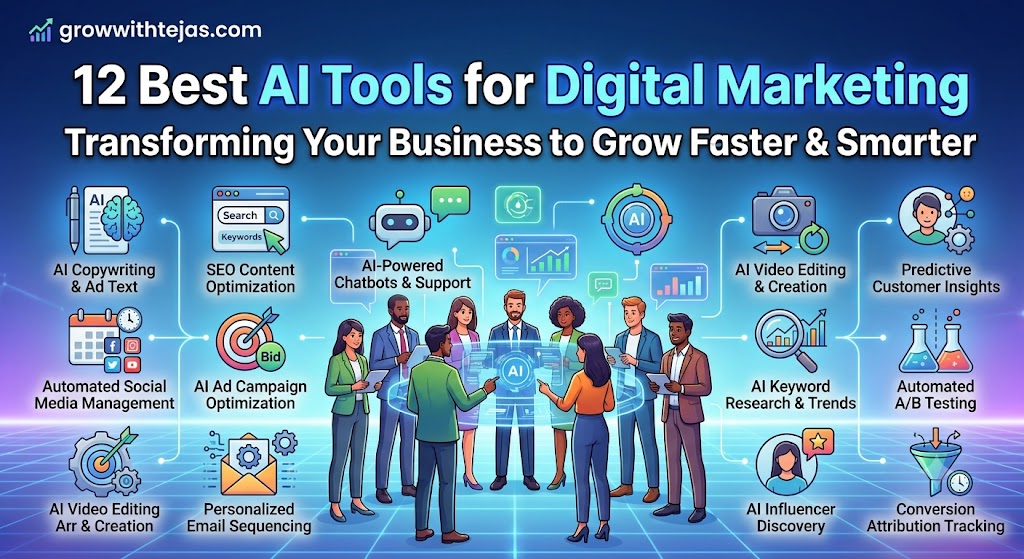
12 Best AI Tools for Digital Marketing
Digital marketing is becoming faster, more competitive, and increasingly powered by artificial intelligence.
Marketers today are using AI to research audiences, generate content, optimize SEO, create advertisements, analyze campaign performance, automate repetitive tasks, and personalize customer experiences.
But with hundreds of AI marketing platforms available, choosing the right ones can quickly become overwhelming.
You don’t need every new AI tool.
You need the tools that solve specific marketing problems and save enough time to justify adding them to your workflow.
In this guide, we’ll explore the 12 best AI tools for digital marketing in 2026, their key use cases, and which type of marketer should consider using each one.
What Are AI Tools for Digital Marketing?
AI tools for digital marketing are software platforms that use artificial intelligence to help marketers complete tasks more efficiently.
Depending on the tool, AI can assist with:
- Content creation
- Search engine optimization
- Keyword research
- Social media marketing
- Email marketing
- Advertising
- Graphic design
- Competitor research
- Marketing automation
- Customer relationship management
- Data analysis
- Campaign planning
The biggest advantage isn’t simply generating content faster.
AI allows marketers to spend less time on repetitive execution and more time on strategy, creativity, testing, and decision-making.
OpenAI, for example, now specifically teaches marketing teams to use ChatGPT for campaign planning, creative development, content variations, customer insights, and campaign-performance analysis.
12 Best AI Tools for Digital Marketing
1. ChatGPT – Best Overall AI Tool for Digital Marketing
Best for: Content, research, strategy, brainstorming, analysis and marketing workflows
ChatGPT is one of the most versatile AI tools available to digital marketers.
Instead of being designed for only one marketing activity, it can support almost every stage of a campaign.
Marketers can use ChatGPT to:
- Generate blog post ideas
- Create content briefs
- Write social media captions
- Brainstorm advertising concepts
- Generate email subject lines
- Develop buyer personas
- Analyze customer feedback
- Research competitors
- Create campaign strategies
- Rewrite landing page copy
- Analyze marketing data
- Generate multiple ad variations
For example, instead of asking:
“Write an Instagram caption for my product.”
A stronger prompt would be:
“Create five Instagram captions for a productivity app targeting Indian freelancers aged 22–35. Use a conversational tone, focus on saving time, and end each caption with a different CTA.”
The quality of your AI output usually improves as your instructions become more specific.
ChatGPT is especially useful because it can work across the full marketing workflow—from brainstorming and research to campaign creation and performance analysis. OpenAI’s current marketing materials specifically position it for customer insight, campaign development, personalization, and analysis.
Why marketers should consider ChatGPT
Instead of using separate AI tools for every small writing or research task, ChatGPT can act as a general-purpose marketing assistant.
2. Jasper – Best AI Tool for Marketing Content
Best for: Marketing copy and brand-focused content production
Jasper is built specifically with marketers and marketing teams in mind.
It can help create:
- Blog content
- Product descriptions
- Advertising copy
- Email campaigns
- Landing pages
- Social media posts
- Marketing campaign assets
One of Jasper’s strengths is helping organizations produce larger volumes of marketing content while maintaining consistent messaging.
This makes it more appealing to marketing teams producing content across multiple channels rather than someone who simply needs occasional AI writing assistance.
Best suited for
- Content marketing teams
- Agencies
- Ecommerce businesses
- Companies producing content at scale
3. Semrush – Best AI Tool for SEO and Competitor Research
Best for: SEO, keyword research and competitive analysis
SEO still requires far more than asking AI to write an article.
You need to understand:
- Search intent
- Keywords
- Competitors
- Backlinks
- Content gaps
- Organic visibility
- Technical SEO issues
Semrush combines many of these capabilities in one marketing platform and has continued incorporating AI-assisted workflows.
Marketers can use Semrush for:
- Keyword research
- Competitor analysis
- SEO audits
- Backlink research
- Content opportunities
- Position tracking
- Content planning
AI can speed up the analysis, but the underlying SEO data remains the more important part of the platform.
Best suited for
SEO professionals, agencies, bloggers and businesses serious about organic search growth.
4. Surfer SEO – Best AI Tool for Content Optimization
Best for: Optimizing articles for search engines
You’ve written a 2,000-word article.
But is it actually optimized around the topic you’re targeting?
Surfer SEO analyzes pages ranking for a particular search query and provides recommendations that can help writers improve topical coverage.
It can assist with elements such as:
- Content structure
- Relevant terms
- Article length
- Headings
- Topic coverage
- Content optimization
Instead of blindly repeating your primary keyword, you can understand the wider topic and concepts that competing pages cover.
Independent 2026 AI-marketing comparisons continue to place Surfer among the leading tools for search-focused content optimization.
Best suited for
Bloggers, SEO writers, affiliate marketers and content teams.
5. Canva Magic Studio – Best AI Tool for Marketing Design
Best for: Social media graphics and visual content
Not every small marketing team has a graphic designer.
Canva has made professional-looking design much more accessible, while AI-powered features have further accelerated the process.
Marketers can use Canva to create:
- Instagram posts
- Facebook creatives
- LinkedIn posts
- YouTube thumbnails
- Presentations
- Infographics
- Advertising creatives
- Short videos
- Promotional graphics
For marketers, this means one campaign idea can quickly be adapted into different visual formats for multiple platforms.
Example
Imagine you’re promoting a webinar.
You could create:
- An Instagram post
- An Instagram Story
- A LinkedIn graphic
- A presentation
- An email banner
- A YouTube thumbnail
from the same campaign concept.
Best suited for
Social media marketers, content creators, small businesses and marketing teams without full-time designers.
6. HubSpot Breeze – Best AI Tool for CRM and Marketing Automation
Best for: Leads, CRM, email marketing and customer journeys
Marketing isn’t useful if leads disappear after filling out your form.
HubSpot combines marketing, CRM, sales and customer-service functions, while Breeze brings AI into many of these workflows.
AI can assist businesses with activities such as:
- Customer segmentation
- Content creation
- Lead research
- Sales prospecting
- CRM workflows
- Customer support
- Marketing campaigns
This makes HubSpot especially attractive for businesses where marketing and sales teams need to work from the same customer information.
Best suited for
- B2B businesses
- Agencies
- SaaS companies
- Service businesses
- Companies managing larger lead pipelines
7. Perplexity – Best AI Tool for Marketing Research
Best for: Quick research and source discovery
Every marketing campaign starts with research.
You may need to understand:
- Competitors
- Industry trends
- Customer problems
- Product categories
- Market statistics
- Content ideas
Traditional search engines can require opening many different tabs and manually combining the information.
Perplexity provides AI-generated research responses while linking to sources marketers can investigate further.
This makes it useful for early-stage research.
However, you should still verify important statistics, claims and business information using original or authoritative sources.
Best suited for
SEO professionals, content writers, strategists, consultants and marketing researchers.
8. Zapier – Best AI Tool for Marketing Automation
Best for: Automating repetitive marketing workflows
One of the biggest opportunities with AI isn’t writing.
It’s eliminating repetitive work.
Zapier allows marketers to connect different applications and create automated workflows.
For example:
Website form submitted → Add lead to CRM → Send welcome email → Notify sales team → Add lead to email list
Without automation, someone may need to perform several of those tasks manually.
Another workflow could be:
New blog post published → Generate social post draft → Add to content calendar → Notify marketing team
Marketing tasks you can automate
- Lead capture
- Email follow-ups
- CRM updates
- Notifications
- Social media workflows
- Spreadsheet updates
- Content distribution
- Customer onboarding
Best suited for
Agencies, SaaS companies, ecommerce businesses and marketing teams using multiple applications.
9. Grammarly – Best AI Tool for Editing Marketing Content
Best for: Improving marketing copy and communication
AI-generated content still needs editing.
Even human-written content benefits from another review.
Grammarly can help improve:
- Grammar
- Readability
- Tone
- Sentence clarity
- Business communication
- Email copy
- Marketing documents
This is particularly useful for marketers producing large amounts of written communication every day.
For example, you can use it when reviewing:
- Client emails
- Landing pages
- Sales proposals
- Blog posts
- Social media captions
- Newsletters
Best suited for
Content writers, freelancers, agencies and marketing teams.
10. Notion AI – Best AI Tool for Marketing Productivity
Best for: Content calendars, documentation and marketing operations
Marketing teams produce enormous amounts of information.
You may have:
- Campaign plans
- Meeting notes
- Brand guidelines
- Content calendars
- Customer research
- Social media ideas
- Marketing SOPs
- Project briefs
Notion gives teams a central location for organizing this information.
Its AI capabilities can then help summarize, organize, rewrite and find information.
Example marketing workspace
A small agency could create a Notion workspace containing:
Client → Campaign → Content Calendar → Creative Brief → Tasks → Results
Instead of searching across random documents and chat messages, important marketing information stays organized.
Best suited for
Marketing agencies, remote teams, startups and content teams.
11. Hootsuite – Best AI Tool for Social Media Marketing
Best for: Social media planning and management
Managing one social media account is easy.
Managing accounts across Instagram, Facebook, LinkedIn, X, TikTok and other platforms becomes much more complicated.
Social media management platforms such as Hootsuite help marketers organize publishing, monitoring and reporting.
AI can also assist with:
- Caption generation
- Content ideas
- Post variations
- Social scheduling
- Content repurposing
A marketer could create one campaign idea and adapt the message for different networks instead of writing everything from scratch.
For example:
Professional and insight-driven.
Shorter and more visually engaging.
X
Concise and conversation-oriented.
AI makes producing those variations significantly faster.
Best suited for
Social media managers, agencies and brands publishing frequently across multiple platforms.
12. AdCreative.ai – Best AI Tool for Advertising Creatives
Best for: Creating ad variations
Paid advertising requires constant experimentation.
One Facebook advertisement that performs well today may stop performing after the audience has seen it repeatedly.
That means marketers constantly need:
- New headlines
- New visuals
- Different layouts
- Different CTAs
- New messaging angles
AdCreative.ai is designed to speed up the creation of those advertising variations.
Instead of designing every new concept manually, marketers can generate multiple options and then test which ones perform best.
The important word is test.
AI cannot guarantee that a particular creative will become a winning advertisement.
Actual campaign data should determine which creatives deserve more budget.
Best suited for
Performance marketers, ecommerce businesses, agencies and paid-advertising teams.
Best AI Tools for Digital Marketing by Category
| Marketing Task | Recommended AI Tool |
|---|---|
| Overall marketing assistant | ChatGPT |
| Marketing content | Jasper |
| SEO & keyword research | Semrush |
| SEO content optimization | Surfer SEO |
| Graphic design | Canva |
| CRM & marketing automation | HubSpot Breeze |
| Research | Perplexity |
| Workflow automation | Zapier |
| Writing improvement | Grammarly |
| Marketing organization | Notion AI |
| Social media management | Hootsuite |
| Advertising creatives | AdCreative.ai |
How to Choose the Best AI Marketing Tools
Seeing twelve different tools doesn’t mean you need twelve subscriptions.
Before buying an AI marketing platform, consider the following.
1. Identify Your Biggest Marketing Bottleneck
Start by asking:
What marketing task consumes the most time?
If it’s writing, consider ChatGPT or Jasper.
If it’s SEO research, consider Semrush.
If it’s creating graphics, Canva may produce the highest return.
If you’re manually transferring leads between applications, automation tools such as Zapier could be more valuable than another content generator.
Solve the bottleneck first.
2. Consider Your Existing Marketing Stack
Your AI tools should ideally work with the software you’re already using.
For example, if your entire marketing operation is built around HubSpot, adding HubSpot’s own AI capabilities may be more convenient than adding several disconnected platforms.
The fewer times you have to copy information manually between tools, the more useful your marketing stack becomes.
3. Calculate the Real ROI
Don’t evaluate software based only on monthly subscription price.
Consider this:
A tool costs ₹3,000 per month.
But it saves your team 15 hours every month.
That subscription may be inexpensive compared with the value of those hours.
On the other hand, a ₹500 tool you never use isn’t a bargain.
4. Test Before Building Your Entire Workflow Around It
AI tools change rapidly.
New features are launched.
Prices change.
Better alternatives appear.
Avoid rebuilding your entire marketing operation around a tool before you’ve properly tested it.
Start with one workflow.
Measure whether it saves time or improves results.
Then expand.
5. Don’t Let AI Replace Marketing Judgment
AI can generate 100 headlines.
It still doesn’t automatically know which headline will convert.
AI can create an SEO article.
It doesn’t guarantee that Google will rank it.
AI can produce advertising creatives.
It can’t guarantee profitable campaigns.
Experienced marketers should still make decisions based on:
- Customer insights
- Brand positioning
- Campaign data
- Testing
- Business objectives
- Creativity
The strongest approach is AI + human judgment, not AI instead of human judgment.
How Digital Marketers Can Use AI: Practical Workflow
Here’s a simple example.
Suppose you’re launching a new online course.
Step 1: Research
Use Perplexity and ChatGPT to research:
- Audience questions
- Competitors
- Pain points
- Content opportunities
Step 2: SEO
Use Semrush to identify relevant keywords.
Use Surfer SEO when optimizing important articles.
Step 3: Content
Use ChatGPT or Jasper to develop:
- Blog outlines
- Social posts
- Email campaigns
- Landing page ideas
- Ad copy
Step 4: Design
Use Canva to create:
- Instagram posts
- LinkedIn graphics
- Ads
- Presentation slides
- Promotional banners
Step 5: Distribution
Use Hootsuite to organize social content.
Use HubSpot for email marketing and lead management.
Step 6: Automation
Use Zapier to connect forms, CRM systems, email platforms and spreadsheets.
Step 7: Analysis
Bring campaign results into an AI assistant and ask questions such as:
“Which campaign generated the best conversion rate, and what patterns can you identify between our top-performing campaigns?”
This is where AI becomes much more valuable than simply using it as an article writer.
Advantages of Using AI in Digital Marketing
Faster Content Production
AI can create initial drafts and variations significantly faster than starting from a blank page.
Better Research
Marketers can analyze larger amounts of information quickly.
Increased Personalization
AI can help adapt messages for different audiences.
Faster Experimentation
Instead of creating one advertising headline, marketers can generate twenty variations and test them.
Reduced Repetitive Work
Marketing automation can remove manual tasks from lead management, reporting and content distribution.
Increased Productivity
Small marketing teams can produce more without immediately increasing headcount.
Limitations of AI in Digital Marketing
AI isn’t perfect.
Marketers should understand its limitations.
AI Can Generate Incorrect Information
Always verify statistics, dates, quotes and factual claims.
AI Content Can Become Generic
If everyone enters the same basic prompt, everyone receives similar content.
Add your own:
- Experience
- Opinions
- Data
- Case studies
- Examples
- Brand voice
AI Doesn’t Understand Your Customer Automatically
You need to provide context.
Customer research still matters.
AI Doesn’t Guarantee SEO Rankings
Good SEO requires more than generating articles.
Search intent, authority, backlinks, user experience, technical SEO and content quality still matter.
AI Doesn’t Guarantee Advertising Results
Real campaign performance should guide decisions.
Will AI Replace Digital Marketers?
AI is more likely to change digital marketing jobs than eliminate marketing entirely.
The repetitive parts of marketing are becoming easier to automate.
But businesses still need people who understand:
- Customers
- Brand positioning
- Strategy
- Creative direction
- Offers
- Analytics
- Business economics
The marketer who knows how to use AI effectively may have an advantage over someone who refuses to use it.
The real skill is learning where AI adds leverage and where human judgment matters more.
Final Thoughts
There is no single best AI tool for digital marketing that handles every marketing activity perfectly.
Different tools solve different problems.
For a simple marketing stack, you might start with:
ChatGPT + Canva + Semrush + your existing CRM
Then add tools such as Zapier, Surfer SEO or Hootsuite when you identify a specific workflow that needs improvement.
The goal shouldn’t be collecting AI subscriptions.
The goal should be creating a marketing system that helps you:
- Research faster
- Create better content
- Automate repetitive work
- Test more ideas
- Understand campaign performance
- Spend more time on strategy
AI is becoming a normal part of modern marketing. The marketers who benefit most won’t necessarily be those using the most tools—they’ll be the ones using the right tools for the right jobs.
Frequently Asked Questions
What are the best AI tools for digital marketing?
Some of the best AI tools for digital marketing include ChatGPT, Jasper, Semrush, Surfer SEO, Canva, HubSpot Breeze, Perplexity, Zapier, Grammarly, Notion AI, Hootsuite and AdCreative.ai.
Which AI tool is best for digital marketers?
ChatGPT is one of the best general-purpose AI tools for digital marketers because it can assist with campaign planning, content creation, audience research, brainstorming, data analysis and marketing strategy. Current OpenAI marketing guidance highlights many of these same workflows.
What is the best AI tool for SEO?
Semrush is useful for keyword research, competitor research, backlinks and SEO analysis, while Surfer SEO focuses more heavily on optimizing individual pieces of content.
What is the best AI tool for social media marketing?
Canva is useful for producing social media visuals, while platforms such as Hootsuite are useful for managing publishing and social-media workflows.
Can AI do digital marketing?
AI can perform or assist with many digital marketing tasks, including content generation, research, SEO analysis, advertising, automation, social media and data analysis. However, marketers still need to provide strategy, oversight, creative judgment and quality control.
Is ChatGPT good for digital marketing?
Yes. ChatGPT can help marketers brainstorm campaigns, develop content, analyze information, generate variations, research audiences and summarize campaign results. OpenAI currently provides dedicated marketing workflows and resources for these use cases.