AI Stock Trading Bots for Institutional Investors
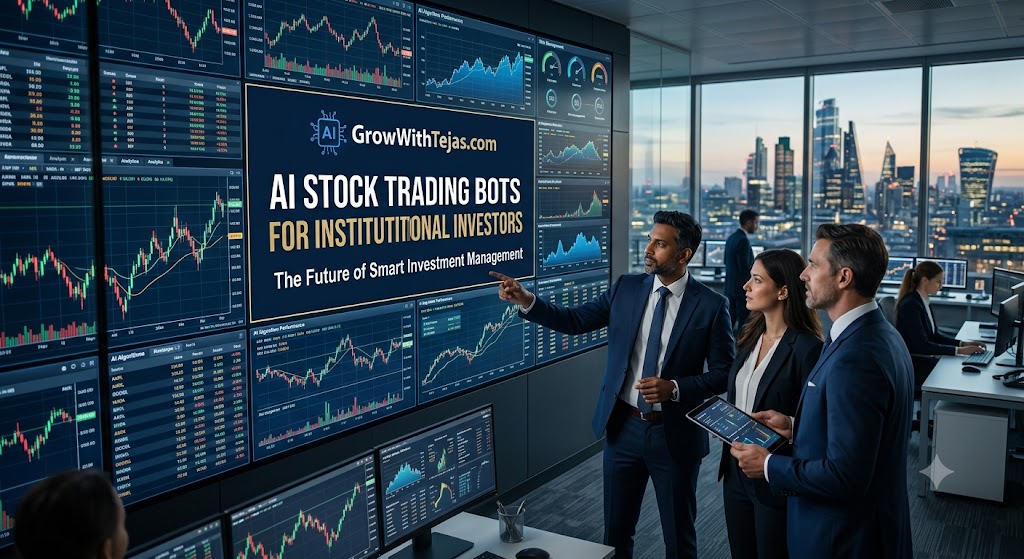
Artificial Intelligence (AI) has transformed the financial industry, and one of its biggest innovations is AI stock trading bots for institutional investors. Unlike traditional trading systems, AI-powered bots analyze enormous amounts of market data, identify profitable opportunities, and execute trades in milliseconds without human emotions influencing decisions.
Large financial institutions, hedge funds, asset management firms, banks, and proprietary trading companies increasingly rely on AI trading technology to stay competitive in today’s fast-moving financial markets.
In this guide, you’ll learn how institutional AI trading bots work, their advantages, challenges, and what the future holds.
What Are AI Stock Trading Bots?
AI stock trading bots are software programs that use:
- Artificial Intelligence (AI)
- Machine Learning (ML)
- Deep Learning
- Natural Language Processing (NLP)
- Predictive Analytics
to analyze financial markets and automatically execute buy and sell orders.
Unlike rule-based trading systems, AI bots continuously learn from new market data and improve their trading strategies over time.
Why Institutional Investors Use AI Trading Bots
Institutional investors manage billions of dollars, making speed and accuracy critical.
AI trading bots help institutions by:
- Processing millions of market signals simultaneously
- Detecting profitable opportunities faster
- Eliminating emotional decision-making
- Executing high-frequency trades
- Managing portfolio risk automatically
- Monitoring multiple global markets 24/7
Key Features of Institutional AI Trading Bots
1. Real-Time Market Analysis
AI continuously monitors:
- Stock prices
- Market volatility
- Trading volume
- Economic indicators
- Company financial reports
- Breaking news
- Social media sentiment
This enables instant reactions to changing market conditions.
2. Predictive Market Forecasting
Machine learning algorithms analyze years of historical data to forecast:
- Price trends
- Market momentum
- Sector performance
- Volatility
- Earnings impact
These predictions help institutions make informed investment decisions.
3. High-Frequency Trading (HFT)
Institutional AI bots can:
- Execute thousands of trades per second
- Capture tiny price movements
- Reduce execution delays
- Improve liquidity
High-frequency trading is nearly impossible without AI-powered automation.
4. Risk Management
AI trading systems automatically monitor:
- Portfolio exposure
- Stop-loss levels
- Maximum drawdown
- Asset diversification
- Correlation risks
This reduces investment losses during volatile markets.
5. Portfolio Optimization
AI helps institutions:
- Rebalance portfolios automatically
- Allocate capital efficiently
- Maximize expected returns
- Reduce unnecessary risks
6. Alternative Data Analysis
Modern AI bots analyze data beyond traditional financial reports, including:
- Satellite imagery
- Consumer spending
- Shipping activity
- Weather data
- Search engine trends
- News sentiment
- Social media discussions
Alternative data often provides an early signal before stock prices react.
Benefits of AI Stock Trading Bots for Institutional Investors
Faster Decision Making
AI processes millions of data points in seconds, enabling near-instant decisions.
Improved Accuracy
Machine learning models identify hidden market patterns that humans may overlook.
Reduced Emotional Bias
AI follows data-driven strategies instead of fear or greed.
Lower Operational Costs
Automation reduces manual research and repetitive trading tasks.
Continuous Market Monitoring
AI bots operate around the clock, tracking global markets even when traders are offline.
Better Portfolio Performance
With optimized strategies and disciplined execution, institutions can improve long-term investment efficiency.
Technologies Behind AI Trading Bots
Leading institutional trading platforms combine several advanced technologies:
Machine Learning
Learns from historical trading data.
Deep Learning
Detects complex price patterns.
Natural Language Processing (NLP)
Analyzes financial news, earnings reports, and market sentiment.
Reinforcement Learning
Improves trading decisions based on previous outcomes.
Big Data Analytics
Processes structured and unstructured financial information.
Cloud Computing
Provides scalable computing power for complex trading models.
Common Use Cases
Institutional investors use AI trading bots for:
- Equity trading
- Quantitative investing
- ETF management
- Index arbitrage
- Options trading
- Futures trading
- Forex markets
- Commodity trading
- Portfolio rebalancing
- Risk hedging
Challenges of AI Trading Bots
Although powerful, AI trading systems have limitations.
Data Quality
Poor-quality data can lead to inaccurate predictions.
Overfitting
Some models perform well on historical data but fail in live markets.
Market Shocks
Unexpected events may affect AI predictions.
Regulatory Compliance
Institutions must ensure AI systems comply with financial regulations.
Cybersecurity
Trading infrastructure must be protected against cyber threats.
Best Practices for Institutional AI Trading
Successful firms typically:
- Use high-quality financial data
- Continuously retrain AI models
- Monitor algorithm performance
- Combine AI with human oversight
- Diversify trading strategies
- Implement robust cybersecurity measures
- Perform regular stress testing
Future of AI Stock Trading Bots
The next generation of institutional trading systems will likely include:
- Generative AI for investment research
- Autonomous portfolio management
- Explainable AI for transparent decision-making
- Quantum computing integration
- AI-driven ESG investment analysis
- Advanced predictive analytics
- Real-time macroeconomic forecasting
As AI technology continues to evolve, institutional investors will increasingly rely on intelligent automation to enhance efficiency and maintain a competitive edge.
Final Thoughts
AI stock trading bots for institutional investors are reshaping the financial industry by delivering faster execution, advanced market analysis, and intelligent risk management. While these systems offer significant advantages, they work best when paired with high-quality data, strong governance, and experienced human oversight.
For institutions seeking to improve operational efficiency and investment performance, AI-powered trading is becoming an essential component of modern portfolio management rather than an optional tool.
Frequently Asked Questions (FAQs)
1. What are AI stock trading bots?
They are automated trading systems that use artificial intelligence and machine learning to analyze markets and execute trades.
2. Who uses AI trading bots?
Hedge funds, investment banks, asset managers, pension funds, and proprietary trading firms.
3. Can AI outperform human traders?
AI can outperform humans in speed, data analysis, and automation, but human expertise remains important for oversight and strategic decisions.
4. Are AI trading bots fully automated?
Many are highly automated, but institutional firms typically maintain human supervision for risk and compliance.
5. What data do AI trading bots analyze?
Market prices, company financials, news, economic indicators, social media sentiment, and alternative datasets.
6. Do AI trading bots eliminate investment risk?
No. They help manage risk but cannot eliminate market uncertainty.
7. Is machine learning necessary for AI trading?
Machine learning significantly improves adaptability and predictive capabilities, making it a core technology in advanced AI trading systems.
8. Are AI trading bots legal?
Yes, provided they comply with applicable financial regulations in the relevant jurisdiction.