Automated AI Customer Support Integration: Everything You Need to Know
Customer expectations have changed dramatically over the last few years. People now expect businesses to respond instantly, provide personalized assistance, and remain available 24/7. Hiring large customer support teams isn’t always practical or affordable. This is where automated AI customer support integration becomes a game changer.
Artificial Intelligence (AI) enables businesses to automate repetitive customer interactions while delivering fast, accurate, and personalized responses. Whether you’re running an eCommerce store, SaaS company, travel agency, healthcare platform, or local business, integrating AI into your customer support system can significantly improve customer satisfaction and reduce operational costs.
In this guide, we’ll explore what automated AI customer support integration is, how it works, its benefits, best practices, implementation steps, and the top AI tools available today.
What Is Automated AI Customer Support Integration?
Automated AI customer support integration is the process of connecting AI-powered tools such as chatbots, virtual assistants, voice bots, and intelligent help desks with your existing customer service platforms.
Instead of requiring human agents to answer every customer question, AI systems automatically:
- Answer common questions
- Resolve simple issues
- Track customer orders
- Schedule appointments
- Process refunds
- Escalate complex problems
- Recommend products
- Collect customer feedback
The AI continuously learns from customer interactions, becoming smarter over time.
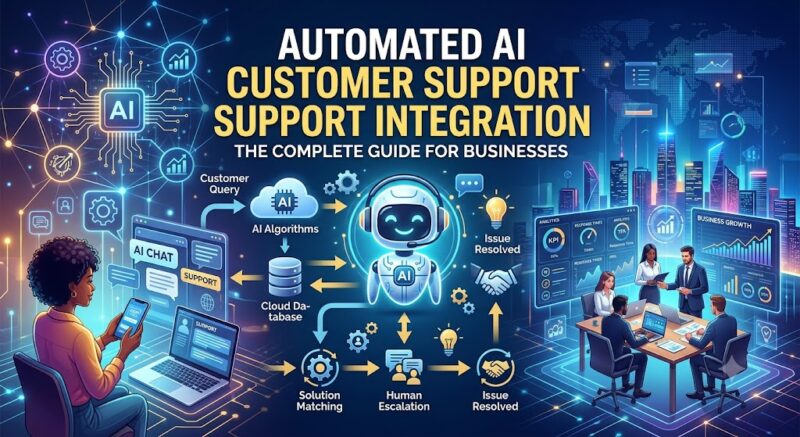
How AI Customer Support Works
The typical workflow looks like this:
Step 1: Customer Starts Conversation
A customer contacts your business through:
- Website chat
- Facebook Messenger
- Mobile App
- Voice Assistant
Step 2: AI Understands the Query
Using Natural Language Processing (NLP), AI identifies:
- Customer intent
- Keywords
- Language
- Sentiment
- Previous interactions
Step 3: AI Provides an Answer
The AI searches:
- Knowledge base
- FAQs
- CRM data
- Product database
- Order history
It then provides the best response instantly.
Step 4: Human Handoff (If Needed)
If the issue requires a human agent:
- Conversation history is transferred
- Customer doesn’t repeat information
- Agent receives complete context
Benefits of Automated AI Customer Support Integration
1. 24/7 Customer Service
AI never sleeps.
Customers receive instant support:
- Nights
- Weekends
- Holidays
This increases customer satisfaction significantly.
2. Faster Response Times
Instead of waiting:
- 5 minutes
- 30 minutes
- Several hours
Customers receive replies within seconds.
3. Lower Support Costs
AI automates repetitive tasks like:
- Password resets
- Order tracking
- Booking confirmations
- Shipping updates
- Frequently asked questions
This reduces the need for large support teams.
4. Increased Productivity
Human agents can focus on:
- Complex issues
- High-value customers
- Sales opportunities
- Technical support
Rather than answering repetitive questions.
5. Better Customer Experience
AI provides:
- Personalized greetings
- Previous purchase history
- Product recommendations
- Faster issue resolution
Customers appreciate quick and relevant responses.
6. Multilingual Support
Modern AI tools support dozens of languages, allowing businesses to serve customers worldwide without hiring multilingual teams.
7. Improved Customer Insights
AI analyzes:
- Frequently asked questions
- Customer satisfaction
- Pain points
- Support trends
- Product issues
This helps improve products and services.
Where Can AI Customer Support Be Integrated?
Businesses commonly integrate AI with:
- Websites
- Mobile applications
- CRM software
- Help desk systems
- WhatsApp Business
- Facebook Messenger
- Shopify
- WooCommerce
- Salesforce
- HubSpot
- Zendesk
- Freshdesk
- Microsoft Teams
- Slack
Features of Modern AI Customer Support
A powerful AI support solution should include:
- Intelligent chatbot
- Live chat integration
- Voice assistant
- Knowledge base search
- Sentiment analysis
- Ticket automation
- Human handoff
- CRM integration
- Order tracking
- AI-generated responses
- Analytics dashboard
- Multilingual support
- Workflow automation
Industries Using AI Customer Support
E-commerce
AI helps customers with:
- Order tracking
- Product recommendations
- Returns
- Refunds
- Payment questions
Healthcare
Healthcare providers use AI for:
- Appointment booking
- Patient FAQs
- Prescription reminders
- Insurance information
Banking
Banks automate:
- Account inquiries
- Balance checks
- Loan information
- Fraud alerts
Travel
Travel companies use AI for:
- Hotel bookings
- Flight information
- Tour packages
- Travel updates
- Cancellation requests
Education
Educational institutions automate:
- Admission inquiries
- Course information
- Fee details
- Student support
Steps to Integrate AI Customer Support
Step 1: Identify Customer Queries
Review customer support data and identify repetitive questions.
Step 2: Build a Knowledge Base
Prepare:
- FAQs
- Product information
- Policies
- Shipping details
- Service information
Step 3: Select an AI Platform
Choose an AI solution that supports:
- Website integration
- CRM integration
- API connectivity
- Analytics
Step 4: Train the AI
Provide:
- Company information
- Product details
- Customer conversations
- FAQs
- Support documents
Step 5: Test the System
Check:
- Response accuracy
- Escalation process
- Customer experience
- Error handling
Step 6: Launch and Monitor
Monitor:
- Customer satisfaction
- Resolution rate
- Chat volume
- AI accuracy
- Human intervention rate
Continuously improve based on customer feedback.
Best Practices for AI Customer Support Integration
Follow these recommendations:
- Keep answers simple.
- Update the knowledge base regularly.
- Allow easy access to human support.
- Personalize responses using customer data.
- Monitor chatbot performance.
- Review conversations regularly.
- Protect customer privacy and data.
- Train AI with real customer conversations.
Common Challenges
Limited Knowledge
If AI lacks information, it may provide incorrect answers.
Solution: Update your knowledge base regularly.
Poor User Experience
Complex chatbot flows frustrate customers.
Solution: Keep conversations natural and concise.
Lack of Human Backup
Not every issue can be automated.
Solution: Always provide an easy option to connect with a live agent.
Integration Issues
Older software may not support AI integration.
Solution: Choose AI platforms with flexible APIs and pre-built integrations.
Future of AI Customer Support
Emerging trends include:
- AI voice agents
- Emotion detection
- Predictive customer support
- Hyper-personalized interactions
- Autonomous customer service
- AI-powered multilingual conversations
- Generative AI knowledge assistants
- Omnichannel customer experiences
Businesses adopting AI early will be better positioned to deliver faster, more consistent support while scaling efficiently.
Frequently Asked Questions
Is AI customer support only for large companies?
No. Small businesses can also benefit from affordable AI tools that automate common customer queries.
Can AI completely replace human support?
No. AI is best suited for routine tasks, while human agents remain essential for complex or sensitive issues.
Is AI customer support expensive?
Many platforms offer free plans or low-cost options, making AI accessible for businesses of all sizes.
Can AI work with WhatsApp?
Yes. Many AI platforms integrate with WhatsApp Business to automate customer conversations.
Is AI customer support secure?
It can be, provided you choose reputable platforms and follow data privacy and security best practices.
How long does integration take?
Basic integrations can take a few hours, while more advanced implementations may take several weeks depending on complexity.
Final Thoughts
Automated AI customer support integration is transforming the way businesses interact with customers. By automating repetitive tasks, reducing response times, and enabling 24/7 assistance, AI helps organizations improve customer satisfaction while lowering operational costs.
Whether you’re a startup or an established enterprise, integrating AI into your customer support strategy can create more efficient workflows, free your team to handle complex issues, and deliver a better overall customer experience. Start with a clear understanding of your customers’ needs, build a strong knowledge base, and continuously refine your AI system to maximize its impact.