Affiliate Marketing Explained for Beginners
Affiliate marketing is one of the easiest ways to earn money online without creating your own product or handling customer service. Whether you’re a blogger, YouTuber, social media creator, or website owner, affiliate marketing allows you to generate passive income by recommending products and services you genuinely trust.
If you’ve ever wondered how people earn commissions from blogs or YouTube videos, this guide will explain affiliate marketing in simple terms.
What Is Affiliate Marketing?
Affiliate marketing is a performance-based marketing model where you promote another company’s product or service using a unique referral link. Whenever someone purchases through your affiliate link, you earn a commission. It has become one of the most accessible online business models because it typically requires little or no upfront investment and focuses on creating valuable content that helps users make buying decisions.
Simple Example
Imagine you write a blog about laptops.
You recommend a laptop on Amazon and include your affiliate link.
A visitor clicks the link and purchases the laptop.
Amazon pays you a commission.
You never ship the product or handle customer support.
How Does Affiliate Marketing Work?
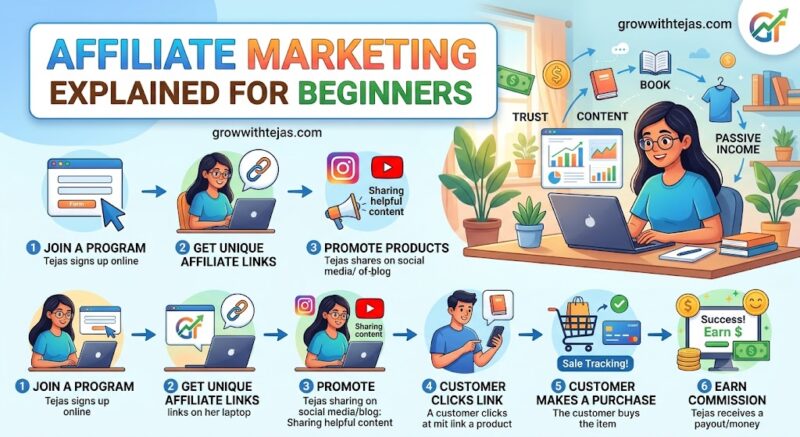
The affiliate marketing process is straightforward:
- Join an affiliate program.
- Receive your unique affiliate tracking link.
- Create useful content around the product.
- Share your affiliate link.
- Visitors click your link.
- They make a purchase.
- You receive a commission.
This entire process is tracked automatically through cookies and affiliate software.
Who Is Involved in Affiliate Marketing?
There are four main participants:
1. Merchant
The company selling the product.
Examples:
- Amazon
- Bluehost
- Canva
- Hostinger
2. Affiliate
This is you—the person promoting the product.
3. Customer
The person who purchases using your affiliate link.
4. Affiliate Network
Some companies manage affiliate programs through networks like:
- CJ Affiliate
- ShareASale
- Impact
- Rakuten Advertising
Why Is Affiliate Marketing So Popular?
Affiliate marketing has several advantages:
- Low startup cost
- No inventory management
- No customer support
- Flexible working hours
- Passive income potential
- Can be combined with blogging, YouTube, or social media
- Scalable over time with SEO and content marketing
How Much Money Can Beginners Make?
Income varies depending on:
- Website traffic
- Content quality
- Niche selection
- Commission rates
- Conversion rate
Typical progression (not guaranteed):
- First 3 months: Learning and building content
- 3–6 months: First commissions
- 6–12 months: Consistent earnings if content ranks well
- 12+ months: Potential to scale significantly with quality content and audience growth
Remember, affiliate marketing is not a get-rich-quick scheme.
Best Niches for Affiliate Marketing
Choose a niche with strong demand and products people regularly purchase.
Popular niches include:
Technology
- Laptops
- Smartphones
- Software
- AI tools
Finance
- Credit cards
- Investing platforms
- Insurance
Health & Fitness
- Supplements
- Fitness equipment
- Online coaching
Education
- Online courses
- Learning platforms
- Books
Travel
- Hotels
- Flights
- Travel insurance
- Tour packages
Digital Marketing
- SEO tools
- Web hosting
- Email marketing software
- Website builders
How to Start Affiliate Marketing
Step 1: Choose Your Niche
Pick something you enjoy and understand.
Examples:
- Digital marketing
- Gardening
- Photography
- Personal finance
- Travel
- AI tools
Step 2: Build a Platform
You can promote affiliate products through:
- Blog
- YouTube
- Email newsletter
- Podcast
For long-term success, a blog is one of the best options because SEO can bring consistent organic traffic.
Step 3: Join Affiliate Programs
Popular beginner-friendly programs include:
- Amazon Associates
- Bluehost Affiliate
- Hostinger Affiliate
- Canva Affiliate
- Semrush Affiliate
- Fiverr Affiliate
- Impact
- ShareASale
Step 4: Create Helpful Content
Examples:
- Product reviews
- Comparison articles
- Buying guides
- Tutorials
- Best product lists
- Case studies
Good content solves readers’ problems instead of simply promoting products.
Step 5: Learn SEO
Search engine optimization (SEO) helps your articles rank on Google.
Important SEO elements:
- Keyword research
- On-page SEO
- Internal linking
- Meta descriptions
- Fast-loading pages
- Mobile-friendly design
SEO can generate free traffic for years.
Step 6: Build Trust
Only recommend products you genuinely believe in.
Readers are more likely to purchase when they trust your recommendations.
Always disclose affiliate relationships to maintain transparency and comply with applicable advertising guidelines.
Types of Affiliate Content
Create different kinds of content, such as:
Product Reviews
Example:
- Bluehost Review
Comparison Articles
Example:
- ChatGPT vs Gemini
Best Lists
Example:
- Best AI Writing Tools
Tutorials
Example:
- How to Build a WordPress Website
Resource Pages
A curated page listing your favorite tools.
Common Affiliate Marketing Mistakes
Avoid these common pitfalls:
- Choosing too many niches
- Promoting poor-quality products
- Ignoring SEO
- Publishing thin content
- Expecting instant results
- Not tracking performance
- Forgetting affiliate disclosures
Best SEO Tips for Affiliate Blogs
To improve rankings:
- Target low-competition keywords
- Write comprehensive articles
- Use descriptive headings
- Optimize images
- Add internal links
- Update old posts regularly
- Improve page speed
- Answer common user questions
Tools Every Affiliate Marketer Should Use
Useful tools include:
- WordPress
- Google Search Console
- Google Analytics 4
- Rank Math SEO
- Canva
- Grammarly
- ChatGPT
- Keyword research tools
Is Affiliate Marketing Worth It?
Yes—if you’re willing to invest time in learning SEO, creating valuable content, and building an audience. Affiliate marketing rewards consistency rather than shortcuts. Focus on helping your readers first, and commissions are more likely to follow over time.
Final Thoughts
Affiliate marketing is one of the best online business models for beginners because it doesn’t require you to create products or manage inventory. With the right niche, a well-optimized website, and helpful content, you can build a sustainable source of online income.
Success won’t happen overnight, but consistent publishing, strong SEO practices, and honest recommendations can help you grow your traffic and affiliate earnings over time.
Frequently Asked Questions (FAQs)
1. Is affiliate marketing free to start?
Yes. Most affiliate programs are free to join.
2. Do I need a website?
No, but having a website is highly recommended for long-term SEO traffic.
3. How do affiliates get paid?
Usually through bank transfer, PayPal, UPI (where supported), or other payment methods offered by the affiliate program.
4. Can beginners make money?
Yes, but it typically takes several months of consistent effort before meaningful results appear.
5. Which niche is best?
Technology, AI tools, finance, health, education, and travel are popular choices.
6. Is SEO important?
Yes. SEO helps attract free, long-term organic traffic.
7. Can I use affiliate links on social media?
Yes, if the affiliate program allows it.
8. How many blog posts should I publish?
Aim for at least 30–50 high-quality, SEO-focused articles to build a solid foundation.
9. Do I need technical skills?
No. Basic WordPress and SEO knowledge is enough to get started.
10. Is affiliate marketing passive income?
It can become a source of passive income once your content consistently attracts visitors, but it requires ongoing effort to create and update content.